Advanced Quantum Computing Applications
Quantum Computing Architectures
Superconducting Circuits
Superconducting qubits are tiny circuits made from materials that conduct electricity with zero resistance at extremely low temperatures. Think of them as artificial atoms whose quantum states can be precisely controlled. These circuits, typically fabricated on silicon chips much like classical processors, must be cooled to temperatures colder than deep space, usually around 15 millikelvins, inside large dilution refrigerators.
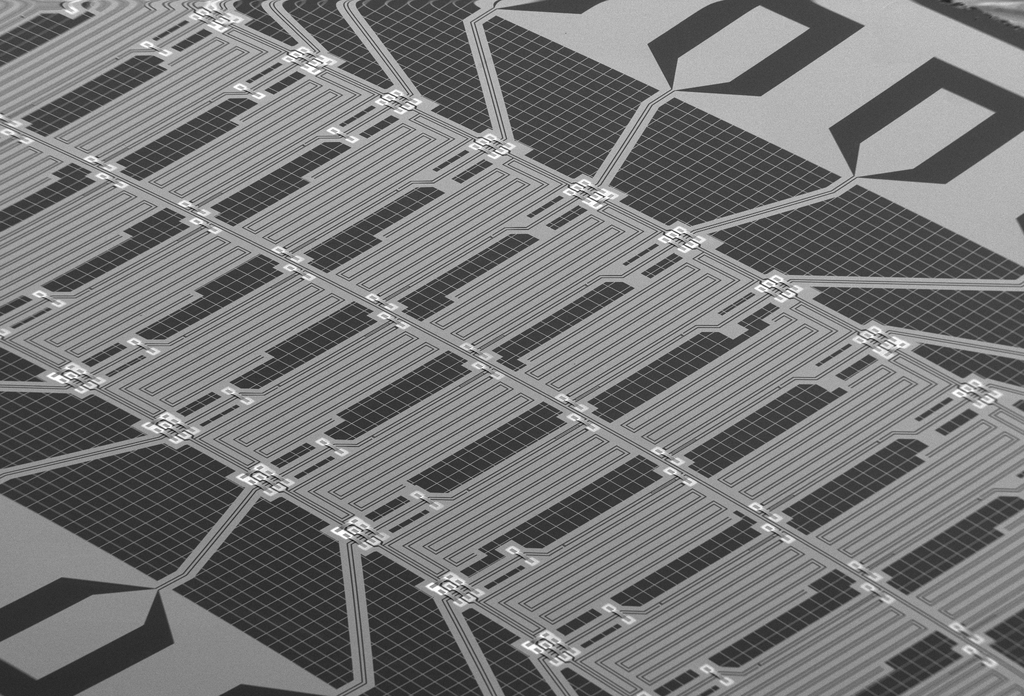
The core component of many superconducting qubits is the Josephson junction. This is a thin layer of non-superconducting material sandwiched between two superconductors. It acts as a non-linear inductor, which allows the circuit's energy levels to be unevenly spaced. This is crucial because it lets us isolate the two lowest energy levels to serve as our qubit states, and . We can then use carefully tuned microwave pulses to nudge the qubit from one state to another or into a superposition of both.
One of the biggest advantages of this approach is speed. Gates, or logical operations, can be performed very quickly, often in nanoseconds. Plus, engineers can leverage decades of experience from the semiconductor industry to design and manufacture these chips at scale.
The primary challenge is decoherence. Superconducting qubits are extremely sensitive to their environment. Any external noise, like tiny fluctuations in temperature or electromagnetic fields, can disrupt their delicate quantum states and introduce errors into the computation. This fragility necessitates the extreme cold and extensive shielding, which makes the hardware complex and expensive.
Trapped Ions
A completely different approach uses individual atoms as qubits. In a trapped-ion quantum computer, atoms, such as those of ytterbium or calcium, are stripped of an electron to become positively charged ions. These ions are then suspended in a vacuum using electromagnetic fields, holding them perfectly still in a line. Each ion serves as a natural, nearly perfect qubit.
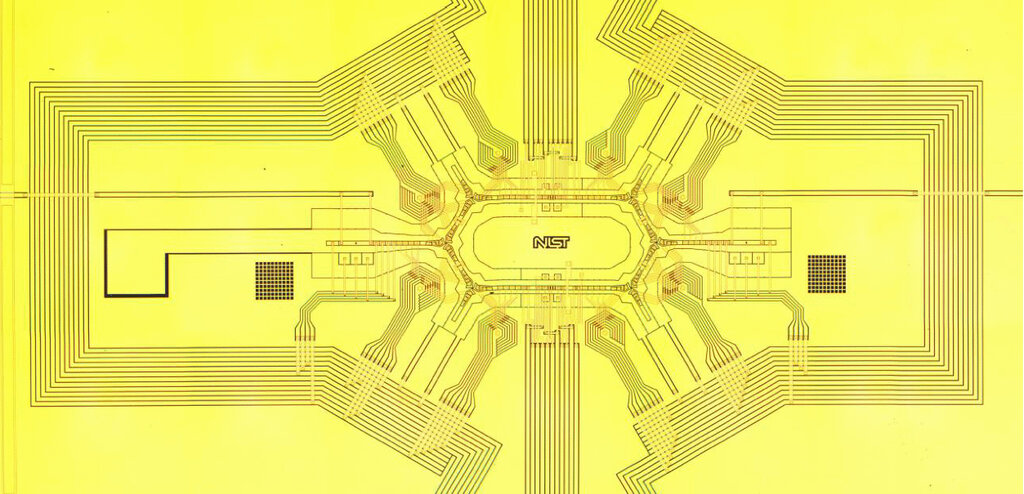
The qubit's and states correspond to different internal energy levels of the ion's electrons. Lasers are aimed with extreme precision at individual ions to manipulate their state. To make qubits interact for multi-qubit gates, the lasers can also excite the collective motion of the ions in the trap, allowing information to be shared along the chain. Because each ion is an identical, stable atom, these qubits have very long coherence times and high gate fidelities.
The main drawback of trapped-ion systems is speed. The interactions mediated by the ions' motion are much slower than the microwave pulses in superconducting circuits, with gate operations taking microseconds instead of nanoseconds. Scaling is also a significant hurdle; while controlling a few dozen ions in a single trap is feasible, managing thousands or millions for a fault-tolerant computer will require new architectures, like networking multiple traps together.
Photonics
Photonic quantum computing uses particles of light, photons, as qubits. Information can be encoded in a photon's properties, such as its polarization (the orientation of its oscillation) or its spatial mode (which path it takes through a circuit). For instance, a horizontally polarized photon could represent , and a vertically polarized one could represent .
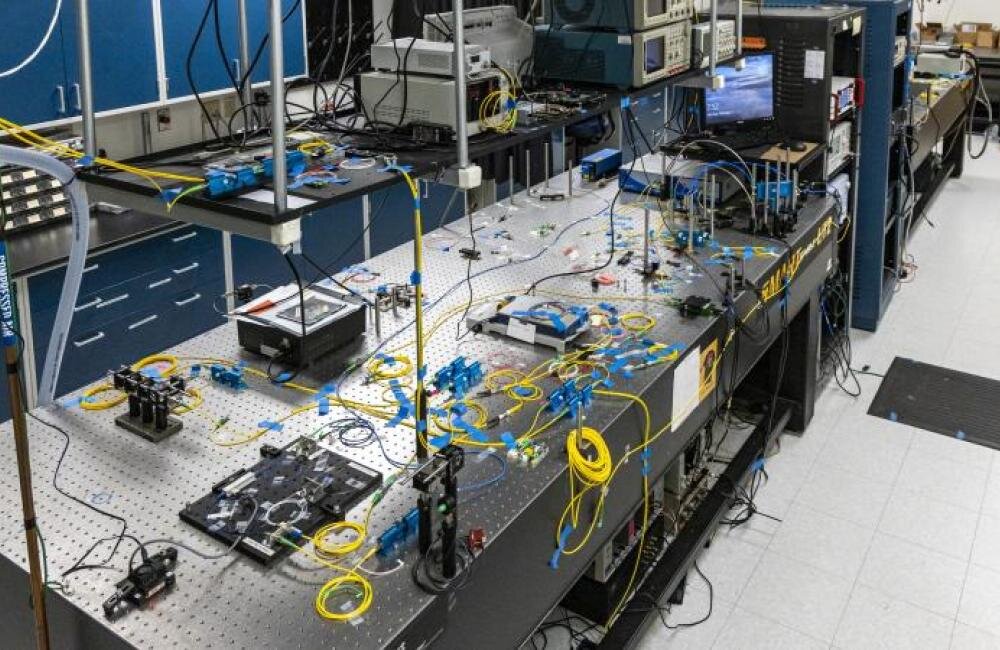
Unlike matter-based qubits, photons are not easily disturbed by their environment, leading to very low decoherence. They also don't require extreme cooling, and can operate at room temperature. Quantum gates are implemented with standard optical components like beam splitters, which can put a photon into a superposition of paths, and phase shifters, which alter its quantum phase. The main difficulty is getting photons to interact with each other, which is necessary for creating two-qubit gates. This is a fundamental challenge because photons naturally just pass right through one another.
A key advantage is that photonic chips can be fabricated using established silicon photonics manufacturing processes. Furthermore, since the qubits are photons, these systems are naturally suited for quantum communication and networking over long distances using fiber optics.
Comparing the Architectures
Each architecture presents a unique set of trade-offs. There is no single "best" approach yet, and ongoing research continues to improve all of them. The choice often depends on the specific problem a quantum computer is designed to solve.
| Feature | Superconducting Qubits | Trapped Ions | Photonic Qubits |
|---|---|---|---|
| Qubit Type | Artificial atom (circuit) | Single atom (ion) | Single particle (photon) |
| Gate Speed | Fast (nanoseconds) | Slow (microseconds) | Fast (femtoseconds) |
| Coherence | Low | High | High |
| Connectivity | Local (neighboring) | High (all-to-all) | Challenging |
| Operating Temp. | Cryogenic (~15 mK) | Near room temp. | Room temp. |
The field is rapidly evolving. Researchers are also exploring hybrid systems that combine the strengths of different architectures, such as using superconducting circuits to control photons or linking trapped-ion modules via photonic interconnects. The ultimate winner in the race to build a fault-tolerant quantum computer may be one of these platforms, or a new approach altogether.
What component in a superconducting qubit acts as a non-linear inductor, creating the unevenly spaced energy levels needed to isolate the |0⟩ and |1⟩ states?
A primary advantage of trapped-ion qubits over superconducting qubits is their...