Advanced Python Development
Advanced Data Structures
Beyond the Basic List
In Python, we often use lists to store collections of items. They're flexible and easy to use. But as problems get more complex, we need more specialized ways to organize data. Standard lists might not be the most efficient tool for every job. This is where more advanced data structures come into play. They give us specific rules for how data can be added, removed, and accessed, which can make our programs faster and more logical.
Let's explore three fundamental data structures that go beyond Python's built-in list: linked lists, stacks, and queues. While Python's list can mimic some of their behaviors, understanding their underlying structure is key to writing better, more efficient code.
Data structures like arrays, linked lists, trees, graphs, and hash tables are ways of organising information in the computer's memory.
Linked Lists
Imagine a scavenger hunt. Each clue tells you where to find the next one. You can't just jump to the end; you have to follow the chain of clues in order. A linked list works the same way.
Unlike a standard Python list, which stores its elements next to each other in memory, a linked list is made of individual elements called nodes. Each node contains two things: the data it's holding and a pointer (or a link) to the next node in the sequence. The last node simply points to None, signaling the end of the list.
This structure makes adding or removing elements from the beginning of the list very fast. With a regular list, removing the first item requires shifting every other element one spot to the left, which can be slow for very long lists. With a linked list, you just update the Head to point to the second node. That's it.
The tradeoff is that accessing an element in the middle of a linked list is slower. You can't just jump to index 500. You have to start at the Head and traverse 500 nodes to get there. There are also doubly linked lists, where each node has a pointer to the next node and the previous node, making it easier to move backward through the list.
Linked lists are excellent for situations where you'll be doing a lot of insertions and deletions at the beginning or end of your data.
Let's see how you might implement a simple node and linked list in Python.
class Node:
    def __init__(self, data=None):
        self.data = data
        self.next = None

class LinkedList:
    def __init__(self):
        self.head = None

    # Method to add a new node at the beginning
    def add_at_front(self, data):
        new_node = Node(data)
        new_node.next = self.head
        self.head = new_node

    # Method to print the list
    def print_list(self):
        current = self.head
        while current:
            print(current.data, end=" -> ")
            current = current.next
        print("None")

# Example Usage
ll = LinkedList()
ll.add_at_front(3)
ll.add_at_front(2)
ll.add_at_front(1)
ll.print_list() # Output: 1 -> 2 -> 3 -> None
Stacks and Queues
Stacks and queues are abstract data types that are less about structure and more about rules. They can be built using arrays or linked lists, but they impose strict limits on how you interact with the data.
Stacks: Last-In, First-Out (LIFO)
A stack works like a pile of plates. You add a new plate to the top, and when you need a plate, you take the one from the top. The last plate you put on is the first one you take off. This is called the LIFO principle: Last-In, First-Out.
stack
noun
A data structure that follows the Last-In, First-Out (LIFO) principle, where elements are added and removed from the same end, called the 'top'.
The two main operations for a stack are:
- Push: Adding an element to the top of the stack.
- Pop: Removing the element from the top of the stack.
Stacks are used in many places in computing. The "undo" functionality in a text editor is often a stack. Each action you take is pushed onto a stack, and when you hit "undo," the most recent action is popped off and reversed.
# Simple stack implementation using a Python list
stack = []

# Push operations
stack.append('a')
stack.append('b')
stack.append('c')

print("Initial stack:", stack) # Output: ['a', 'b', 'c']

# Pop operations
item1 = stack.pop()
print("Popped item:", item1) # Output: 'c'
print("Stack after pop:", stack) # Output: ['a', 'b']

item2 = stack.pop()
print("Popped item:", item2) # Output: 'b'
print("Stack after pop:", stack) # Output: ['a']
Queues: First-In, First-Out (FIFO)
A queue is like a line at a grocery store. The first person to get in line is the first person to be served. This is the FIFO principle: First-In, First-Out.
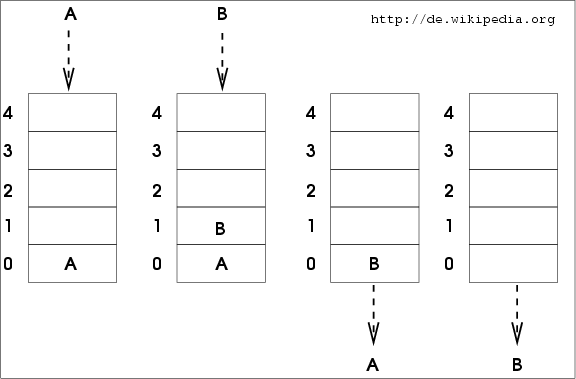
The main operations for a queue are:
- Enqueue: Adding an element to the back (end) of the queue.
- Dequeue: Removing an element from the front of the queue.
Queues are perfect for managing tasks. Think of a print queue. Documents are added to the back of the line and are printed in the order they were received.
While you can use a regular list for a queue, it's inefficient. Removing from the front of a list (e.g., list.pop(0)) requires shifting all other elements. A better tool in Python is collections.deque, which is optimized for fast appends and pops from both ends.
from collections import deque

# Queue implementation using deque
queue = deque()

# Enqueue operations
queue.append('Task 1')
queue.append('Task 2')
queue.append('Task 3')

print("Initial queue:", queue)

# Dequeue operations
first_task = queue.popleft() # pop from the front
print("Processing:", first_task)
print("Queue after dequeue:", queue)

second_task = queue.popleft()
print("Processing:", second_task)
print("Queue after dequeue:", queue)
Ready to test your knowledge?
What is the primary structural difference between a standard Python list and a linked list?
Which data structure follows the Last-In, First-Out (LIFO) principle?
Understanding these structures opens the door to creating more sophisticated and efficient programs. They are the building blocks for many complex algorithms you'll encounter in software development.