Advanced Public Speaking Strategies
Advanced Narrative Framing
Shaping Ideas with Story
You already know that stories make ideas stick. But a simple beginning, middle, and end isn't enough when the stakes are high. To truly persuade, you need to move beyond telling a story and start shaping your message with proven narrative structures. These frameworks aren't just for Hollywood screenwriters; they are powerful tools for building tension, creating emotional resonance, and moving an audience to action.
The Power of Contrast
The most persuasive speeches create a gap between what is and what could be. This contrast generates energy and a desire for change. Communication expert analyzed the structure of world-changing speeches and found a common pattern she calls the "sparkline." It involves oscillating between the unsatisfactory present and a desirable future.
You start by establishing the status quo, the everyday reality. Then, you introduce the promise of something better. You move back and forth between these two poles, heightening the contrast with each swing. This creates a narrative tension that can only be resolved by the audience accepting your vision for the future.
This structure works because it mirrors our own experience of striving. We live in the tension between our current reality and our aspirations. By framing your message this way, you tap into a fundamental human driver and position your idea as the bridge to a better world.
The Hero's Journey, Reimagined
Another powerful framework is , a narrative pattern identified by Joseph Campbell. While it's famous in myths and movies, it’s also incredibly effective in a business or professional context. But here’s the key: you are not the hero of the story. Your audience is.
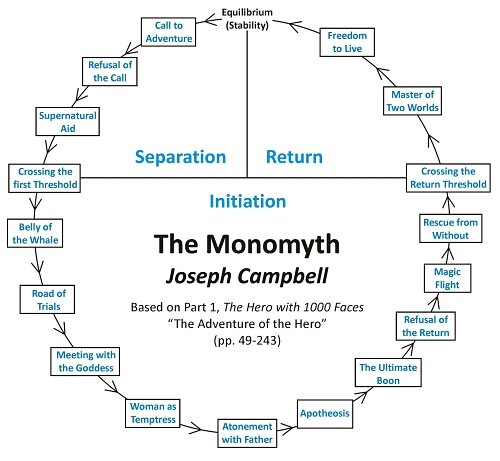
In this framing, you play the role of the mentor or guide. Think Yoda, not Luke Skywalker. Your audience is facing a challenge—the "Call to Adventure." They have obstacles and doubts. Your role is to provide them with the knowledge, tools, or inspiration—the "magic sword"—they need to overcome their challenges and achieve their goals. This positions your message not as a command, but as a gift that empowers them on their own journey.
Weaving Nested Loops
For complex topics, a linear story can feel flat. This is where come in. This technique involves starting a story, pausing it to tell a second, related story, and maybe even a third, before resolving them in reverse order.
Imagine a speaker presenting on corporate innovation. They might start with a story about a specific team's struggle (Story A). Before revealing the outcome, they pause and tell a story about the CEO's original vision for the company (Story B). Then, they might even share a short anecdote about a single innovative employee (Story C).
They would resolve Story C first, then use that to resolve Story B, and finally, bring it all back to resolve the initial team's struggle in Story A, tying all three narratives together.
This method creates suspense and intellectual curiosity. The audience's brains work to keep the open loops in memory, waiting for closure. When you finally connect all the threads, the resulting conclusion feels more profound and inevitable.
According to Nancy Duarte's "sparkline" model, what is the most effective way to structure a persuasive message?
When applying the Hero's Journey framework in a professional presentation, who should be positioned as the "hero"?
These structures are not rigid formulas, but flexible frameworks. The goal is to consciously choose a narrative shape that best serves your message and your audience, transforming a simple presentation into a memorable and persuasive experience.