Advanced Psychometric Validation
Introduction to Psychometric Validation
How Do We Measure the Mind?
Psychology isn't just about theories and ideas; it's also about measurement. How do we quantify something as complex as intelligence, anxiety, or personality? That's the job of psychometrics, the field focused on creating and evaluating psychological tests. But a test is only useful if it's good. And to be good, it needs to go through a rigorous process called validation.
Psychometric validation is how we ensure a test measures what it claims to measure, accurately and consistently. Think of a personality quiz you might find online. How do you know its results are meaningful? Without proper validation, you don't. It might be entertaining, but it isn't a reliable tool. Validation gives us confidence that the scores from a test reflect a real psychological attribute.
Psychometrics, a field within psychology, deals with the theory and techniques of psychological measurement, including the development and validation of tests, scales, and assessments used to quantify psychological attributes.
Accuracy and Consistency
Two principles are at the heart of test validation: validity and reliability. They sound similar, but they measure two different, crucial qualities.
validity
noun
The degree to which a test measures what it is intended to measure.
Validity is about accuracy. If you create a test to measure depression, the questions should be about symptoms of depression, not about your favorite color or what you ate for breakfast. A valid test hits the target it's aiming for.
reliability
noun
The degree to which a test produces stable and consistent results.
Reliability is about consistency. If you take an IQ test today and get a score of 120, you should get a similar score if you take it again next week (assuming you haven't done anything to drastically change your IQ). A reliable test gives you the same result over and over under the same conditions.
Here's the key relationship: A test can be reliable without being valid, but it cannot be valid without first being reliable. A broken scale that's always off by five pounds is reliable (consistent) but not valid (accurate). A scale that gives a different number every time is neither.
Building a Better Test
Creating and validating a psychometric instrument is a careful, step-by-step process. It doesn't happen by just writing down a few questions that seem right.
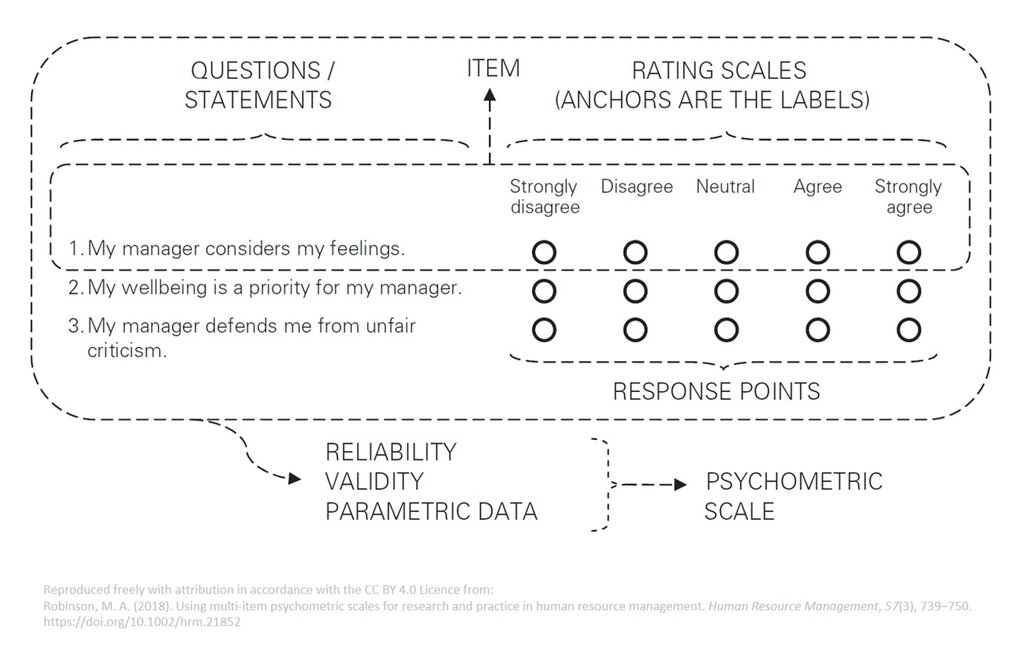
Here’s a simplified look at the process:
-
Define the Construct: The first step is to clearly define what you want to measure. Is it “student engagement,” “job satisfaction,” or “social anxiety”? This definition must be precise.
-
Develop the Items: Next, researchers create a large pool of questions, or items, that relate to the construct. For a test on anxiety, items might ask about worrying, physical tension, or avoidance behaviors.
-
Administer the Test: The draft test is given to a large, representative sample of people. This helps gather data on how the items perform in the real world.
-
Analyze the Results: This is where the statistics come in. Researchers analyze the data to check the test's reliability and validity. They look for items that don't perform well and might remove them. This process is often repeated multiple times, refining the test until it meets high standards.
This rigorous validation is why well-established psychological tests, like those used in clinical or educational settings, are trusted tools. They have been carefully constructed and tested to ensure their results are both meaningful and consistent.
Now, let's test your understanding of these core concepts.
What is the primary goal of psychometrics?
A researcher creates a new online quiz to measure conscientiousness. However, the questions are mostly about how much a person enjoys socializing and attending parties. This quiz most clearly lacks:
Understanding validity and reliability is the first step in appreciating the science behind how we measure psychological traits. It's the foundation that ensures the tools we use are truly up to the task.