Advanced Prosocial Optimization
Oxytocin-Vasopressin Modulation
Oxytocin and Vasopressin: A Neurobiological Duality
Oxytocin (OXT) and arginine vasopressin (AVP) are structurally similar neuropeptides, differing by only two amino acids, yet they exert distinct and sometimes opposing effects on social behaviour. Both are synthesised predominantly in the magnocellular neurosecretory cells of the hypothalamus, specifically within the paraventricular nucleus (PVN) and supraoptic nucleus (SON). From there, they are released into the bloodstream via the posterior pituitary or projected directly to various brain regions involved in social cognition.
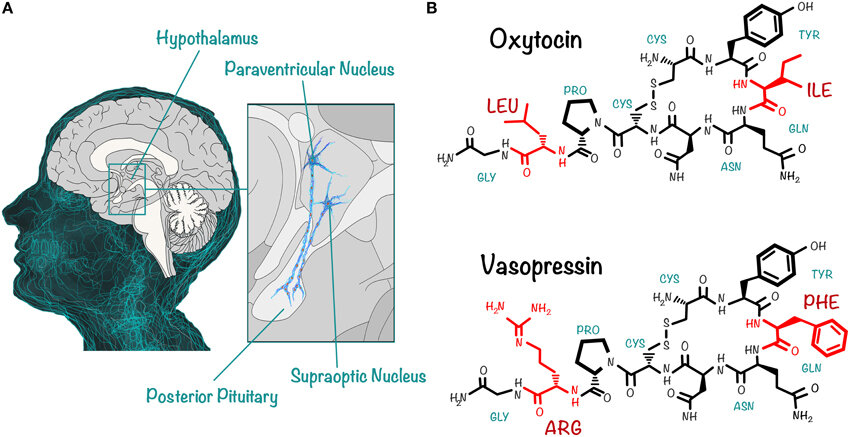
While OXT is widely associated with prosocial behaviours like trust, empathy, and bonding, AVP's role is more complex. It contributes to social recognition, pair bonding, and paternal care, but is also implicated in aggression and anxiety. This functional divergence is not due to the peptides themselves but rather the specific distribution and signalling characteristics of their respective receptors.
Receptor Architecture and Functional Specificity
The differential effects of OXT and AVP are largely dictated by the neuroanatomical distribution of their receptors. OXT receptors (OXTR) are densely expressed in regions like the amygdala, nucleus accumbens, and bed nucleus of the stria terminalis (BNST). The activation of OXTR in the central amygdala, for instance, has a potent anxiolytic effect, dampening fear responses and thereby facilitating social approach and trust-building. This is a key mechanism for the , where OXT signalling can decrease the aversion to social risks.
Vasopressin acts via three main receptor subtypes: V1a, V1b, and V2. In the brain, the V1a receptor (V1aR) is most relevant for social behaviour. V1aR distribution overlaps with OXTR in some areas but is also distinct, with high concentrations in the lateral septum and hypothalamus. In many species, high V1aR density in the lateral septum is linked to aggressive and defensive behaviours, acting as a counterbalance to OXT's anxiolytic effects. This OXT/AVP balance is critical for appropriately navigating complex social environments, from cooperation to competition.
Genetic Underpinnings of Social Variation
Individual differences in social responsiveness, empathy, and altruism have a significant genetic component, much of which is tied to the oxytocinergic system. Polymorphisms in the OXTR gene are widely studied. For example, the G allele of the single nucleotide polymorphism (SNP) rs53576 is often associated with higher levels of empathy, optimism, and parental sensitivity compared to the A allele. Individuals with the A allele may show greater stress reactivity and a higher risk for social-emotional difficulties.
These genetic variations don't determine behaviour, but they create predispositions by altering receptor function or expression, thereby influencing how an individual's brain responds to social stimuli and integrates with the HPA axis during stress.
Beyond the receptor itself, genes controlling OXT release are also critical. The gene encodes a transmembrane glycoprotein that functions as an ectoenzyme, catalysing the synthesis of cyclic ADP-ribose, a second messenger essential for OXT release from hypothalamic neurons. Variations in the CD38 gene have been linked to social behaviour, including parental touch and the propensity for altruistic acts. Lower CD38 expression can result in reduced oxytocin secretion, potentially impacting the ability to form and maintain social bonds.
These genetic influences on the OXT and AVP systems create a spectrum of social phenotypes. They modulate an individual's baseline for social anxiety, their sensitivity to social cues, and their inherent motivation to engage in prosocial behaviour. Understanding these neurobiological and genetic foundations provides a more nuanced view of the complex interplay between nature and nurture in shaping human sociality.
What is the primary reason for the different, and sometimes opposing, effects of Oxytocin (OXT) and Arginine Vasopressin (AVP) on social behaviour?
According to research on the OXTR gene, which allele of the rs53576 polymorphism is associated with greater stress reactivity and a higher risk for social-emotional difficulties?