Advanced Prompt Engineering Mastery
Advanced Prompt Engineering Techniques
Thinking Step by Step
To get better answers from a large language model, you need to guide its reasoning. One of the most effective ways to do this is with Chain-of-Thought (CoT) prompting. Instead of asking for a final answer directly, you instruct the model to explain its thinking process. By adding a simple phrase like "Let's think step by step," you encourage the model to break down a complex problem into smaller, manageable parts.
Consider this question: A coffee shop has 120 paper cups. On Monday, they use 35 cups. On Tuesday, they use twice as many cups as on Monday. They then receive a new shipment of 100 cups. How many cups do they have at the end of Tuesday?
A direct prompt might lead to a quick, and possibly incorrect, calculation. A CoT prompt, however, guides the model through the logic.
A coffee shop has 120 paper cups. On Monday, they use 35 cups. On Tuesday, they use twice as many cups as on Monday. They then receive a new shipment of 100 cups. How many cups do they have at the end of Tuesday? Let's think step by step.

Here's the AI's likely reasoning:
1.  **Start with the initial number of cups:** 120.
2.  **Calculate cups used on Monday:** 35 cups.
3.  **Calculate cups used on Tuesday:** Twice Monday's usage is 2 * 35 = 70 cups.
4.  **Calculate remaining cups before the new shipment:** 120 - 35 - 70 = 15 cups.
5.  **Add the new shipment:** 15 + 100 = 115 cups.

**Final Answer:** The coffee shop has 115 cups.
This method forces the model to externalize its reasoning process, often catching its own errors along the way. It’s particularly useful for arithmetic, commonsense, and symbolic reasoning tasks.
Popular prompt strategies like Chain-of-Thought Prompting can dramatically improve the reasoning abilities of Large Language Models (LLMs) in various domains.
Finding the Best Path
Chain-of-Thought is powerful, but it still follows a single line of reasoning. What if that path leads to a dead end or a wrong conclusion? That's where more advanced techniques come in.
Self-Consistency improves on CoT by running the same prompt multiple times. This generates several different reasoning paths. The final answer is then determined by a majority vote. It's like asking a committee of experts to solve a problem and choosing the most common solution. This approach makes the final answer more robust, as it's less likely that multiple independent thought processes will arrive at the same incorrect conclusion.
The Tree-of-Thoughts (ToT) framework takes this a step further. Instead of just generating complete, separate paths, it explores different options at each step of the reasoning process. It builds a tree of possible thoughts, evaluates the viability of different branches, and prunes the ones that seem unpromising. This allows the model to backtrack from mistakes and explore alternative solutions, much like a human would when solving a complex puzzle.
This deliberate exploration of different solution paths allows the model to tackle problems that require strategic planning or significant trial and error, like solving a Rubik's Cube or proving a mathematical theorem.
Reasoning and Acting
Sometimes, reasoning alone isn't enough. An AI might need to interact with external tools to find information or perform actions. The ReAct (Reasoning and Acting) framework combines the step-by-step reasoning of CoT with the ability to take action.
In a ReAct loop, the model generates a thought about what it needs to do, then chooses an action to take, like performing a web search. It then receives an observation—the result of that action—and uses it to generate the next thought. This cycle of Thought -> Action -> Observation continues until the model has enough information to answer the original query.
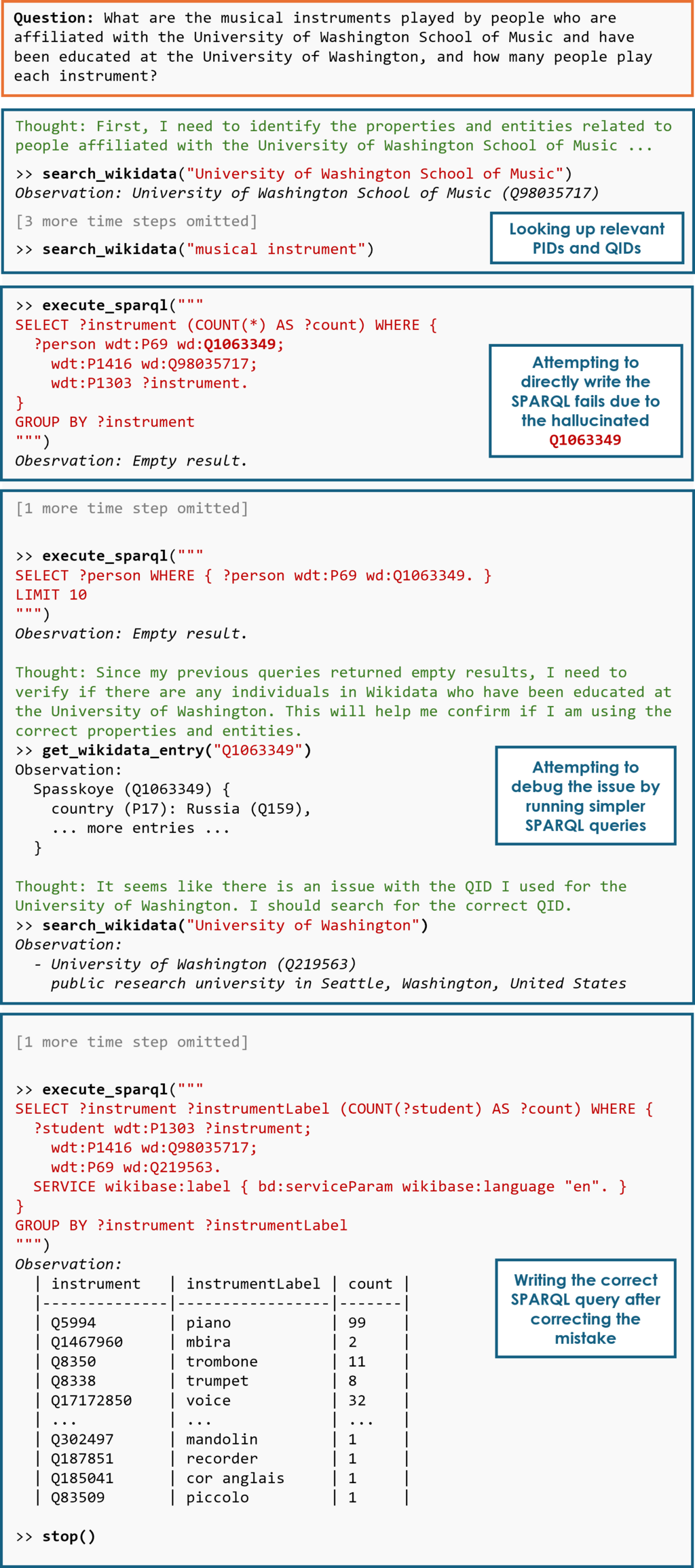
For example, if you ask, "Who was the lead actor in the highest-grossing film of 2023?", a ReAct agent would approach it like this:
| Step | Process | Detail |
|---|---|---|
| 1 | Thought | I need to find the highest-grossing film of 2023. |
| 2 | Action | Search("highest-grossing film of 2023") |
| 3 | Observation | The search result is "Barbie". |
| 4 | Thought | Now I need to find the lead actor of "Barbie". |
| 5 | Action | Search("lead actor in Barbie movie") |
| 6 | Observation | The search result is "Margot Robbie". |
| 7 | Thought | I have all the information needed to answer the question. |
| 8 | Answer | Margot Robbie was the lead actor in the highest-grossing film of 2023. |
This approach allows LLMs to solve problems that require up-to-date information or interaction with external systems, overcoming the limitations of their static training data.
Ready to test your understanding? This quiz covers the advanced prompting techniques we've discussed.
What is the primary goal of Chain-of-Thought (CoT) prompting?
Which prompting technique is most suitable for a problem that requires strategic planning and the ability to backtrack from dead ends, like solving a complex puzzle?
By mastering these techniques, you can guide LLMs to tackle more complex problems with greater accuracy and reliability, moving from simple queries to sophisticated, multi-step reasoning.