Advanced Professional Dynamics in Mexico
Mastering High Context Nuance
Reading the Air
In a Mexican business setting, the most important messages are often conveyed between the lines. The atmosphere of a meeting, or el clima, can tell you more than the words spoken. This high-context environment prioritizes harmony and relationship-building. The goal is to maintain —a sense of rapport and pleasantness that keeps professional relationships smooth.
Understanding this is crucial. You're expected to read the room, interpret subtle cues, and understand that what is left unsaid is often the real message. Directness can be perceived as aggressive or rude, potentially damaging the trust you've worked to build.
The Polite "No"
A direct "no" is rare in Mexican professional culture because it can disrupt harmony. Instead, you'll often hear vague affirmations that function as polite rejections. Learning to decode these phrases is essential for managing expectations and understanding the true status of a project.
Someone might say, "lo checamos" (we'll check it) or "lo voy a revisar" (I'll review it). While these sound positive, they often mean "This isn't a priority" or "I don't agree, but I don't want to confront you." Another common phrase is responding with "mañana" (tomorrow) when asked for a timeline. This is less a firm deadline and more a gentle deferral.
| Direct (Low-Context) Phrase | High-Context Mexican Equivalent | Likely Underlying Meaning |
|---|---|---|
| "No, I can't do that." | "Déjame ver qué se puede hacer." (Let me see what can be done.) | "This is probably not going to happen." |
| "This is a bad idea." | "Es una propuesta interesante, hay que madurarla." (It's an interesting proposal, we need to let it mature.) | "I disagree, but I won't say so directly." |
| "I need an answer now." | "¿Cuándo crees que podríamos tener una idea?" (When do you think we could have an idea?) | A softer, less demanding way to ask for a timeline. |
| "This has a mistake." | "Se podría mejorar esta parte." (This part could be improved.) | A way to point out an error without assigning blame. |
The key is to avoid pinning someone down. If you push for a direct "yes" or "no," you risk creating an uncomfortable situation. It's better to mirror this indirect style. Instead of asking, "Can you finish this by Friday?" you might say, "Would it be possible to have this ready for Friday?" This phrasing provides an easier, more harmonious way for your counterpart to signal potential issues.
Unspoken Signals
Beyond verbal cues, non-verbal communication is rich with meaning. Physical proximity, for instance, is an important indicator. Standing closer to someone during a conversation than you might in other cultures signals engagement and is a step toward building —a deep, foundational trust that is the bedrock of any successful business relationship in Mexico.
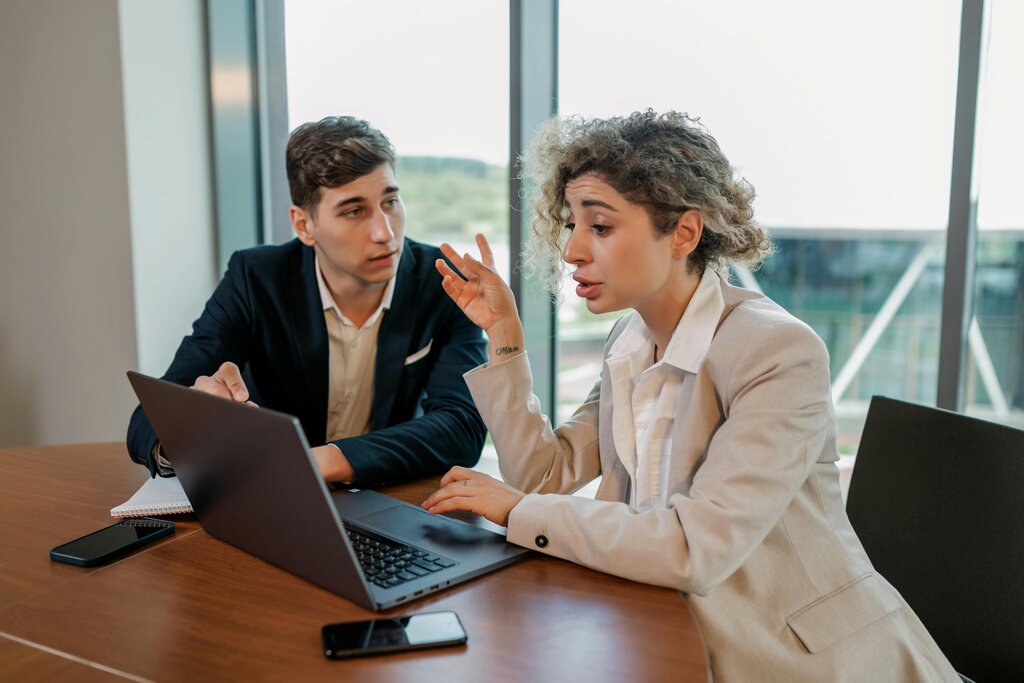
Prolonged eye contact is another marker of trust and sincerity. While in some cultures it might be seen as confrontational, in Mexico it shows you are listening intently and are fully present in the conversation. Avoiding eye contact can be interpreted as disinterest or even dishonesty.
Silence is also a tool. Pauses in conversation are not necessarily awkward; they can be moments for thoughtful consideration. Learning to sit comfortably in these moments without feeling the need to fill the space is a sign of cultural fluency.
A crucial linguistic tool for avoiding conflict is the passive voice. Instead of saying, "You sent the wrong file," a colleague might say, "Se envió el archivo equivocado" (The wrong file was sent). This construction removes personal blame from the statement, focusing on the problem itself rather than the person responsible. It allows issues to be addressed while preserving relationships.
Ready to test your understanding of these subtle cues?
In a Mexican business meeting, which of the following is often more important than the literal words spoken?
The goal of maintaining 'simpatía' in a professional setting is to...
By learning to interpret what's unsaid, you move beyond simple transactions and begin to build the lasting, trust-based relationships that are the foundation of business in Mexico.