Advanced Productivity and Time Optimization
Prioritizing Complex Workflows
Beyond the Urgent
In a complex job, your to-do list can feel less like a plan and more like a fire alarm that never stops ringing. Everything seems critical. The key isn't to work faster, but to work smarter by distinguishing between what’s truly important and what’s just loud. This is where the Eisenhower Matrix, which we've touched on before, evolves from a simple sorting tool into a strategic mindset.
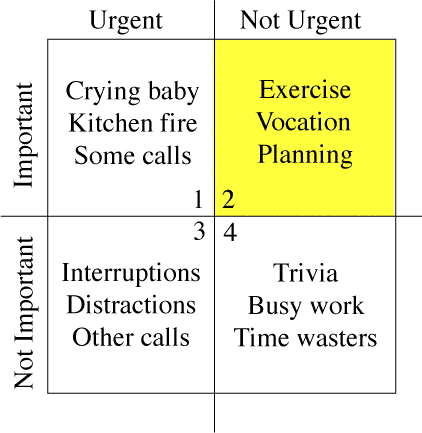
The real challenge is navigating the gray area. When multiple projects have tight deadlines and high stakes, how do you decide what's truly 'Important and Urgent' (Quadrant I) versus what's merely 'Urgent but Not Important' (Quadrant III)? The secret lies in focusing on Quadrant II: 'Important, Not Urgent'. This is the zone of strategic planning, relationship building, and deep work—the activities that prevent future crises and drive long-term success. Most professionals get trapped in Quadrant I, constantly reacting. High-performers live in Quadrant II, proactively shaping their outcomes. A major threat to this is shallow work—tasks that feel productive but contribute little to your main goals.
Finding Your 20 Percent
To identify what belongs in Quadrant II, we can use a powerful mental model: the Pareto Principle, also known as the 80/20 rule. It states that for many outcomes, roughly 80% of the results come from 20% of the effort. In your work, this means a small handful of your tasks generate the vast majority of your impact. The goal is to ruthlessly identify and protect that vital 20%.
How do you find it? Conduct a workload audit. Look back at the last month or quarter. List all your major activities and projects. Now, map them to their actual results. Which tasks led to a major project completion? Which activities strengthened key client relationships? Which efforts directly contributed to revenue or team goals? Be honest. You'll likely find that a few key actions drove most of your success, while much of your time was spent on lower-impact activities.
Look back to leap forward. Your past performance is the best map to your future priorities.
The Delegation Hurdle
The workload audit makes it clear what to focus on, but it also reveals what to let go. This brings us to the hardest part for many ambitious professionals: delegation. Quadrant III tasks ('Urgent, Not Important') are the prime candidates. These are the phone calls, emails, and meetings that demand immediate attention but don't align with your core goals. While it’s easy to see they should be delegated, it’s psychologically difficult to do so.
We resist delegation for several reasons: the fear of losing control, the belief that
it's faster to do it myself
, or guilt over adding to a colleague's workload. Overcoming this requires a shift in perspective. Delegation isn't just offloading work; it's an act of empowerment. It provides growth opportunities for your team and frees you to concentrate on the high-impact 20% of tasks only you can do.
| Barrier to Delegation | Mindset Shift |
|---|---|
| "I can do it faster myself." | "Investing time to train someone now saves more time later." |
| "They won't do it right." | "Perfection is the enemy of done. My role is to provide clear direction and trust my team." |
| "I don't want to burden them." | "This is a growth opportunity for them and a strategic necessity for me." |
Finally, we have Quadrant IV: 'Not Urgent, Not Important'. This is the easiest category to understand but can be tricky to act on. These are the time-wasting activities, pointless meetings, and old, recurring tasks that have lost their purpose. The strategy here is simple but requires discipline: eliminate them. Unsubscribe from the email list. Decline the meeting with no clear agenda. Question recurring reports that no one reads. Every 'no' to a low-value task is a 'yes' to your most important work.
According to the principles discussed, which quadrant of the Eisenhower Matrix should a high-performing professional focus on for long-term success?
How does the Pareto Principle (the 80/20 rule) help in managing a complex workload?