Advanced Principles of Space Physics
Orbital Dynamics
The Rules of Cosmic Traffic
Planets don't just wander aimlessly. They follow a precise set of rules, first described by Johannes Kepler in the early 17th century. While he didn't know why they moved this way, his three laws perfectly described the how.
First Law: The Law of Ellipses. Planets move in elliptical orbits, not perfect circles, with the Sun at one of the two foci. An ellipse's shape is defined by its semi-major axis (), which is half of its longest diameter, and its eccentricity (), a measure of how stretched out it is. A circle is just an ellipse with an eccentricity of zero.
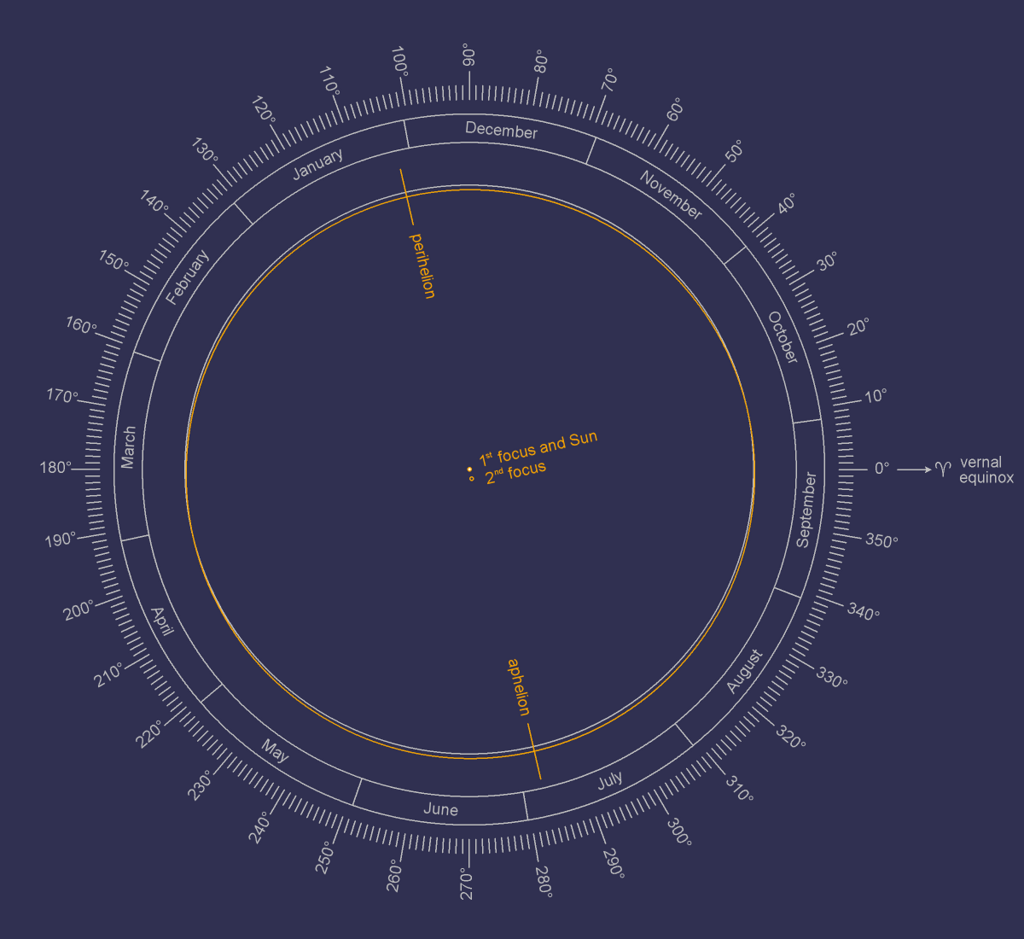
The semi-major axis () and semi-minor axis () are related to eccentricity () by a simple formula. This relationship is key to calculating the exact shape and size of any orbit.
Second Law: The Law of Equal Areas. This law states that a line segment joining a planet and the Sun sweeps out equal areas during equal intervals of time. This means a planet moves fastest when it's closest to the Sun (perihelion) and slowest when it's farthest away (aphelion). This is a direct consequence of the conservation of angular momentum in a central force field.
Third Law: The Law of Harmonies. Kepler found a stunningly simple mathematical relationship between an orbit's size and the time it takes to complete one revolution. The square of a planet's orbital period () is directly proportional to the cube of its semi-major axis ().
From Description to Explanation
Kepler's laws were a breakthrough, but they were empirical—based on observation, not a fundamental theory. It took Isaac Newton to provide the physical explanation. By uniting the concepts of terrestrial gravity (a falling apple) and celestial motion, he formulated his Law of Universal Gravitation, which underpins all of orbital mechanics.
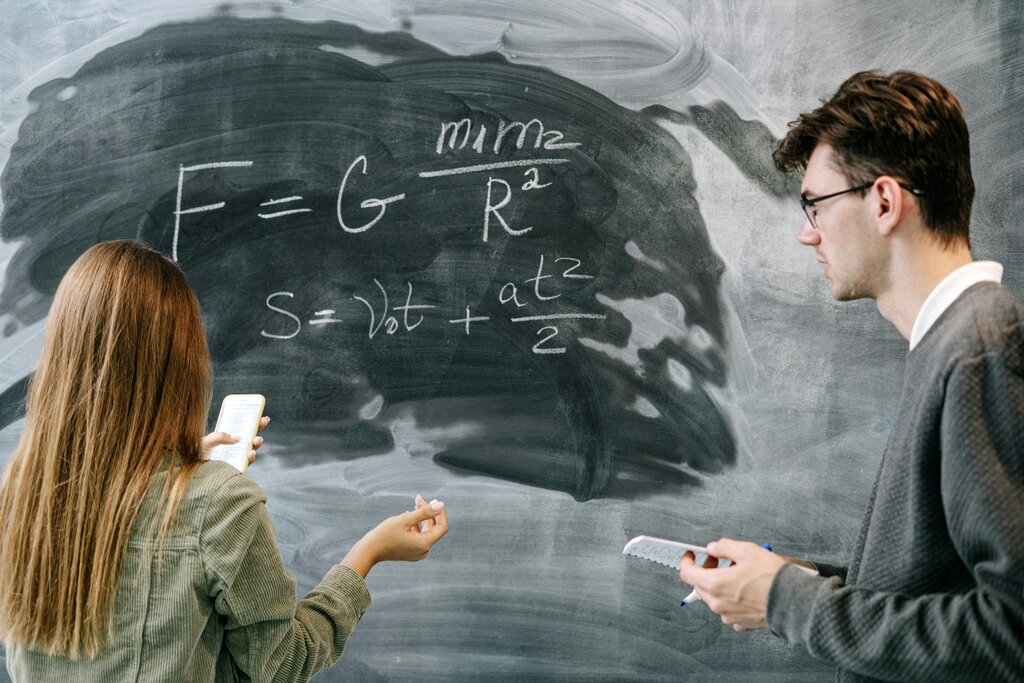
Newton showed that the gravitational force () between two objects is proportional to the product of their masses ( and ) and inversely proportional to the square of the distance () between their centers. The constant of proportionality is , the gravitational constant.
By equating this gravitational force to the centripetal force required to keep an object in a circular orbit (), Newton derived a more powerful version of Kepler's Third Law. This new form wasn't just a proportionality; it was an equation that included the masses of the objects, allowing for precise calculations.
Leaving Home
Getting a satellite into a stable orbit or sending a probe to another planet requires a precise understanding of energy. The total energy of an orbit is the sum of its kinetic energy (due to motion) and its potential energy (due to gravity). This total energy determines the orbit's shape and size.
An orbit's total energy is constant. It can trade kinetic energy for potential energy (and vice versa) by changing its distance from the central body, but the sum remains the same.
To escape a planet's gravitational pull entirely, a spacecraft must achieve escape velocity. This is the minimum speed needed to reach a point where gravity's pull is negligible. At this speed, the object's kinetic energy is exactly equal to its gravitational potential energy, giving it a total orbital energy of zero. This results in a parabolic trajectory.
Most interplanetary missions don't launch directly into an escape trajectory. Instead, they use fuel-efficient maneuvers like the to move between two different circular orbits. This is an elliptical orbit that touches the inner orbit at one end and the outer orbit at the other.
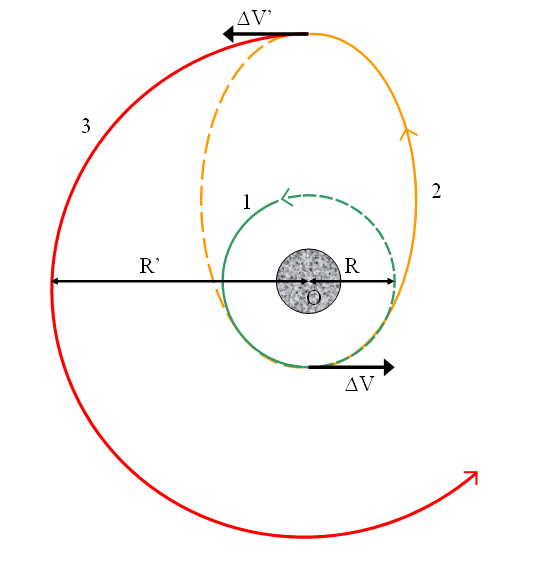
Calculating the details of these transfers is a direct application of everything we've discussed: Kepler's laws define the path, Newton's law provides the force, and the principles of orbital energy determine the fuel required for the engine burns. These mathematical tools are what allow us to precisely navigate the solar system.