Advanced Principles of Martial Systems
Kinetic Chaining Mechanics
The Body as a Whip
A powerful strike isn't born in the fist or the foot. It starts from the ground. Think of a whip. The handle moves a short distance, but the energy travels along its length, accelerating until the tip cracks through the air. Your body works the same way. This sequence of energy transfer is called the kinetic chain—a series of interconnected body segments working together to generate force.
Every powerful movement, from a punch to a kick, begins with your feet on the floor. By pushing against the ground, you generate a ground reaction force—the initial spark of energy. This force doesn't just push you up; it travels through your ankles, knees, and into your hips. The rotation of your hips acts like a gearbox, multiplying this initial force and sending it upwards through your torso. Your core muscles then tighten, creating a stable channel to transfer that energy into your shoulder, down your arm, and finally, into your fist at the moment of impact. Each link in the chain adds momentum and velocity, creating a whole far more powerful than the sum of its parts.
Think of your core—the complex of muscles around your torso and hips—as the engine room. If your legs create the initial burst of power, your core is the transmission that ensures none of it gets lost. A stable, engaged core creates a rigid link between your rotating hips and your upper body. Without this core stability , the chain becomes flimsy. The energy dissipates before it can reach its target, resulting in a weak, inefficient strike. This is why exercises that strengthen the entire trunk are fundamental to any martial art.
Two Strikes, One Principle
The kinetic chain is a universal principle, but different martial arts apply it in unique ways. Let's compare two powerful strikes: the cross from Western boxing and the roundhouse kick from Muay Thai.
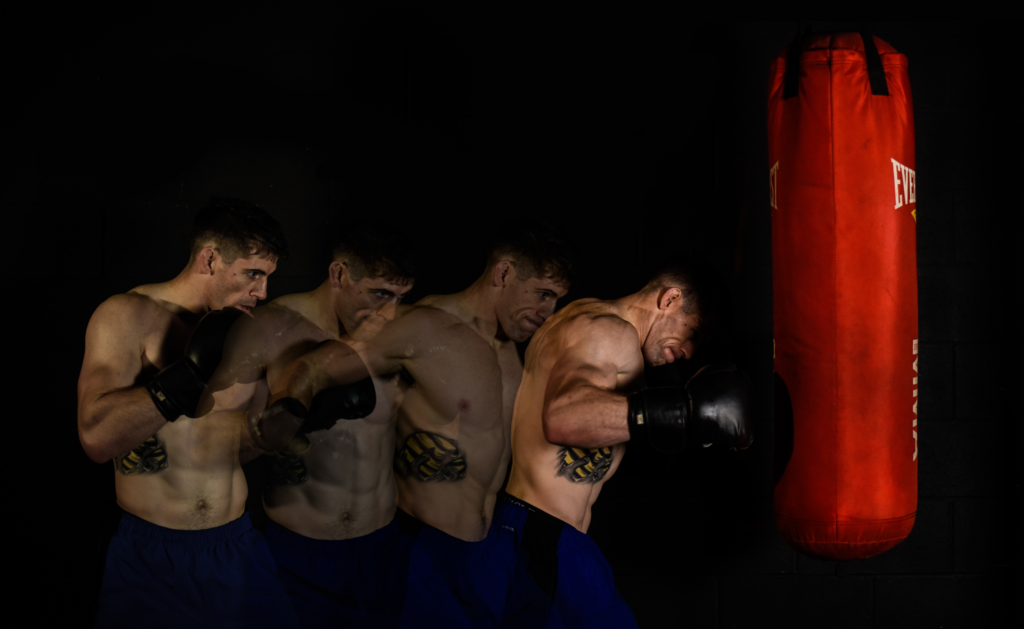
The boxer’s cross is a masterpiece of rotational force. The strike starts with a hard pivot of the rear foot, driving the heel outwards. This motion forces the rear hip to rotate forward violently. The energy surges through the stable core and into the torso, which rotates along the same line. The shoulder follows, and finally, the arm extends, delivering the accumulated force directly to the target. It’s a linear strike powered entirely by rotation.
The roundhouse kick uses a similar principle but for a different weapon. The fighter pivots on their supporting leg, turning their heel towards the target to open up the hips. This hip rotation is explosive and is the primary driver of the kick. The kicking leg stays relatively relaxed, swinging like a baseball bat through the target. The power isn’t from the leg muscles alone; it's from the massive torque generated by the hips and transferred through the core. The arms swing in the opposite direction to provide a counterbalance, ensuring all the energy is directed into the kick.
Whether it's a punch or a kick, the formula is the same: generate force from the ground, amplify it with hip rotation, transfer it through a stable core, and deliver it efficiently to the target.
Understanding this flow of energy is the difference between simply moving your limbs and executing a truly powerful, structurally sound technique. It transforms striking from a simple action into a full-body application of physics.
What is the 'kinetic chain' in the context of a martial arts strike?
According to the principle of the kinetic chain, where does the power for a strong strike primarily originate?