Advanced Principles of Martial Arts Systems
Advanced Kinetic Linking
The Body as a Whip
Power in martial arts doesn't come from just your arm or your leg. It comes from the entire body working as a single, coordinated system. Think of a whip. The handle moves a short distance, but by the time that energy travels to the tip, it's moving incredibly fast. Your body works the same way through a principle called the kinetic chain—an interconnected system of muscles and joints that transfers energy from one part to the next.
This chain reaction is what separates a novice's push from an expert's devastating strike. Every powerful movement, whether it's a Muay Thai roundhouse kick or a Brazilian Jiu-Jitsu sweep, begins not with the limb that makes contact, but with your connection to the ground. By mastering how to link these movements sequentially, you turn your body into an efficient, power-generating machine.
The entire body acts as a single unit, with force flowing from the ground, through your core, and out through your limbs.
Power from the Ground Up
Every athletic movement starts with the ground. When you push off the floor, the floor pushes back with an equal and opposite force. This is the (GRF), and it's the first link in generating power. The simple act of rotating your foot into the mat initiates a cascade of energy that travels up your legs and into your hips.
In striking, a powerful right cross doesn't start in the shoulder; it starts with the ball of the right foot digging into the canvas. In grappling, a successful takedown drive uses the powerful push from the legs against the ground to propel your body forward. Even when you're on your back in BJJ, the force for a bridge or a sweep comes from driving your feet into the mat to lift your hips.
The Engine of Rotation
Once the energy moves up from the ground, it reaches the body's powerhouse: the hips and core. This is where linear force from the legs is converted into rotational force, or —the key to unlocking explosive power. Your core muscles act as a transmission, stabilizing the spine and efficiently transferring this rotational energy from your lower body to your upper body.
A Muay Thai roundhouse kick is a perfect example. The power isn't generated by just swinging the leg; it's generated by aggressively rotating the hips as the kick is thrown. Similarly, many BJJ sweeps, like the hip bump, don't rely on muscling the opponent over. Instead, they use a powerful, explosive hip rotation to disrupt the opponent's base and reverse the position.
Unleashing the Whip
The final stage is coordinating the joints in the correct sequence to maximize velocity. The movement must flow from larger, slower body parts to smaller, faster ones. For a punch, the sequence is: foot, knee, hip, torso, shoulder, elbow, and finally, the fist. Each joint adds its velocity to the chain, culminating in a rapid, powerful strike. If the timing is off, the chain is broken, and power is lost.
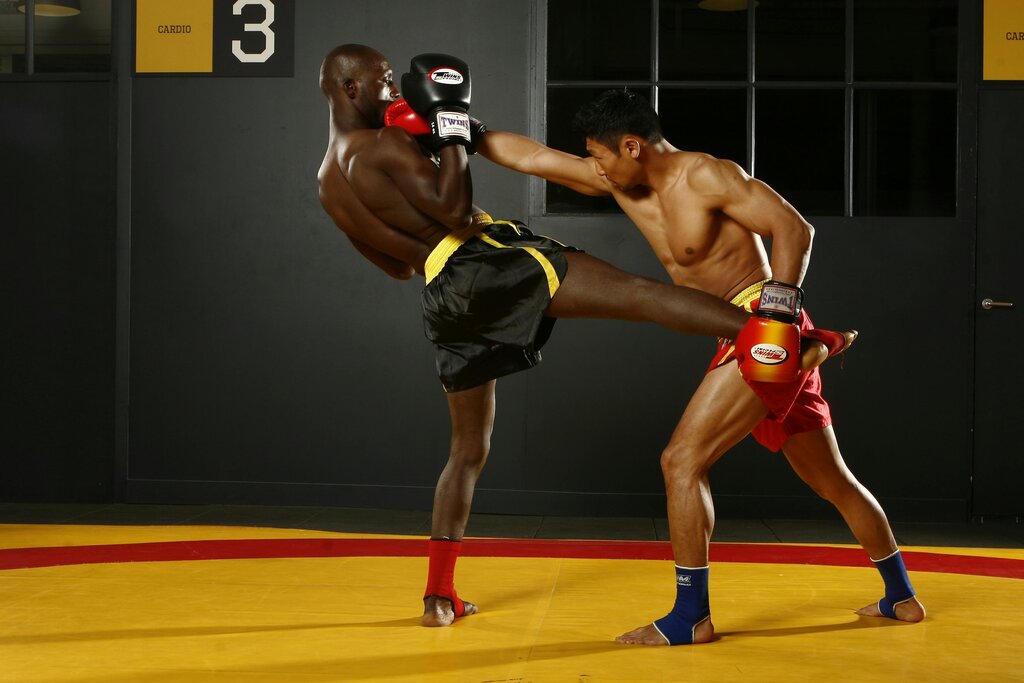
This sequential acceleration also creates angular momentum. As the striking limb extends, it carries this momentum, much like an ice skater spinning faster as they pull their arms in. The snap at the end of a punch or kick is the final, sharp transfer of all the energy accumulated along the kinetic chain.
Proper sequence is critical. A breakdown in the chain at any point—stiff hips, a weak core, or improper footwork—leaks energy and dramatically reduces power and speed.
By understanding these principles—starting with the ground, rotating through the core, and sequencing the movement—you can bridge the gap between performing isolated techniques and applying them with full power and integration in a live combat scenario.
According to the text, what is the primary function of the 'kinetic chain' in martial arts?
Where does the generation of power for almost every athletic movement in martial arts begin?