Advanced Principles of Martial Arts Systems
Kinetic Linking Mechanics
The Body as a Whip
A powerful strike isn't born in the arm or leg. It starts from the ground and travels through the body like a wave. This sequence of movement is called the kinetic chain. Think of it like cracking a whip: the energy starts at the handle (your feet), flows up the length of the whip (your legs and torso), and concentrates with explosive speed at the very tip (your fist or foot).
The process begins with a push from the ground. Your feet provide the initial force, which then travels up through your ankles, knees, and into your hips. The rotation of your hips is the engine of the strike, generating significant torque. This twisting motion continues up through your core and torso, multiplying the force before it's finally unleashed through your shoulder, arm, and into the target. Each link in the chain adds momentum and velocity, culminating in a strike far more powerful than any single muscle group could produce on its own.
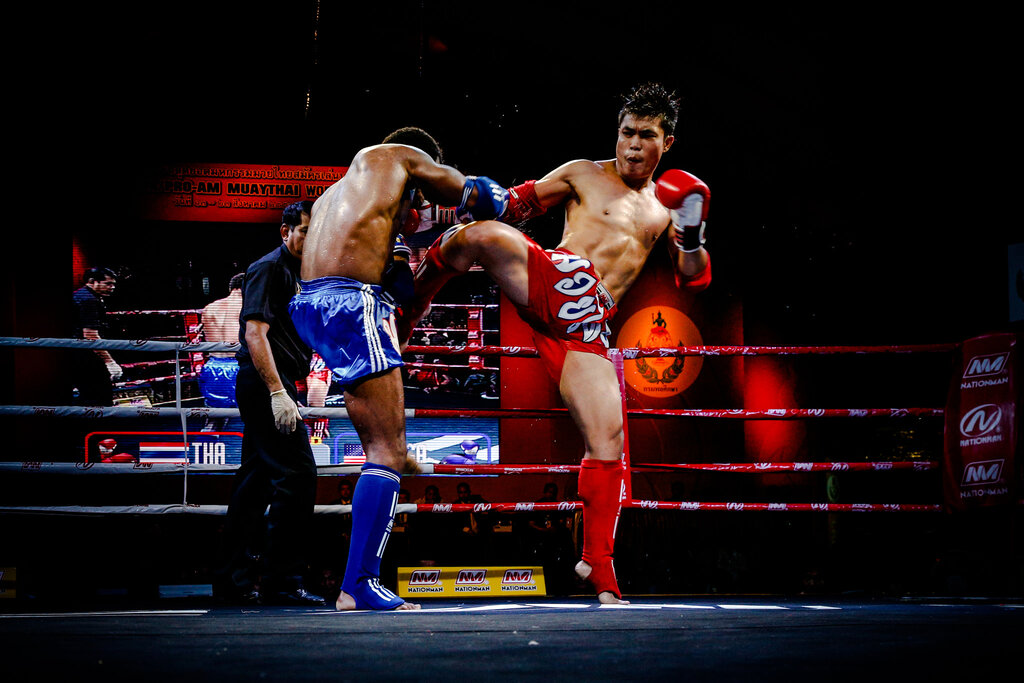
Rotational vs. Linear Power
While the kinetic chain is universal, different martial arts emphasize different mechanics to generate power. The main distinction is between linear and rotational force. Western Boxing, for example, often relies on a linear drive. For a cross, the power is generated from the back foot and driven forward in a relatively straight line through the hips and torso, maximizing direct force and reach.
In contrast, styles like Muay Thai and Karate are masters of rotational power. A Muay Thai roundhouse kick involves a powerful rotation of the hips and torso, creating a devastating arc of force. Karate employs a unique “double hip” movement, where the hips snap first away from the target and then whip back towards it, creating a powerful rebound effect. This rotation is amplified by the —a principle where the muscles of the torso are stretched like a rubber band and then released, creating a snap-back of rotational force.
Making Contact
Generating force is only half the battle. The other half is transferring it into the target. This is where the concept of comes into play. It’s not just about how much you weigh, but how much of your body mass is actively engaged and stiffened at the moment of impact. Hitting a target with a relaxed arm is like striking it with a wet noodle, most of the energy dissipates within your own limb. But by timing the tensing of your entire body—from your fist, through your core, and down to your feet planted on the ground—you turn your body into a solid, unified object. This ensures the kinetic energy you've built up is transferred into the target, not absorbed by your own joints.
Stability is the foundation of this principle. Your connection to the ground is what allows you to brace for impact and channel force effectively. Without a stable lower body, the force of your own strike would push you off-balance, wasting energy and creating an opening for a counter-attack. Proper grounding allows you to use the floor as a backstop, ensuring the kinetic chain has a solid anchor to pull from and push against.
By leveraging the kinetic chain, optimizing speed through relaxation, and training with intention, martial artists can develop more powerful and faster strikes.
Let's review the key ideas about generating power in your strikes.
Now, test your understanding of how these principles come together.
According to the principle of the kinetic chain, where does the force for a powerful strike originate?
Which concept describes the stretching and snap-back of torso muscles to amplify rotational power, similar to a rubber band?
By understanding the body as a single, interconnected system, you can move beyond simple muscle action and tap into a much deeper well of power.