Advanced Principles of Martial Arts Systems
Kinetic Chain Power Generation
The Body as a Power Chain
A powerful strike isn't born in the fist or the foot. It's the end result of a chain reaction that starts from the ground. Think of your body as a series of connected segments: feet, shins, thighs, hips, torso, and arms. This is the kinetic chain, and learning to use it efficiently is the difference between a light tap and a knockout blow.
Each link in the chain transfers energy to the next. The goal is to build momentum sequentially, starting with the largest, most stable parts of your body and funnelling that force into the smaller, faster limbs. It’s like cracking a whip. The handle (your core) moves relatively slowly, but that energy multiplies as it travels down the length, creating incredible speed at the tip.

Starting from the Ground Up
Every powerful movement begins with your connection to the floor. When you push against the ground with your feet, the ground pushes back with an equal and opposite force. This is Newton's third law in action, and in biomechanics, we call it Ground Reaction Force (GRF).
This isn't just a passive force. It’s the raw energy you feed into your kinetic chain. By driving your foot into the ground to initiate a punch or kick, you are borrowing force from the entire planet. This initial force travels up your leg, into your hips, and begins the sequence that will eventually power your strike. A weak connection to the ground means you're leaving a massive amount of power on the table.
Firm footing is the foundation of force. Without it, you're just waving your arms and legs.
The Power Sequence
Once you've generated force from the ground, it needs to travel through your body in the correct order. This is called a Proximal-to-Distal Movement Sequence (PDMS). 'Proximal' refers to parts of your body closer to the centre (like your hips and torso), while 'distal' refers to parts further away (like your hands and feet).
Power flows from the inside out. First, the larger, slower, more powerful muscles of the legs and hips activate. Then, the torso rotates, transferring the now-accelerating energy to the shoulder. Finally, the arm and fist, or leg and foot, are launched towards the target. Each segment adds its own velocity to the chain, resulting in maximum speed at the point of impact. Rushing this sequence or moving segments out of order breaks the chain and dissipates power.
The Engine Room
Your hips and core are the engine of your kinetic chain. They connect your lower and upper body and are responsible for generating immense rotational power, or torque. This is where the force from the ground is amplified and directed.
Consider a Muay Thai roundhouse kick. The practitioner pivots on the supporting foot, using it as a stable axis. The hips rotate explosively, creating torque that whips the striking leg around like a baseball bat. The power comes from the rotation of the entire body, not just the leg muscles. Contrast this with a traditional front kick. While it also uses GRF, the power is more linear. The hips thrust forward, driving the striking leg straight into the target. The kinetic chain is shorter and the motion is more of a powerful push than a circular whip. Both are effective, but they use the body’s engine in different ways to achieve different results.
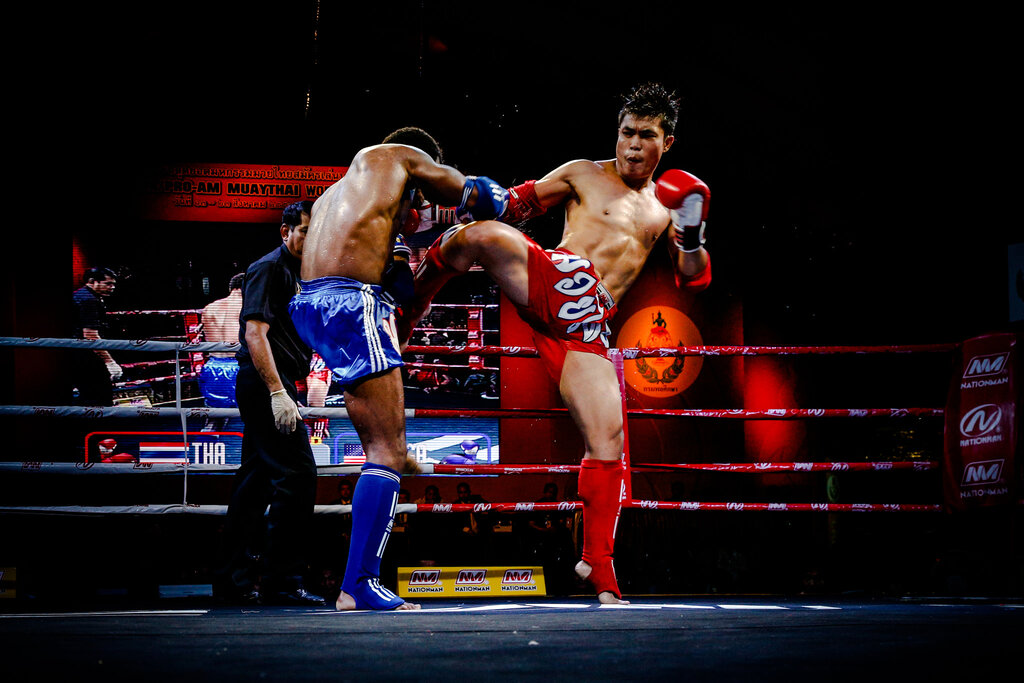
Mastering your body's kinetic chain turns your striking from a simple muscular action into an exercise in applied physics. By starting from the ground, sequencing your movements correctly, and using your core as the engine, you unlock a new level of power and efficiency.
Time to see if these concepts have landed. Test your understanding.
What is the 'kinetic chain' in the context of striking?
The initial force for a powerful strike is generated from the ground. This concept is known as:
Understanding these principles is the first step. The next is feeling them in your own body through practice.