Advanced Principles of Martial Arts Systems
Biomechanical Power Generation
The Kinetic Chain
A powerful strike isn't born in the fist or the foot. It's the final link in a chain of events that starts from the ground. This sequence of motion is called the —a concept borrowed from biomechanics that describes how the body's segments work together to produce maximum force. Think of it like cracking a whip. The handle moves first, but the powerful snap happens at the very tip. Your body works the same way.
The power flows in a proximal-to-distal pattern. It begins with the parts of your body closest to your center (proximal), like your legs and hips, and moves outward to your limbs (distal). Each segment builds on the momentum of the last, accelerating the chain until the energy is delivered at the point of impact. Interrupting this flow at any point is like having a loose link in a chain; the energy dissipates, and the final strike loses its power.
From the Ground Up
Every powerful movement starts with a push against the earth. When you push off the ground to initiate a strike, the ground pushes back with an equal and opposite force. This is Newton's Third Law in action, and it's called Ground Reaction Force (GRF). This is the raw energy you'll channel into your technique.
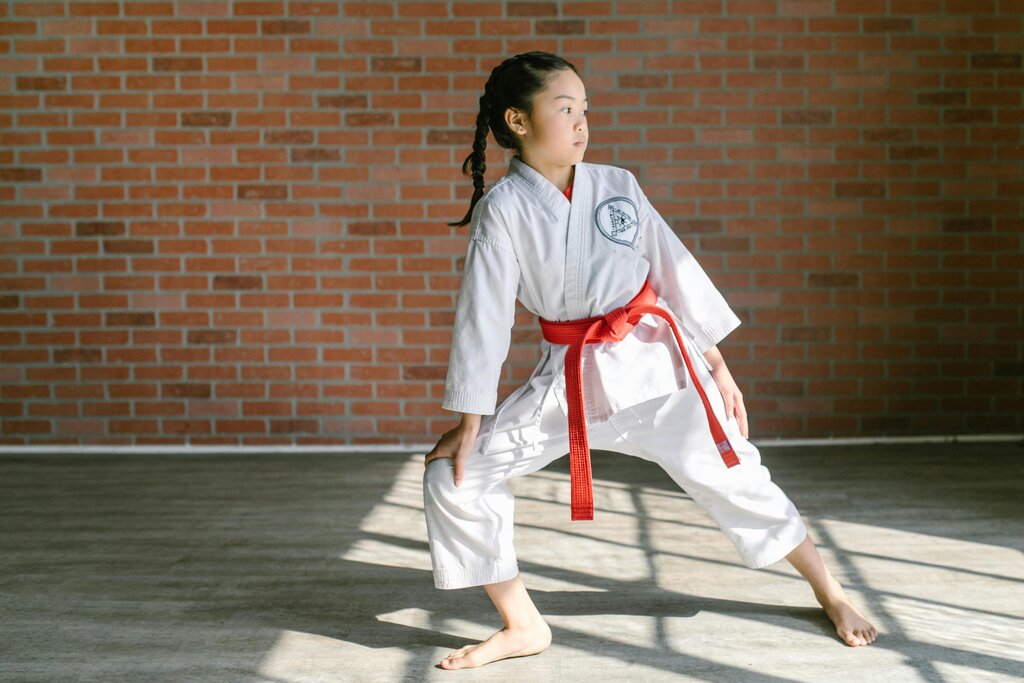
A solid, balanced stance is non-negotiable. It's the platform from which all power is launched. Without a firm connection to the ground, the GRF dissipates, and the kinetic chain starts with a fraction of its potential energy. You're not just standing on the floor; you're using the entire planet as a backstop for your strike.
The Engine of Power
The force from the ground travels up your legs, but the real amplifier is your core and hips. This is the engine that converts the linear push from the ground into devastating rotational power, or s. A punch thrown with only the arm is weak. A punch driven by hip rotation carries the force of your entire body.
This principle is most obvious in circular strikes like hooks and roundhouse kicks. As your leg swings in an arc during a roundhouse, it generates centripetal force, which keeps the foot moving along its circular path. The real power comes from the explosive rotation of the hips that initiates the kick. Your leg simply acts as the final delivery system for the torque generated at your body's center.
Structure and Impact
For linear strikes like a straight punch or front kick, the goal is slightly different. Instead of maximizing rotation, you want to create the most efficient, direct path for force to travel from the ground to the target. This is achieved through or skeletal stacking.
By aligning the bones of your arm and shoulder with your core and legs, you create a solid, unified structure. All the force generated by the kinetic chain is channeled directly into your fist. Any bend in the wrist or elbow at the moment of impact creates an energy leak, weakening the strike and risking injury.
Proper alignment allows you to transfer force, not just absorb it.
Finally, the impact itself is governed by the principles of impulse and momentum. Impulse is the change in momentum, and it's a product of both force and the time over which that force is applied.
This is why speed is critical. A faster strike reduces the time of impact (), which increases the peak force () for the same change in momentum. It’s also why follow-through is important—it ensures you are applying force through the target, not just at its surface, maximizing the transfer of momentum.
What is the 'kinetic chain' in the context of striking?
According to the principle of the kinetic chain, power flows in which pattern?