Advanced Principles of Genetic Inheritance
Non-Mendelian Inheritance Patterns
When Genes Don't Play by the Rules
Gregor Mendel's work with pea plants gave us a powerful framework for understanding inheritance. The idea of dominant and recessive alleles neatly explains many traits. But genetics is rarely that simple. The relationship between genotype and phenotype can be much more nuanced, leading to patterns of inheritance that go beyond a simple dominant-recessive relationship.
One of the most straightforward departures from Mendel's rules is incomplete dominance. In this case, neither allele is completely dominant over the other. The heterozygous phenotype is an intermediate, a blend of the two homozygous phenotypes. Think of it like mixing paint. If you cross a red snapdragon flower (genotype ) with a white one (), you don't get red or white flowers in the next generation. Instead, all the offspring are pink ().
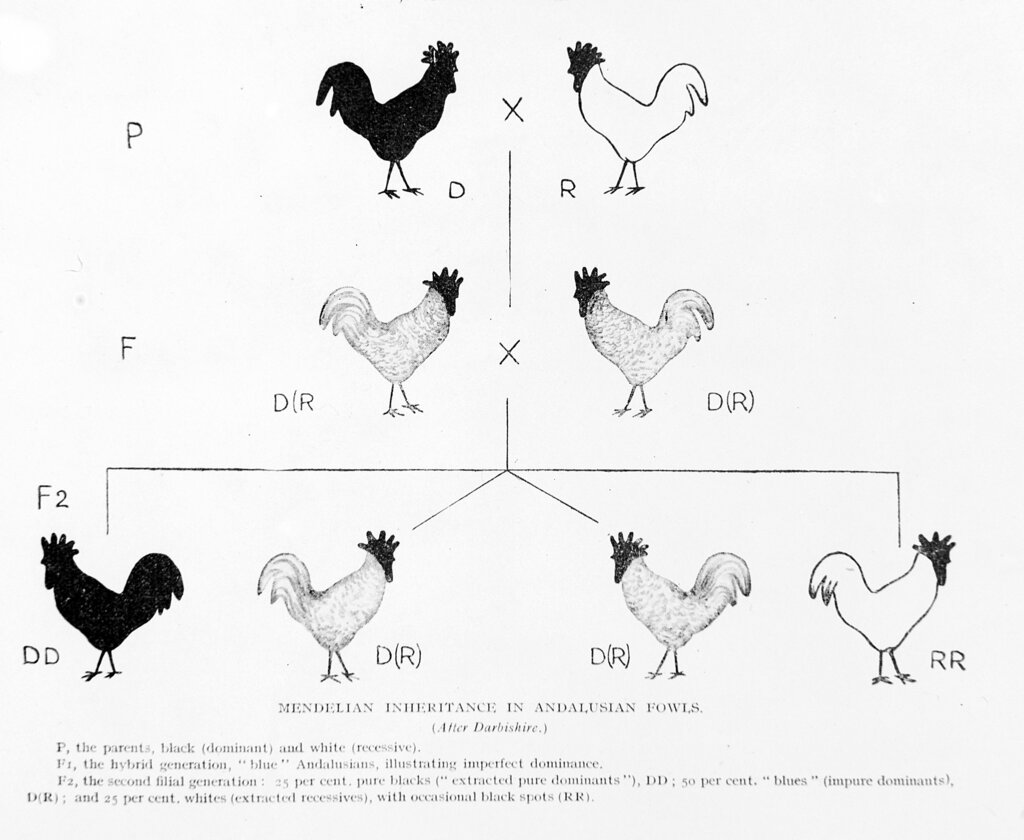
When these pink F1 hybrids are crossed with each other, the F2 generation shows a tell-tale phenotypic ratio that matches the genotypic ratio. This is a key departure from the classic 3:1 Mendelian ratio.
Sharing the Spotlight
Instead of blending, some alleles can be codominant. This means that in a heterozygote, both alleles are fully and separately expressed. There's no mixing; both traits show up. The most common example of this in humans is the ABO blood group system, which is also a great example of multiple alleles—a situation where more than two alleles exist for a single gene in the population.
The gene for blood type, the I gene, has three common alleles: , , and . The allele codes for type A antigens on red blood cells, and the allele codes for type B antigens. The allele codes for no antigen. In terms of dominance, and are both dominant over , but they are codominant with each other. If a person inherits both and , their red blood cells will have both A and B antigens, resulting in type AB blood. Neither allele masks the other; they share the phenotypic spotlight.
| Phenotype (Blood Type) | Possible Genotypes |
|---|---|
| A | or |
| B | or |
| AB | |
| O |
One Gene, Many Effects
Sometimes, a single gene can influence multiple, seemingly unrelated phenotypic traits. This phenomenon is called pleiotropy. Instead of a one-to-one relationship between a gene and a trait, one gene can have a cascade of effects throughout the body. A classic example in humans is Marfan syndrome, a genetic disorder affecting the body's connective tissue. It's caused by a mutation in a single gene, FBN1.
This one faulty gene can lead to a wide range of symptoms: unusual height, long limbs and fingers, vision problems (due to lens dislocation), and life-threatening heart problems (like aortic aneurysm). All these different effects stem from the single gene's role in producing a protein essential for the structure of connective tissues found across the body.
In pleiotropy, one gene acts as a master switch, influencing a network of different biological pathways and resulting in a suite of traits.
These examples show that inheritance is far more complex than Mendel's initial experiments suggested. While his laws provide a crucial foundation, incomplete dominance, codominance, multiple alleles, and pleiotropy demonstrate the intricate ways genes can interact to create the vast diversity of life.
In snapdragons, the allele for red flowers () shows incomplete dominance over the allele for white flowers (). If a red snapdragon () is crossed with a white snapdragon (), what will the phenotype of the offspring be?
Which of the following scenarios best illustrates the concept of codominance?
Understanding these non-Mendelian patterns is key to grasping the full picture of genetics.