Advanced Principles of Chemical Dynamics
Chemical Bonding Dynamics
From Flat Drawings to 3D Shapes
You already know how to draw Lewis structures, which are great 2D maps of how atoms are connected. But molecules aren't flat. They're three-dimensional objects, and their shape is everything. A molecule's shape determines how it interacts with other molecules, which is the basis for everything from how drugs work in the body to the properties of industrial solvents.
The key to predicting these 3D shapes is the Valence Shell Electron Pair Repulsion theory, or VSEPR theory. The name sounds complicated, but the idea is simple: electron pairs in the outer shell of an atom repel each other. Whether they're in a chemical bond or a lone pair, they want to get as far away from each other as possible. This mutual repulsion forces the molecule into a specific, predictable geometry.
For example, a molecule with a central atom bonded to two other atoms (like ) will be linear, with the atoms 180° apart. If it's bonded to three atoms (like ), the molecule will be trigonal planar, with 120° angles. Four atoms (like methane, ) result in a tetrahedral shape, with bond angles of 109.5°. This tetrahedral geometry is fundamental to organic chemistry.
The Wrinkle in the Rules
The simple geometries hold true when all electron pairs are bonding pairs. But lone pairs—those not involved in a bond—change things. Lone pairs are held only by one nucleus, so they spread out more and exert a stronger repulsive force than bonding pairs. This extra push distorts the bond angles.
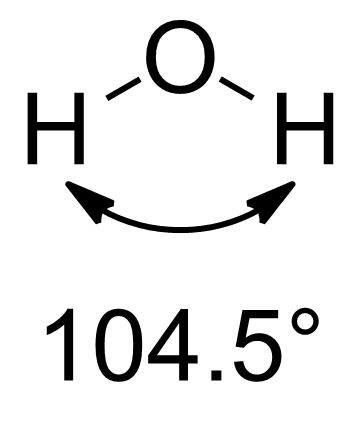
Water () is a classic example. Oxygen has four electron pairs: two bonding pairs with hydrogen and two lone pairs. The electron geometry is tetrahedral, but the lone pairs squeeze the H-O-H bond angle down from the ideal 109.5° to about 104.5°. The resulting molecular shape is described as 'bent'.
To account for these shapes, we use the concept of hybridization. This is the idea that atomic orbitals (like s and p orbitals) mix to form new, identical hybrid orbitals. This mixing allows the atom to form stronger bonds and achieve the geometries predicted by VSEPR.
There are three main types you'll encounter:
- sp³ hybridization: One s and three p orbitals mix to form four sp³ orbitals, arranged in a tetrahedron (109.5° angles). This is found in molecules like methane () and water ().
- sp² hybridization: One s and two p orbitals mix to form three sp² orbitals, arranged in a trigonal plane (120° angles). The remaining p orbital is used for a double bond. Ethene () is a key example.
- sp hybridization: One s and one p orbital mix to form two sp orbitals, arranged linearly (180° angles). The two remaining p orbitals form a triple bond, as seen in ethyne ().
| Electron Domains | Hybridization | Electron Geometry | Example |
|---|---|---|---|
| 2 | sp | Linear | |
| 3 | sp² | Trigonal Planar | |
| 4 | sp³ | Tetrahedral |
Charge, Polarity, and Stickiness
Sometimes more than one valid Lewis structure can be drawn for a molecule. To figure out which one is the most stable and likely to exist, we use a tool called formal charge. It's a way of tracking electrons, comparing the number of valence electrons an atom should have with the number it 'owns' in the Lewis structure.
The best Lewis structure is the one where the formal charges on all atoms are as close to zero as possible. If there must be a negative charge, it should be on the most electronegative atom.
This idea of electronegativity also leads to molecular polarity. When atoms with different electronegativities form a covalent bond, the electrons are shared unequally, creating a bond dipole. Whether the entire molecule is polar depends on its shape. In carbon dioxide (), the C=O bonds are polar, but because the molecule is linear and symmetrical, the dipoles cancel each other out, making the molecule nonpolar.
Water, on the other hand, is bent. Its bond dipoles don't cancel, giving the molecule a net dipole moment. This makes water a polar molecule.
A molecule's overall polarity is the sum of its bond dipoles. Symmetrical shapes can lead to nonpolar molecules even if the individual bonds are polar.
This polarity is what governs the 'stickiness' between molecules, known as intermolecular forces (IMFs). These forces are much weaker than covalent bonds but are critical for physical properties like boiling point and solubility.
Two key types are:
- Hydrogen Bonding: An especially strong type of dipole-dipole interaction that occurs when hydrogen is bonded to a highly electronegative atom like nitrogen, oxygen, or fluorine. This is the force that holds water molecules together.
- London Dispersion Forces: These are present in all molecules, polar or not. They arise from temporary, random fluctuations in electron distribution that create fleeting dipoles. They are the only IMF present in nonpolar molecules like methane () and are generally weaker, though they become stronger as the molecule gets larger.
These forces directly impact how industrial solvents behave. A polar solvent like water will dissolve polar solutes, while a nonpolar solvent like hexane is needed for nonpolar substances—a principle you might know as 'like dissolves like'. Understanding a molecule's shape allows us to predict its polarity and, in turn, its behavior as a solvent.
What is the fundamental principle of Valence Shell Electron Pair Repulsion (VSEPR) theory?
According to VSEPR theory, what is the molecular geometry of a methane molecule ()?
By moving from 2D structures to 3D shapes, and understanding the forces between molecules, we gain a much deeper insight into why substances have the properties they do.