Advanced Plant Taxonomy and Phylogenetic Systems
Modern Classification Systems
A New Family Tree
For a long time, botanists classified flowering plants (angiosperms) based on what they looked like. They compared petals, leaf structures, and stems. This approach, exemplified by the influential Cronquist system, made sense. If two plants looked similar, they were probably related. But looks can be deceiving. Sometimes, unrelated plants evolve similar features independently to adapt to similar environments, a phenomenon known as convergent evolution. This created a messy, often inaccurate family tree.
In the 1990s, a new tool became widely available: DNA sequencing. By comparing the genetic code of plants, scientists could uncover evolutionary relationships with far greater accuracy. This led to the formation of the Angiosperm Phylogeny Group, or APG, an international collaboration of botanists. Their goal was to redraw the angiosperm family tree based on molecular evidence rather than just morphology. The result was a radical reorganisation that is still being refined today.
The Rule of Monophyly
The guiding principle of the APG system is . A group is considered monophyletic if it includes a common ancestor and all of its descendants, with no descendants left out. Think of it like a family photo of you, your parents, and all your siblings. If your cousin is in the photo, it's no longer a monophyletic group of just your immediate family. It has to be a complete, unbroken branch of the tree of life.
This strict adherence to monophyly is why the APG system is often described as 'conservative'. The group will only formally recognise a new order or family, or move a plant from one group to another, when there is strong, consistent molecular evidence to support the change. This avoids the constant reshuffling that might happen if classifications were based on weaker data. It ensures the system is stable and reflects true evolutionary history as accurately as possible.
What's New in APG IV?
The APG system is a work in progress. As sequencing technology improves and more plants are analysed, the tree is updated. The first system (APG I) was published in 1998, followed by updates in 2003 (APG II) and 2009 (APG III). The current version, , was released in 2016.
The jump from APG III to APG IV wasn't a complete overhaul. It was more of a refinement, reflecting the 'conservative' approach. Most of the major family relationships remained stable. However, several important changes were made based on new evidence. Five new orders were recognised: Boraginales, Dilleniales, Icacinales, Metteniusales, and Vahliales. Additionally, some families that were previously lumped together were split apart, while other families were merged.
These changes reflect the core mission of APG: to create a classification system that accurately maps the evolutionary journey of flowering plants.
The Big Picture
APG IV organises angiosperms into several major clades. At the very base of the tree are the basal angiosperms . This is not one single group, but rather a series of lineages that branched off early in angiosperm evolution. They represent the oldest surviving branches of the flowering plant family tree. Famous examples include water lilies and Amborella, a unique shrub from New Caledonia considered by many to be the sister group to all other living angiosperms.
Next are the Magnoliids, a large and diverse clade that includes magnolias, laurels, and black pepper. Finally, the vast majority of flowering plants fall into two other major groups: the Monocots (like grasses, orchids, and palms) and the Eudicots (a huge group including roses, daisies, and oaks).
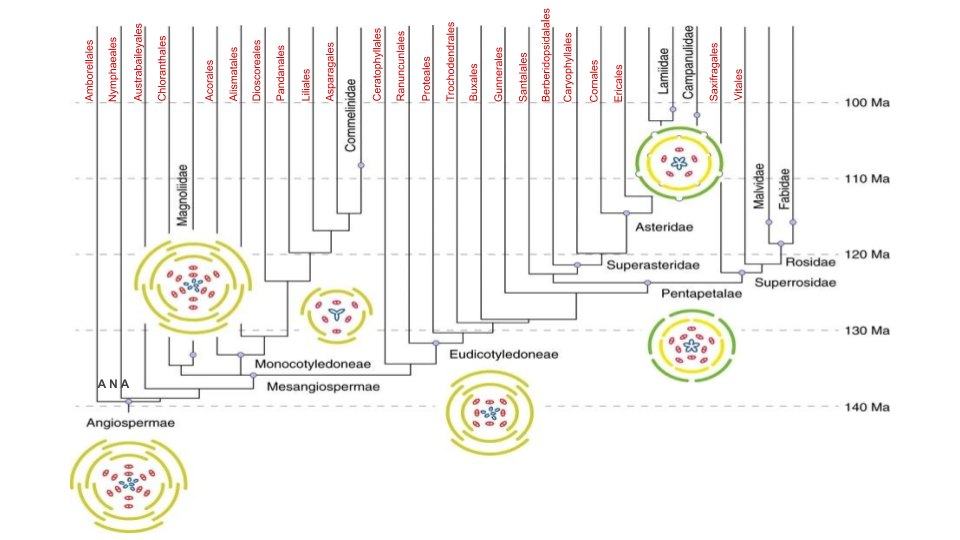
Despite the power of genetic analysis, some questions remain. A few families and genera are still considered 'unplaced' because the data is not yet clear enough to confidently assign them to a specific order. These taxonomic puzzles highlight the frontiers of botanical research. As more genomes are sequenced, the positions of these wandering branches of the angiosperm tree will slowly be resolved, bringing us ever closer to a complete picture of the evolution of flowers.
Before the 1990s, what was the primary method botanists used to classify flowering plants?
The guiding principle of the APG system is to only recognise groups that are 'monophyletic'. What does this mean?
The shift to a molecular-based system has revolutionised botany, providing a more stable and accurate framework for understanding plant diversity.