Advanced Plant Cultivation Techniques
Soil Chemistry Optimization
The Soil's Pantry: Cation Exchange Capacity
Think of your soil as a pantry for your plants. Some pantries are small, barely holding enough for a day. Others are massive, stocked with a diverse array of ingredients. The soil's ability to store and supply essential nutrients is called its (CEC). It measures how many positively charged ions (cations), like calcium (), magnesium (), and potassium (), the soil can hold. These are the nutrients plants need to thrive.
Soil particles, especially clay and organic matter, are negatively charged. They hold onto these positive nutrient ions until a plant's root, which releases its own positive hydrogen ions (), makes a trade. The root exchanges a hydrogen ion for a nutrient ion it needs. A low CEC soil, like sand, has few negative sites and can't hold many nutrients, which then easily wash away. High CEC soils, rich in clay or organic matter, can store a large reserve of nutrients.
Managing CEC largely comes down to managing soil organic matter. Adding compost or other organic materials is the most effective way for growers to increase their soil's nutrient-holding capacity over time.
The pH Lock and Key
Soil pH is the master variable that controls nutrient availability. Even if your soil has a high CEC and is loaded with nutrients, plants can't access them if the pH is wrong. The pH scale runs from 0 to 14, with 7 being neutral. Anything below 7 is acidic, and anything above is alkaline. Most plants prefer a slightly acidic to neutral range, typically between 6.0 and 7.0, because this is where most nutrients are chemically available for uptake.
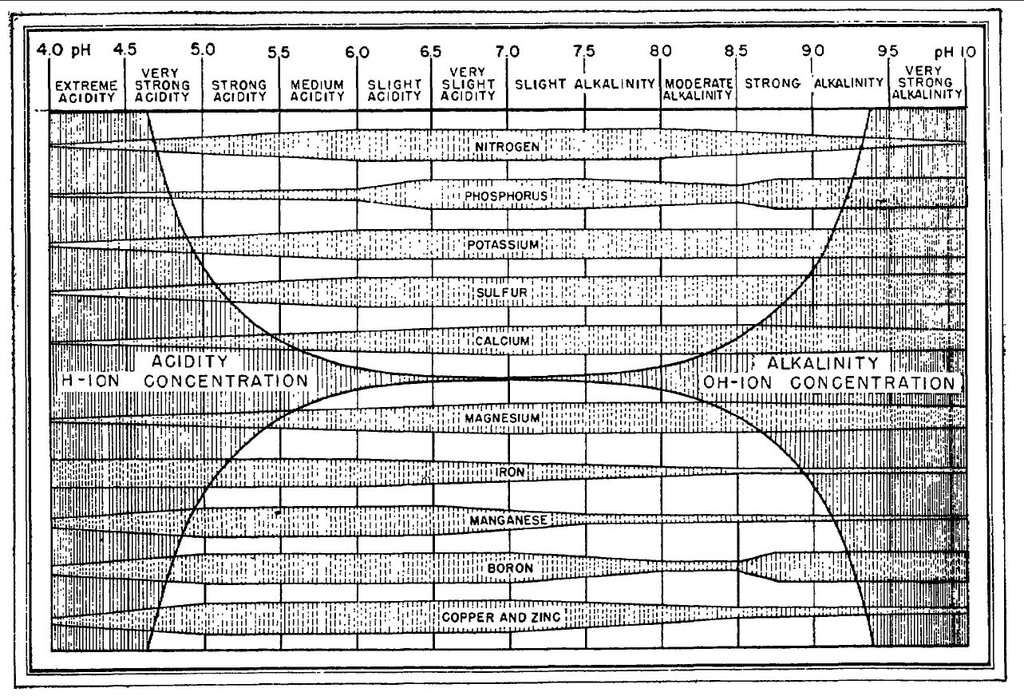
Look at the chart above. Nitrogen is most available between a pH of 6.0 and 8.0. But iron availability plummets as pH increases. A plant showing signs of iron deficiency might not be in iron-poor soil; the soil pH could simply be too high, locking the iron into an unusable form. This is why a soil test is critical. To raise an acidic soil's pH, you can add lime (calcium carbonate). To lower an alkaline soil's pH, you might add elemental sulfur or use acidifying fertilizers.
Organic Matter and Fertilizer Choices
The debate between organic and synthetic fertilizers often misses a key chemical point: to a plant root, a phosphate ion is a phosphate ion, whether it comes from manure or a bag of commercial fertilizer. The difference lies in the delivery system and its impact on the wider soil ecosystem.
Synthetic fertilizers provide nutrients in a ready-to-use form, offering precision and rapid results. However, their high salt content can harm soil microbes, and their water-soluble nature makes them prone to leaching into waterways if over-applied. Organic fertilizers, like compost or manure, release nutrients slowly as microorganisms break them down. This process feeds the soil life and builds (SOM), improving soil structure, water retention, and CEC.
Building SOM is also a strategy for carbon sequestration. Plants pull carbon from the atmosphere, and when they decompose, that carbon becomes part of the stable organic matter in the soil. Healthy soils can be significant carbon sinks. The trade-off is often between short-term yield, where synthetics can give a quick boost, and long-term soil health and resilience, where organic practices excel.
Soil testing is an essential tool for assessing soil composition and health, providing valuable information about nutrient levels, pH, and organic matter content, which guides soil management decisions.
Advanced Amendments
Beyond standard compost, growers can use specialized amendments to fine-tune soil chemistry. is a type of charcoal made by heating organic material in a low-oxygen environment. Its incredibly porous structure provides a vast surface area that acts as a permanent home for beneficial microbes and helps retain water and nutrients.

Green manuring is another powerful technique. This involves planting a "cover crop," like clover or vetch, and then tilling it back into the soil before it sets seed. This adds a huge boost of fresh organic matter and, if you use a legume, a significant amount of nitrogen fixed from the atmosphere.
For micronutrients like iron, zinc, and manganese, precision is key. These elements can be easily locked up in the soil. To prevent this, they are often applied in a chelated form. involves attaching the nutrient ion to a larger organic molecule, which acts like a protective claw, keeping the nutrient soluble and available to the plant root.
Time to see what you've learned.
Ready for a final check?
What does Cation Exchange Capacity (CEC) directly measure?
A plant's leaves are yellowing, indicating an iron deficiency. A soil test shows the soil has high levels of iron, but the pH is 8.2. What is the most likely explanation?
By understanding these chemical relationships, you can move from simply feeding the plant to cultivating a thriving, resilient soil ecosystem that supports healthy crops year after year.