Advanced Pitch Recognition Mastery
Visual Tunneling Foundations
The Pitch Tunnel
Every elite hitter faces the same fundamental problem. A 95-mph fastball travels from the pitcher's hand to the plate in about 400 milliseconds. That's less time than it takes to blink. To make contact, you have to decide whether to swing, and where, when the ball is only halfway there. The challenge is that for the first portion of its flight, every pitch looks the same.
This initial phase of shared trajectory is called the pitch tunnel. For roughly the first 20 feet after the ball leaves the pitcher's hand, a fastball, a curveball, and a slider all appear to be on the exact same path. They occupy a narrow, cone-shaped 'tunnel' in the batter's vision. Your job isn't to guess the pitch out of the hand, but to wait for it to reveal itself.
The Commitment Point
The end of the pitch tunnel, where a pitch begins to show its true identity, is the This is the moment of truth. It typically occurs around 20-25 feet from the pitcher's rubber. Before this point, swinging is pure guesswork. After this point, the ball's spin and gravity take over, causing its path to deviate. A fastball will appear to rise or hold its plane, while a curveball will begin its noticeable break.
Your goal is to train your eyes to stay focused through the tunnel and identify the instant the ball exits it. This is where you gather the critical data needed to adjust your HLP (High-Level Plane) swing. Recognizing this point allows you to hold your posture and resist the urge to commit too early, which is a common mistake that leads to chasing bad pitches.
Finding the Release Window
Before you can track the ball through the tunnel, you must know where the tunnel begins. This starting point is the pitcher's release window. It's the small, specific area where the pitcher consistently releases the ball. Every pitcher, no matter how deceptive, has a mechanical signature.
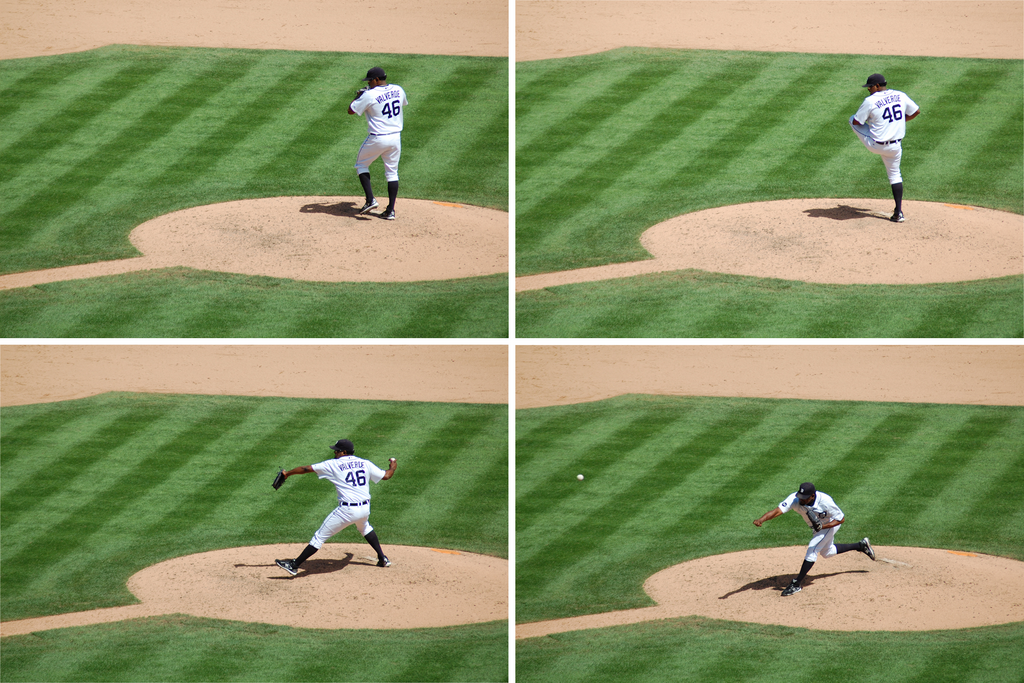
Don't watch the pitcher's whole body. That's a distraction. During the wind-up, soften your focus and let your eyes rest on the general area where you expect the ball to appear. As the pitcher's arm comes forward, narrow your focus to a small 'window' near their head and shoulder. The ball will emerge from this spot on every single pitch. Some pitchers have a high, over-the-top window; others release from a lower, side-arm slot. Identifying this window early in an at-bat is crucial. It simplifies the task from tracking a 6-foot-tall moving object to just waiting for a ball to appear in a predictable location.
Your focus shouldn't be on the pitcher, but on the small window where the ball will be born.
Once the ball appears in the , your visual tracking begins. The task is to keep your head still and follow the ball with only your eyes from this window to the commitment point. Think of it like a visual relay race. Your first job is to see the ball out of the hand. Your second is to track it through the neutral zone of the tunnel. Only then can you make an informed swing decision.
By mastering this first stage, you're building the foundation for elite pitch recognition. You learn to filter out the noise of the wind-up and the initial, deceptive part of the ball's flight. You're training your brain to wait for the signal, not the static.
What is the "pitch tunnel" in baseball?
Why is it a mistake for a batter to decide to swing before the ball reaches the "commitment point"?
Let's check what you've learned about the foundations of visual tunneling.