Advanced Piping, Pipeline Integrity, and NDT Mastery
Advanced Metallurgy Standards
API 5L: PSL 1 vs. PSL 2
The distinction between Product Specification Level 1 (PSL 1) and PSL 2 in API 5L is not merely a matter of increased testing frequency. It represents a fundamental shift in material assurance, especially for high-risk applications. While PSL 1 provides a standard quality level for line pipe, PSL 2 enforces stricter chemical and mechanical properties, including a mandatory maximum for carbon equivalent (CE). More critically, PSL 2 mandates Charpy V-notch impact testing for all grades, establishing minimum toughness values and ensuring resistance to brittle fracture. This is a crucial design consideration for pipelines operating in low temperatures or those transporting materials that could induce cracking.
For offshore or [{
}] applications, PSL 2 is not just recommended; it's the baseline for mitigating catastrophic failure. The specification's focus on fracture toughness and tightly controlled chemistry is non-negotiable in these environments.
| Feature | PSL 1 | PSL 2 |
|---|---|---|
| Chemical Composition | Looser controls; Carbon, Manganese, Phosphorus, Sulfur reported | Tighter controls; CE required for all grades except L175/A25 |
| Yield Strength | Maximum values specified | Maximum and minimum values specified |
| Fracture Toughness | Not required | Required for all grades (Charpy V-notch) |
| Traceability | Traceable until all tests are passed | Mandatory traceability after completion (via heat & lot numbers) |
| Certification | Certificate of Compliance (COC) | Material Test Report (MTR) required |
Weldability and High-Strength Steels
Weldability is a primary concern with high-strength steels like API 5L X70 and X80. As yield strength increases, the risk of hydrogen-induced cracking in the heat-affected zone (HAZ) grows. This is where the Carbon Equivalent (CE) calculation becomes critical. The International Institute of Welding (IIW) formula is a common standard, but for modern micro-alloyed steels, formulas like the one from Ito-Bessyo (Pcm) often provide a better assessment of weldability by giving greater weight to elements like carbon.
To achieve high yield strengths without drastically increasing CE, metallurgists use micro-alloying elements. Small additions of niobium (Nb), vanadium (V), and titanium (Ti) in the range of 0.01% to 0.10% create fine precipitates. These precipitates pin grain boundaries during hot rolling, leading to a refined grain structure—a process known as controlled rolling. The result is a steel that achieves its strength through grain refinement (Hall-Petch effect) rather than high carbon content, preserving toughness and weldability.
Low-Temp Service and MTRs
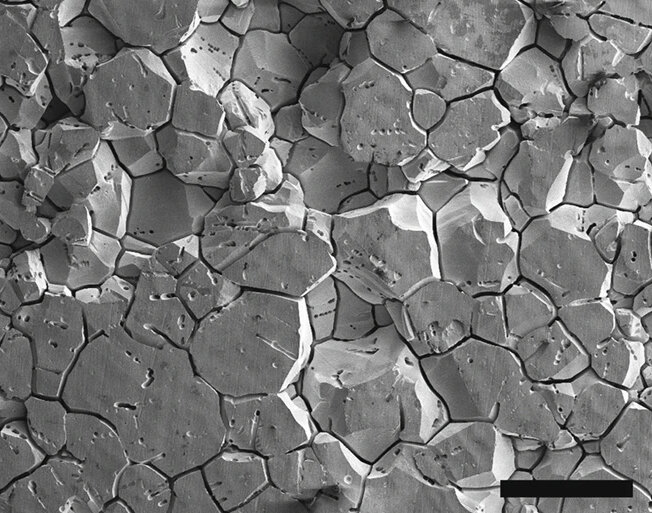
While API 5L PSL 2 addresses toughness, ASTM A333 Grade 6 is the definitive standard for low-temperature carbon steel pipe used in applications down to -50°F (-45°C). Its specification mandates impact testing at this temperature. Metallurgically, A333 Grade 6 achieves its low-temperature properties through a combination of controlled chemistry (low carbon, moderate manganese) and a specific heat treatment: normalizing, or normalizing and tempering. This produces a fine-grained ferrite-pearlite microstructure that resists the ductile-to-brittle transition at low temperatures.
This contrasts with seamless pipe like ASTM A106, which is designed for high-temperature service and has no specified toughness requirements. While an A106 pipe might share a similar chemical composition with an API 5L Grade B pipe, its suitability for low-temperature or high-stress applications cannot be assumed without specific testing.
This is where Material Test Reports (MTRs) become the ultimate source of truth. An MTR is not just paperwork; it is the legal record of a material's identity. For a QC engineer, verifying an MTR involves cross-referencing the heat number on the pipe with the chemical analysis and mechanical test results on the document. This ensures from the furnace melt to the final installation, confirming that the specified grade, with its unique chemistry and processing history, is what was delivered and installed. Any discrepancy can compromise the integrity of a high-pressure system.
The strength of the new ASME standards will allow them to better understand the material and give them the confidence to select the material when the application warrants it.
Time to test your knowledge on these advanced standards.
What is the most critical difference between API 5L PSL 1 and PSL 2 for pipelines in low-temperature or high-stress environments?
Which ASTM specification is specifically designed for carbon steel pipe in low-temperature service down to -50°F (-45°C)?
Understanding these metallurgical nuances is essential for ensuring the safety and reliability of critical infrastructure. The differences between grades are subtle but have significant implications for performance under pressure and in harsh environments.