Advanced Physics and Universal Principles
Classical Mechanics
The Rules of Motion
Classical mechanics is the physics of the world you can see and touch. It explains how a baseball flies through the air, why a car turns, and what keeps planets in orbit. At its heart are three simple but powerful rules, formulated by Isaac Newton centuries ago. They are the instruction manual for how objects move.
- An object in motion stays in motion, and an object at rest stays at rest, unless acted on by an outside force. This is the law of inertia.
Imagine a hockey puck gliding across a perfectly smooth sheet of ice. It will keep moving in a straight line at a constant speed forever, or at least until it hits the wall or friction slows it down. Inertia is an object's resistance to a change in its state of motion.
- The force acting on an object is equal to its mass times its acceleration.
This is the most famous of the three laws. It connects force, mass, and acceleration in a single, elegant equation.
Force () is the push or pull on an object. Mass () is how much stuff the object is made of. Acceleration () is the change in its velocity. This law tells us that it takes more force to accelerate a heavier object. Pushing a car is much harder than pushing a shopping cart, even if you want them to accelerate at the same rate.
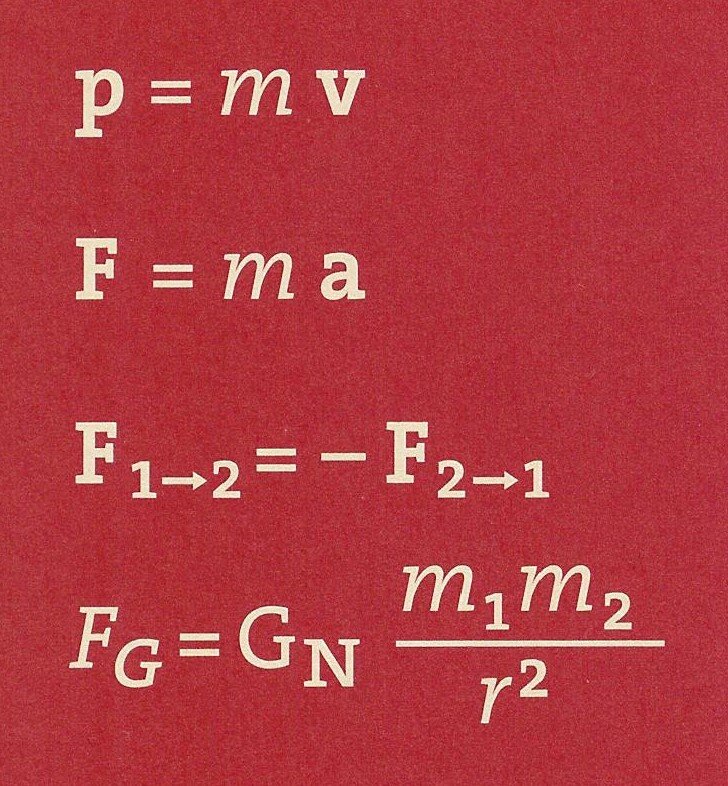
- For every action, there is an equal and opposite reaction.
Forces always come in pairs. When you jump, your feet push down on the ground. In response, the ground pushes up on you with an equal force, launching you into the air. A rocket works the same way. It pushes hot gas out of its engine (action), and the gas pushes the rocket forward (reaction).
Energy and Momentum
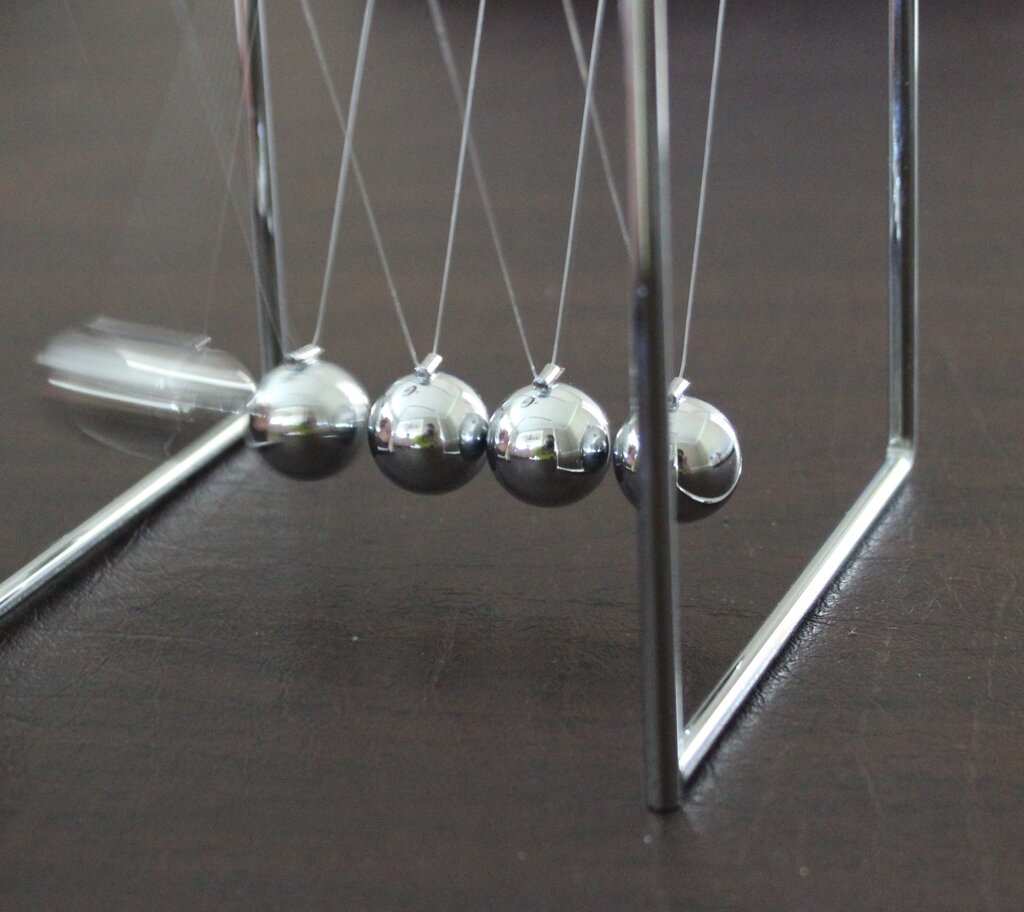
Beyond Newton's laws, two other concepts are crucial: energy and momentum. They are quantities that are "conserved," which is a physicist's way of saying the total amount never changes in an isolated system.
Energy is the ability to do work. It comes in many forms, but in mechanics, we often focus on two: kinetic energy (the energy of motion) and potential energy (stored energy). A roller coaster at the top of a hill has a lot of potential energy. As it rushes down, that potential energy converts into kinetic energy. If you ignore friction, the total mechanical energy—potential plus kinetic—remains constant throughout the ride.
Momentum is often described as "mass in motion." It’s a measure of how hard it is to stop a moving object.
Here, is momentum, is mass, and is velocity. A bowling ball and a baseball can have the same momentum, but the much lighter baseball would need to be moving incredibly fast. Like energy, the total momentum of a system is conserved. In a collision between two billiard balls, the total momentum of both balls right before they hit is the same as the total momentum right after.
Describing Motion
Classical mechanics is often split into two parts: kinematics and dynamics. The difference is simple but important.
Kinematics
noun
The branch of mechanics that describes the motion of objects without considering the forces that cause the motion.
Kinematics is the what. It deals with position, velocity, and acceleration. If you map out the path of a thrown ball and calculate its speed at each point, you're doing kinematics.
Dynamics
noun
The branch of mechanics concerned with the study of forces and their effect on motion.
Dynamics is the why. It uses Newton's laws to explain why the ball follows that specific path. The answer, in this case, is the force of gravity. Kinematics describes the scene, while dynamics explains the plot.
An astronaut in deep space throws a wrench. If no other forces act upon it, what will the wrench do?
If you apply the same net force to two objects, Object A with mass and Object B with mass , how will their accelerations compare?
These core principles—Newton's laws, conservation of energy and momentum, and the distinction between kinematics and dynamics—form the bedrock of classical mechanics. They allow us to predict and understand the motion of nearly everything in our everyday experience.