Advanced Personal Finance and Investing
Modern Portfolio Theory
Beyond Simple Diversification
You already know not to put all your eggs in one basket. That’s diversification 101. But what if you could choose your baskets so carefully that dropping one barely affects the others? That’s the core idea behind Modern Portfolio Theory, or MPT. It’s a mathematical framework for building a portfolio that aims for the highest possible return for the amount of risk you’re willing to take.
Modern Portfolio Theory formalizes the concept of diversification, showcasing that an investor can achieve an optimal portfolio with the maximum expected return for a given level of risk by spreading one’s portfolio across uncorrelated assets.
Developed by economist in the 1950s, MPT shifted the focus from picking individual winning stocks to building a resilient, optimized collection of assets. The theory doesn't care about the risk of any single investment in isolation. Instead, it measures how the risk and return of all your investments work together as a team.
MPT views a portfolio through three main lenses: the expected return of each asset, its volatility (measured by standard deviation or variance), and how it moves in relation to other assets in the portfolio (its ). By combining assets with different characteristics, you can build a portfolio where the whole is less risky than the sum of its parts.
Systematic and Unsystematic Risk
MPT splits investment risk into two categories. The first is unsystematic risk, which is specific to a single company or industry. Think of a factory fire, a product recall, or a damaging lawsuit. This type of risk can be significantly reduced through diversification. If you own 20 different stocks, a disaster at one company won't sink your entire portfolio.
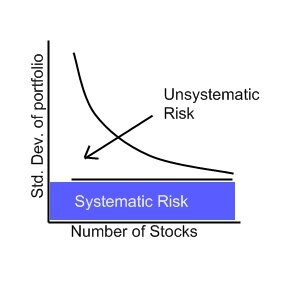
The second type is systematic risk, also known as market risk. This risk affects the entire market and can't be avoided through diversification. Examples include recessions, changes in interest rates, or major geopolitical events. No matter how many different stocks you own, you can't diversify away from a broad market downturn. MPT focuses on managing the trade-off between systematic risk and expected returns.
Finding the Efficient Frontier
Imagine you could plot every possible combination of assets on a graph, with risk (standard deviation) on the x-axis and expected return on the y-axis. You'd get a cloud of dots. Some portfolios would offer high returns but come with high risk. Others would be low-risk but offer meager returns.
The Efficient Frontier is a curve that connects all the portfolios offering the highest expected return for a given level of risk. Any portfolio that lies below this curve is sub-optimal because another portfolio exists that either provides a better return for the same risk or the same return for less risk.
An investor's goal should be to only hold portfolios that lie on the Efficient Frontier.
So, how do you measure if a portfolio is giving you enough bang for your buck? That’s where risk-adjusted returns come in. The most common measure is the Sharpe Ratio, which tells you how much excess return you're getting for each unit of risk you take on.
A higher Sharpe Ratio is better. It indicates a more efficient portfolio that generates more return for the risk involved. By comparing the Sharpe Ratios of different portfolios on the Efficient Frontier, you can find the one that is mathematically optimal.
The Capital Market Line
The Efficient Frontier shows the best portfolios made entirely of risky assets (like stocks and bonds). But what happens when you introduce a risk-free asset, like a Treasury bill, into the mix? This creates a new set of possibilities represented by the Capital Market Line (CML).
The CML represents all possible portfolios you can create by combining the risk-free asset with a single, optimal risky portfolio. This optimal portfolio is the one on the Efficient Frontier that has the highest possible Sharpe Ratio.
By moving along the CML, you can tailor your overall risk level.
- Conservative investors can put more money in the risk-free asset and less in the optimal risky portfolio, landing on the lower-left part of the line.
- Aggressive investors can put all their money in the optimal risky portfolio. They could even borrow money at the risk-free rate to invest more than 100% into that portfolio, moving further up the CML to seek higher returns (and taking on more risk).
This provides a clear, strategic path for asset allocation based on your personal risk tolerance and financial goals.
What is the primary goal of Modern Portfolio Theory (MPT)?
According to MPT, which type of risk can be significantly reduced or eliminated through diversification?
MPT provides a powerful framework for thinking about portfolio construction. It forces you to look beyond individual assets and focus on how they work together to create a portfolio that is optimized for your specific needs.