Advanced Pedagogy for Higher Education
Outcome Based Backwards Design
Begin with the End in Mind
Traditional curriculum planning often starts with content. An instructor gathers textbooks, lists topics, and builds a course week by week. This content-first approach feels logical, but it can lead to a disconnect between what is taught and what students actually need to be able to do after graduation. The result? Graduates who are knowledgeable but not necessarily capable.
Outcome-Based Education (OBE) flips this model. It starts by asking a critical question: What should a graduate be able to do in the real world? This principle of 'designing back' forces a shift in perspective. Instead of focusing on the inputs (the content we deliver), we concentrate on the outputs: the tangible competencies our students will possess.
Backward design is a curriculum development approach that starts with identifying desired learning outcomes and then works backward to design assessments and learning activities that support those outcomes
Think of it like building a house. You wouldn't start by buying bricks and then deciding what kind of house to build. You start with a detailed blueprint—a clear vision of the final structure. In education, that blueprint is the graduate competency profile.
Crafting the Graduate Profile
Before you can define learning outcomes for a single course, you need a high-level vision for the entire programme. What does an ideal graduate look like? This isn't about listing courses they've taken, but about describing the professional they've become. A graduate competency profile is a holistic description of the skills, knowledge, and attitudes a student should have upon graduation.
To build this profile, look beyond the university walls. Analyse job descriptions for target roles, consult with industry advisory boards, and review national or global professional standards. What are the persistent challenges in the field? What emerging technologies are changing the landscape? The goal is to create a profile that is not just academically sound but also aligned with current and future market needs. For example, a profile for a Master of Data Science graduate might include "Can ethically design and deploy machine learning models to solve ambiguous business problems" and "Communicates complex technical findings to non-technical stakeholders persuasively."
From Profile to Outcomes
Once the graduate profile is established, you can derive specific, measurable learning outcomes for each course. A learning outcome is a clear statement of what a student is expected to be able to do. The key is to use strong action verbs.
Avoid vague terms like "understand" or "know about." Instead, use verbs that describe observable actions. This is where frameworks like Bloom's Taxonomy become incredibly useful. Instead of "Students will understand financial models," a better outcome would be "Students will evaluate the risk-return profile of different investment portfolios using the Capital Asset Pricing Model."
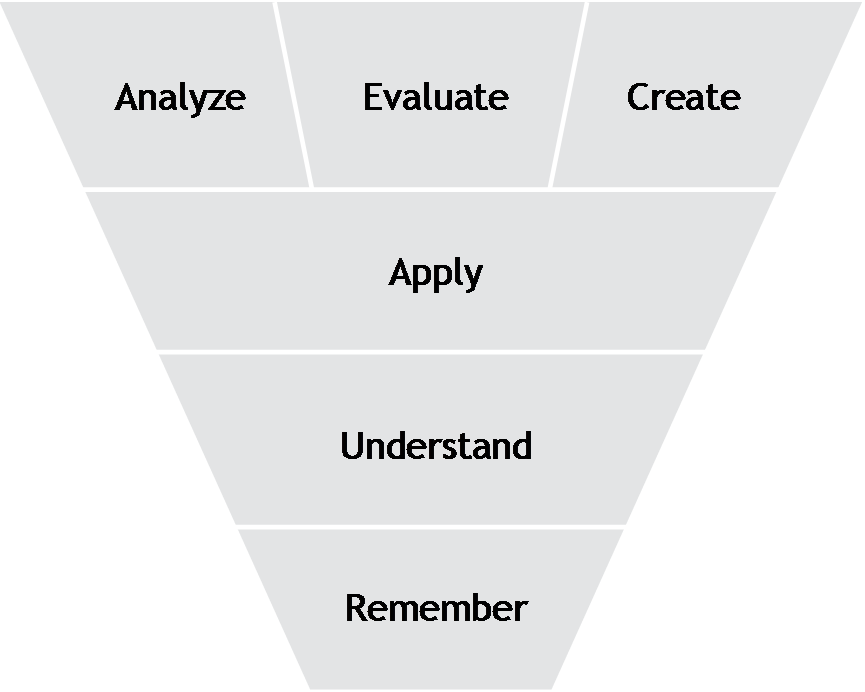
Each outcome should be specific, measurable, achievable, relevant, and time-bound (SMART). Here's a comparison:
| Vague Outcome | Strong, Measurable Outcome |
|---|---|
| Learn about project management. | Develop a comprehensive project plan for a software development lifecycle, including risk assessment and resource allocation. |
| Appreciate Shakespearean literature. | Analyse the use of iambic pentameter in Hamlet to create dramatic tension. |
| Know how to use AI tools. | Design a sequence of prompts for a large language model to generate a market analysis report. |
Mapping the Curriculum
With a clear set of outcomes for the programme and its constituent courses, the final step is curriculum mapping. This is the process of visualising where and how each competency is developed across the entire student journey. A curriculum map ensures that learning is scaffolded—foundational skills are introduced early, then practiced and integrated in more complex contexts later.
For example, a competency like "critical analysis" isn't taught in a single course. It's introduced in a first-year research methods module, applied to case studies in a second-year seminar, and finally mastered in a final-year dissertation. The map reveals gaps (where key skills are neglected) and redundancies (where the same basic concept is taught repeatedly without progression).
Modern tools, including AI-powered platforms, can assist in this process. They can analyse course syllabi to identify thematic connections, suggest logical sequences for skill development, and align the entire curriculum with external standards from accrediting bodies or industry frameworks. This creates a coherent, intentional path that guides students from novice to work-ready professional.
Let's review the core concepts we've covered.
Now, let's test your understanding of these principles.
What is the primary starting point for designing a curriculum using the Outcome-Based Education (OBE) model?
Which of the following learning outcomes is written most effectively according to the principles described?
By starting with the destination in mind, backward design ensures that every piece of the curriculum has a clear purpose. It shifts the focus from delivering content to cultivating competence.