Advanced PCR Techniques and Applications
Advanced PCR Techniques
PCR Beyond Amplification
Standard PCR is a powerful tool for making many copies of a specific DNA sequence. But what if you want to know how much of that sequence you started with? Or what if you need to look for several different sequences in the same sample at once? For these questions, we need more advanced versions of the technique.
Real-Time PCR (qPCR)
Real-time PCR, or qPCR, monitors the amplification of DNA as it's happening. Unlike standard PCR, where you only see the final result after all cycles are complete, qPCR measures the accumulation of product in real-time. This is done by adding fluorescent molecules to the reaction. As more DNA copies are made, the fluorescence in the tube increases. A machine measures this glow after every cycle.
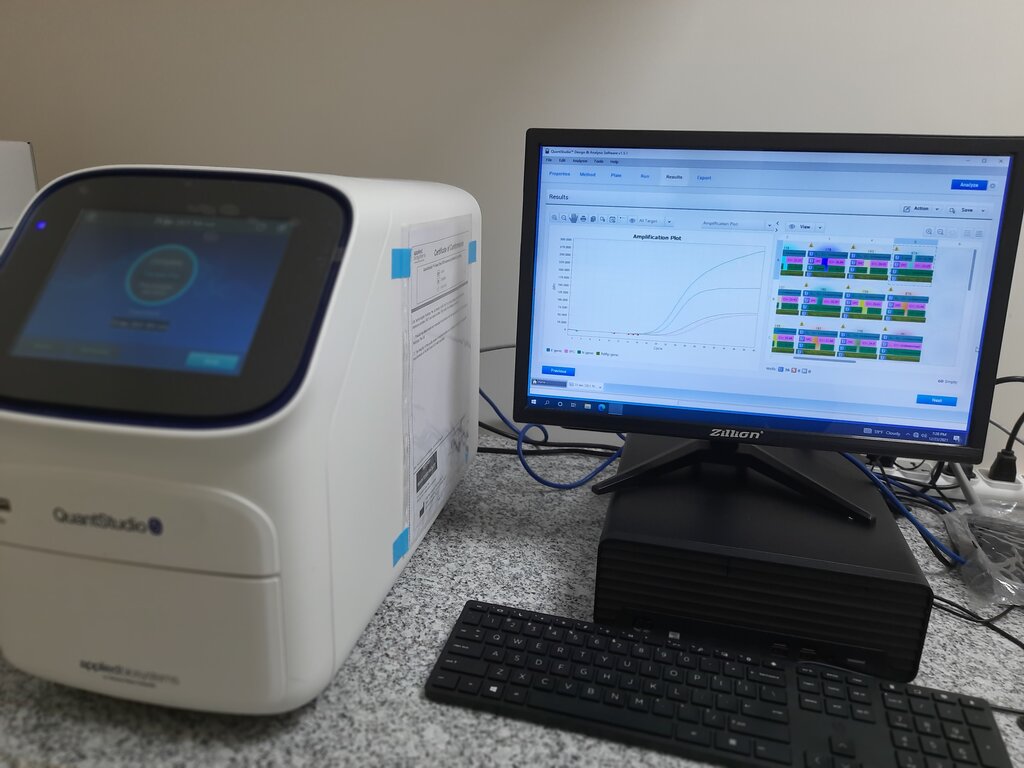
The key metric in qPCR is the Quantification Cycle (Cq), also known as the Threshold Cycle (Ct). This is the cycle number at which the fluorescence from a sample crosses a certain threshold, indicating a significant amount of amplified DNA has been produced.
A sample that starts with a lot of target DNA will reach this threshold in fewer cycles, resulting in a low Cq value. A sample with very little starting material will take more cycles to reach the threshold, giving it a high Cq value. This inverse relationship is the basis for quantification.
This ability to quantify makes qPCR invaluable. It's used to measure gene expression levels—how active certain genes are in a cell. It is also crucial for diagnostics, such as determining the viral load in patients with infections like HIV or COVID-19.
Advantages of Real-Time PCR include the ease of quantification, greater sensitivity, reproducibility and precision, rapid analysis, better control of quality in the process and a lower risk of contamination (62,73).
Digital PCR (dPCR)
Digital PCR takes quantification to an even higher level of precision. Instead of running one reaction in one tube, dPCR partitions the sample into thousands, or even millions, of tiny, separate reactions. Each partition is so small that it either contains one copy of the target DNA molecule or none at all.
After the PCR cycles are complete, the machine simply counts how many of these tiny partitions fluoresce. This provides a direct, absolute count of the number of DNA molecules in the original sample, without needing to reference a standard curve. This makes dPCR extremely sensitive and precise.
It excels at rare event detection, such as finding a single cancerous cell's DNA among thousands of healthy ones (a technique called liquid biopsy), or detecting low levels of a pathogen.
Multiplex PCR
Why run one reaction when you can run many? Multiplex PCR amplifies multiple different DNA targets in a single reaction tube at the same time. This is achieved by adding several distinct pairs of primers to the mix, each pair designed to amplify a specific sequence.
For example, a respiratory panel might use multiplex PCR to simultaneously test a patient's sample for influenza A, influenza B, RSV, and SARS-CoV-2.
This approach is highly efficient, saving time, reagents, and precious sample material. It's a cornerstone of modern diagnostics, used for pathogen identification, genetic disease screening, and forensic analysis.
The main challenge in designing a multiplex assay is making sure all the different primer pairs work well together at the same temperature and don't interfere with each other. This requires careful design and optimization, but the payoff in efficiency is enormous.
Ready to test your knowledge on these advanced techniques?
In a real-time PCR (qPCR) experiment, you analyze two samples. Sample A has a Cq value of 18, and Sample B has a Cq value of 25. What does this result imply?
Which PCR technique is based on partitioning a sample into thousands of individual reactions to achieve absolute quantification without a standard curve?
These advanced PCR methods have transformed molecular biology, moving beyond simple amplification to provide quantitative, precise, and highly efficient analysis of DNA and RNA.