Advanced Pathways in Modern Neuroscience
Circuit Architecture and Integration
The Brain's Recurring Patterns
A single neuron, for all its complexity, is just one voice. The symphony of thought, action, and perception arises from how billions of these neurons are wired together into circuits. These circuits aren't random tangles of wires; they're built from recurring patterns of connection called microcircuit motifs. Think of them as the standard building blocks of neural computation.
The simplest motif is feedforward excitation. One neuron excites another, which in turn excites a third, passing a signal along a chain. This is the most basic way to move information from one part of the brain to another, like a simple relay race. But raw excitation alone is messy and imprecise. To create complex computations, circuits need control and refinement. That's where inhibition comes in.
The complexity of human behavior... depends less on the variety of neurons than on their organization into anatomical circuits with precise functions.
The Art of Inhibition
For every excitatory signal telling a neuron to fire, there are inhibitory signals telling it to quiet down. This constant push and pull creates a delicate excitation-inhibition (E-I) balance, which is critical for stable brain function. Without inhibition, neural activity would spread uncontrollably, like a wildfire, leading to seizures.
Inhibition isn't a monolithic force. It's carried out by a diverse class of cells called interneurons. Two of the most important subtypes in the neocortex are Parvalbumin-expressing (PV) cells and Somatostatin-expressing (SST) cells. They have very different jobs.
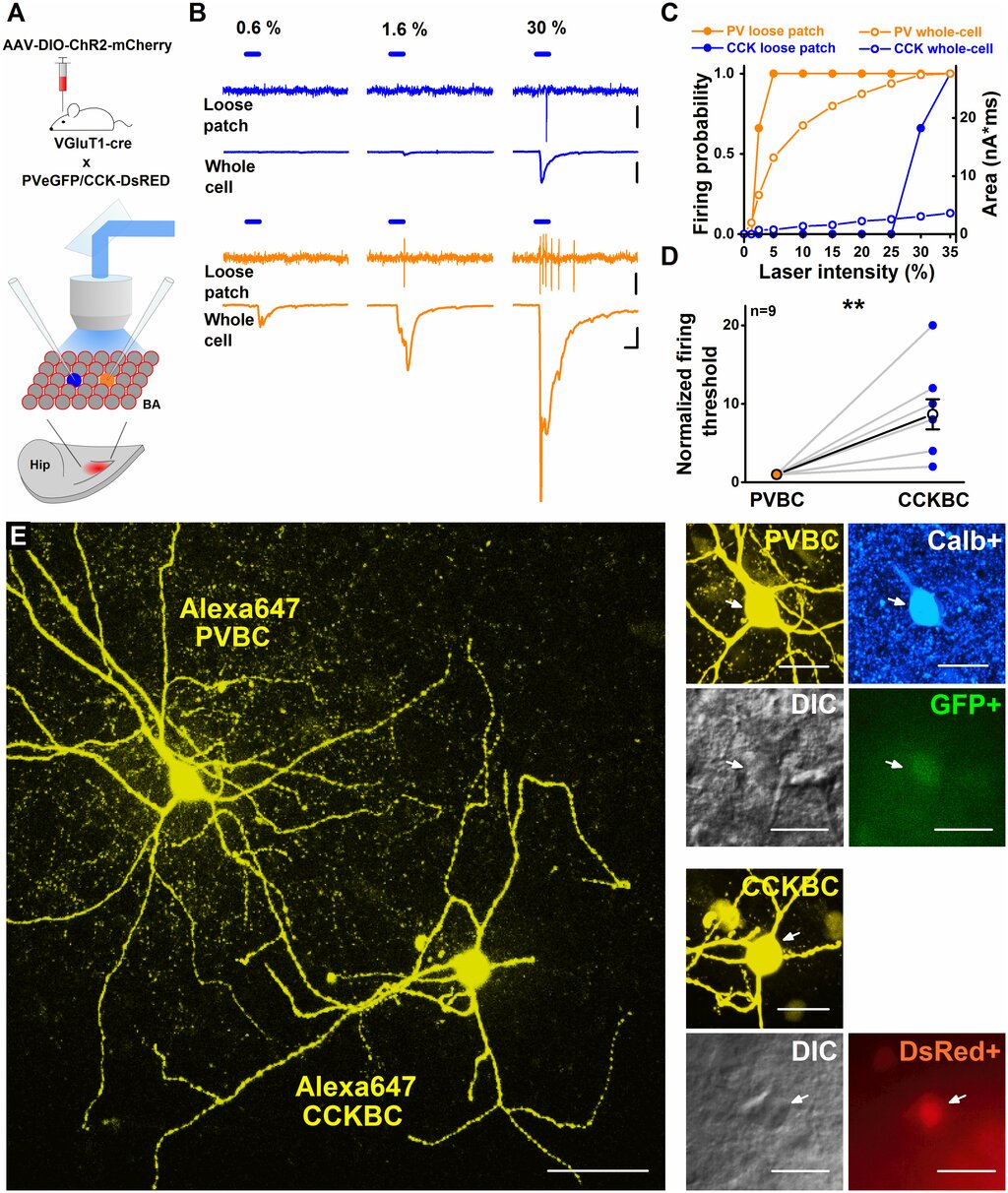
PV interneurons are fast-spiking and typically target the cell body (soma) of excitatory neurons. By clamping down on the soma, where the decision to fire an action potential is made, PV cells exert powerful control over the timing of a neuron's output. They act like a conductor's baton, ensuring signals are sent at precisely the right moment.
SST interneurons, on the other hand, usually target the dendrites—the elaborate branches that receive incoming signals. By inhibiting the dendrites, SST cells can selectively veto or gate specific inputs, controlling which streams of information get integrated. They act more like a mixing board engineer, adjusting the gain on different input channels.
This division of labor allows for incredibly sophisticated control over information flow within a circuit.
Dendrites Do the Math
For a long time, dendrites were seen as simple, passive wires that just funneled synaptic inputs toward the cell body. We now know they are active computational devices in their own right. A single excitatory neuron in the cortex can have thousands of synapses on its dendritic tree. The neuron's job is to integrate this deluge of information and decide whether to fire.
This integration is not a simple matter of adding up all the excitatory and inhibitory inputs. The process is highly non-linear. For example, if two excitatory inputs arrive at the same dendritic branch close together in time, their combined effect can be much greater than the sum of their individual effects. This can trigger a local dendritic spike—a wave of voltage that travels down the dendrite, giving that specific input a powerful voice in the neuron's overall decision.
These non-linearities mean that a single neuron can act like a multi-layered network, performing complex logical operations (like AND or XOR) on its inputs before the signal even reaches the cell body. The location of a synapse on the dendritic tree matters immensely, giving the circuit another layer of computational power.
These local motifs—combinations of excitatory cells, diverse interneurons, and dendritic properties—are then wired together into larger systems using that span entire brain regions like the neocortex and hippocampus. A feedforward inhibitory loop, for instance, occurs when an excitatory neuron stimulates both a downstream target and an inhibitory interneuron. The interneuron then quickly inhibits the target, creating a very brief window of opportunity for the signal to pass. This sharpens the timing of neural communication.
Feedback inhibition works as a thermostat. An excitatory neuron fires and activates an interneuron, which then loops back to inhibit the original neuron, preventing it from firing too much. This is a crucial mechanism for stabilizing circuits and preventing runaway activity. These architectural principles are what allow local circuits to integrate into the massive, coordinated networks that give rise to cognition.
What is the primary role of the excitation-inhibition (E-I) balance in neural circuits?
A neuroscientist observes that a specific input to a neuron is being selectively blocked without affecting other inputs to the same neuron. Which type of interneuron is most likely responsible for this 'gating' effect?
By understanding these fundamental circuit motifs and integration principles, we can begin to see how the brain's intricate structure gives rise to its incredible functional capabilities.