Advanced Open-Source Agentic Systems
Agentic Systems Overview
When AI Starts Doing
For a while, our main interaction with AI has been conversational. We ask a question, and a chatbot or a search engine gives us an answer. It’s a powerful tool for finding information, but it's fundamentally passive. The AI responds; we act.
Agentic systems change this dynamic. Instead of just answering questions, they take action to achieve goals. Think of it like the difference between a librarian and a personal assistant. A librarian can find any book you ask for. A personal assistant can take your request to “plan a birthday party,” and then book a venue, order a cake, and send out invitations on your behalf.
Agentic AI moves from simply providing information to performing tasks and making decisions to achieve a specific outcome.
Agent
noun
In artificial intelligence, an agent is an autonomous entity that can perceive its environment, make decisions, and take actions to achieve specific goals.
An agentic system is more than just a single agent. It's a framework where one or more agents work together. These systems are designed to be goal-oriented. You don't give them a step-by-step list of commands. Instead, you give them a high-level objective, and they figure out the steps themselves.
To achieve a goal, an agent needs a few key things:
- Planning: It must be able to break down a complex goal into smaller, manageable steps.
- Tool Use: It needs access to external tools, like a web browser, a calculator, or a code interpreter, to gather information and perform actions in the real world.
- Memory: It must remember previous actions, their outcomes, and the overall context of its task to learn and adapt.
The LLM Supercharges the Agent
The idea of AI agents isn't new, but building them used to be incredibly difficult. Early systems relied on rigid, hand-coded rules for reasoning and planning. They were brittle and couldn't handle unexpected situations well.
Large Language Models (LLMs) changed everything. LLMs provide a powerful, flexible reasoning engine at the core of the agent. They can understand nuanced human language, formulate complex plans, and decide which tools to use and when. An LLM acts as the agent's “brain,” processing information and directing its actions.
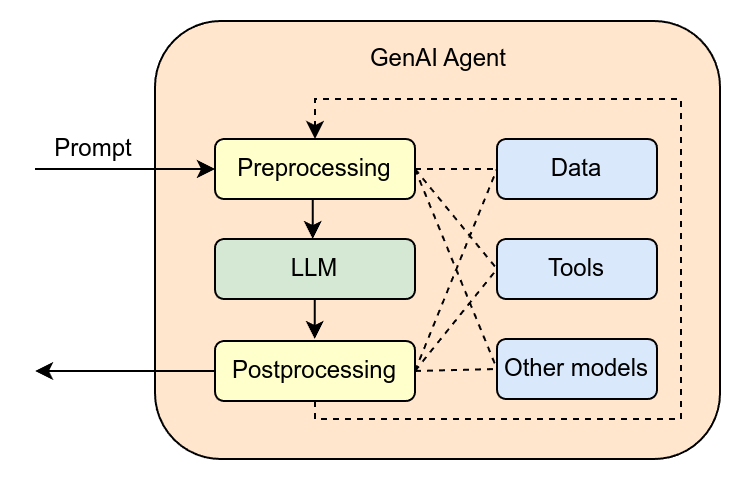
Agentic AI represents a fundamental paradigm shift in artificial intelligence, moving from passive, prompt-driven systems to autonomous, goal-oriented agents that can plan, learn, and execute complex tasks with minimal human intervention.
What Are Agentic Systems Used For?
Because they can handle complex, multi-step tasks, agentic systems are finding use in a wide range of applications. They can automate repetitive digital work, assist with complex research, and even write and debug their own code.
Here are a few examples:
- Personal Assistants: Imagine an AI that can manage your calendar, book travel, and filter your emails based on your priorities, all with minimal input.
- Data Analysis: An agent could be tasked with analyzing a company's sales data. It would form hypotheses, write and run code to query databases, visualize the results, and generate a written report summarizing its findings.
- Software Development: A team of specialized agents could work together to build an application. One agent writes the code, another tests it for bugs, and a third writes the documentation.
These systems represent a major step toward more capable and autonomous AI. They are not just responding to us, but actively working alongside us to get things done.
What is the primary difference between a conversational AI (like a chatbot) and an agentic system?
What role does a Large Language Model (LLM) typically play in a modern agentic system?