Advanced Nucleotide Chemistry and Structural Dynamics
Pentose Ring Stereochemistry
Beyond the Flat Drawing
In textbooks, the five-carbon sugar in a nucleotide is often drawn as a flat pentagon. This is a convenient lie. A flat five-membered ring would force its atoms into uncomfortable positions, creating strain. To relieve this pressure, the ring puckers, bending out of a single plane.
Imagine trying to force five people to stand shoulder-to-shoulder in a very small circle. They would naturally stagger themselves to get more space. The atoms in a pentose ring do the same thing. This bending, or sugar pucker, is not just a minor detail; it's a critical feature that dictates the entire three-dimensional shape of DNA and RNA.
The pucker is typically defined by which atom is most out of the plane formed by the other four. For furanose rings, the displacement is described relative to the plane containing the C1', O4', and C4' atoms. The terms endo and exo tell us the direction of the pucker. An endo pucker means the atom is displaced on the same side of the ring as the base and the C5' atom. An exo pucker means it's on the opposite side. In nucleic acids, endo puckers are the dominant form.
North and South
Two major pucker conformations dominate in DNA and RNA: C3'-endo and C2'-endo. Think of these as two preferred ways the ring can twist. They are often nicknamed 'North' and 'South' respectively, based on their position on a circular map of all possible pucker states called the . The key difference is which carbon atom juts out of the plane.
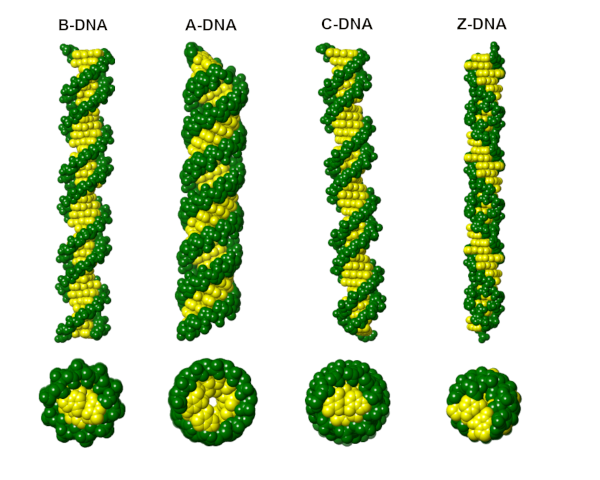
In the C3'-endo (North) conformation, the C3' atom is puckered on the endo side. This brings the phosphate groups attached to the C3' and C5' carbons closer together. This compact arrangement is the standard for A-DNA and for RNA helices.
In the C2'-endo (South) conformation, it's the C2' atom that's displaced. This separates the adjacent phosphate groups, creating a more extended and relaxed backbone. This is the hallmark of the B-DNA double helix, the most common form of DNA in our cells.
The switch between C2'-endo and C3'-endo isn't trivial. It involves breaking and reforming bonds and requires overcoming an energy barrier. However, the energy difference between the two states is small, allowing for dynamic transitions. In deoxyribose, the C2'-endo form is slightly more stable. In ribose, the presence of the 2'-hydroxyl group favors the C3'-endo conformation due to steric and electronic effects.
The Ripple Effect
This seemingly small detail of sugar pucker has massive consequences for the overall structure of a nucleic acid. The distance between adjacent phosphate groups in the backbone is a key parameter controlled by the pucker.
When the sugar is in the C3'-endo form, the phosphates are closer together, at about 5.9 Å. This forces the helix into a shorter, wider shape, characteristic of A-DNA and RNA. It results in a deep, narrow major groove and a very shallow, wide minor groove, making the major groove less accessible to proteins.
Conversely, the increases the distance between phosphates to about 7.0 Å. This extended backbone creates the taller, slimmer helix of B-DNA. It features a wide, accessible major groove, which is crucial for the binding of transcription factors and other DNA-binding proteins. The pucker directly shapes the landscape that proteins must read to access genetic information.
| Feature | C3'-endo ('North') | C2'-endo ('South') |
|---|---|---|
| Found In | A-DNA, RNA | B-DNA |
| Phosphate Distance | ~5.9 Å (Compact) | ~7.0 Å (Extended) |
| Helix Shape | Short and wide | Long and thin |
| Major Groove | Deep and narrow | Wide and accessible |
| Favored Sugar | Ribose | Deoxyribose |
Even the water molecules that surround DNA are affected. The geometry of the grooves, dictated by the sugar pucker, determines how water molecules bind. This 'spine of hydration' in the minor groove of B-DNA is a crucial stabilizing force. Altering the pucker changes this hydration pattern, which in turn can influence protein binding and DNA flexibility.
Why does the pentose sugar in a nucleotide adopt a "puckered" conformation instead of remaining a flat ring?
The common B-form of the DNA double helix is characterized by which sugar pucker conformation?
The conformation of the sugar ring is a fundamental principle of nucleic acid structure. It's a prime example of how small changes in local geometry ripple outwards to define the global architecture and biological function of these vital molecules.