Advanced Neuroglia Functions
Glial Classifications
A World Beyond Neurons
The nervous system is famously composed of neurons, the cells that transmit electrical and chemical signals. But they only make up about half the story. The other half consists of glial cells, or neuroglia. The name comes from the Greek word for "glue," which reflects the early belief that these cells were merely passive support structures holding the neurons in place. We now know their roles are far more active and diverse.
The most fundamental way to classify glial cells is by their location: are they in the central nervous system (CNS), which includes the brain and spinal cord, or the peripheral nervous system (PNS), which consists of all the nerves outside the CNS?
Glia of the Central Nervous System
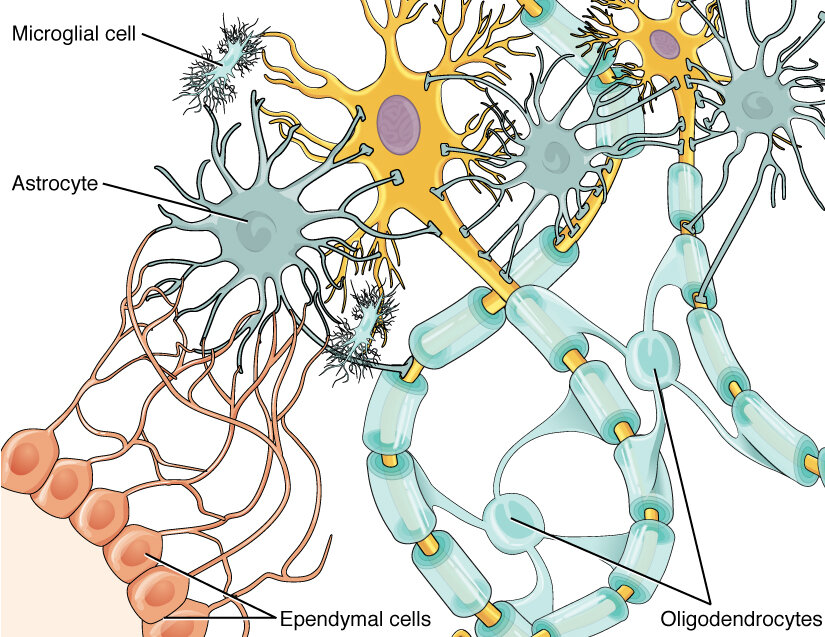
The CNS is a carefully controlled environment, and its glial cells are essential for maintaining this balance. The most abundant are astrocytes. These star-shaped cells have many jobs: they provide structural support, help form the that protects the brain from harmful substances in the blood, and regulate the concentration of ions and neurotransmitters in the space around neurons.
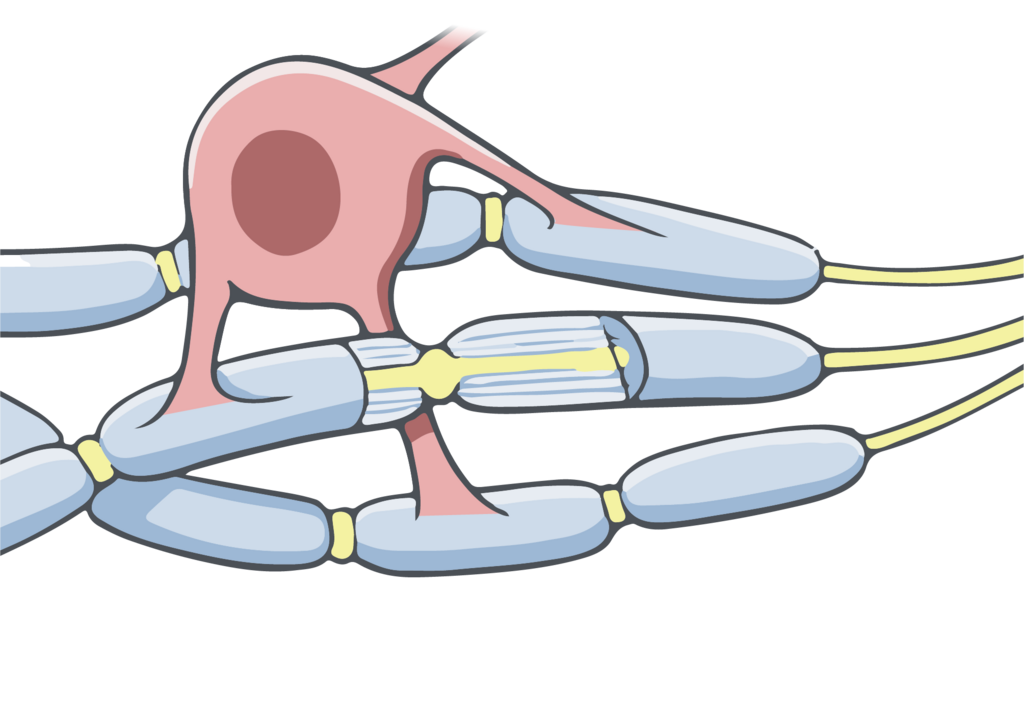
Next are the oligodendrocytes. Their main task is to produce myelin, a fatty substance that they wrap around neuronal axons to create an insulating layer. This myelin sheath allows electrical signals to travel much faster. A single oligodendrocyte can myelinate segments of multiple axons at once, like an octopus wrapping its tentacles around several different ropes.
Lining the fluid-filled cavities of the brain (ventricles) and the spinal cord are the ependymal cells. These cells produce and circulate cerebrospinal fluid (CSF), which cushions the brain and helps transport nutrients and remove waste.
Finally, we have microglia. Unlike the other CNS glia, these are the brain's resident immune cells.
The Glial Divide: Macro vs. Micro
The difference between microglia and other glia is so fundamental that it warrants its own classification. Astrocytes, oligodendrocytes, and ependymal cells are grouped together as macroglia. They, like neurons, originate from the embryonic ectoderm, the same cell layer that forms skin and nerves.
, however, have a completely different origin. They arise from the mesoderm, the layer that gives rise to blood and immune cells. During development, they migrate into the CNS and take up residence. This developmental history explains their unique function: they act as the brain's dedicated immune system, constantly surveying their surroundings for signs of injury or infection. They clear away dead cells and cellular debris, protecting neurons from harm.
Glia of the Periphery
Outside the brain and spinal cord, the PNS has its own set of specialized glial cells. The most well-known are Schwann cells. They perform the same primary function as oligodendrocytes—myelination—but with a key difference. A single Schwann cell myelinates only one segment of one axon. It takes many Schwann cells lined up in a row to insulate a full peripheral nerve fiber.
Another important PNS glial type is the satellite cell. These cells surround the cell bodies of neurons located in PNS . They are analogous to astrocytes, regulating the chemical environment around the neuron cell body, providing nutrients, and offering structural support.
Finally, the —the complex network of nerves that controls the gastrointestinal tract—has its own specialized glia called enteric glial cells. They play critical roles in gut motility, maintaining the intestinal barrier, and mediating communication between the nervous system and the gut's immune system.
| Glial Cell Type | Location | Main Function(s) |
|---|---|---|
| Macroglia (CNS) | ||
| Astrocytes | CNS | Blood-brain barrier, structural support, chemical regulation |
| Oligodendrocytes | CNS | Myelination of multiple axons |
| Ependymal Cells | CNS | Production of cerebrospinal fluid (CSF) |
| Microglia (CNS) | ||
| Microglia | CNS | Immune defense, removal of debris |
| PNS Glia | ||
| Schwann Cells | PNS | Myelination of a single axon segment |
| Satellite Cells | PNS | Support neuron cell bodies in ganglia |
| Enteric Glia | PNS | Support neurons in the gastrointestinal tract |
Understanding these classifications—based on location, function, and developmental origin—is the first step to appreciating the full complexity of the nervous system. These cells are not just passive glue; they are active and essential partners to neurons, ensuring the entire system runs smoothly.
Which glial cells are responsible for producing and circulating cerebrospinal fluid (CSF) in the central nervous system?
A key difference between Schwann cells and oligodendrocytes is that...