Advanced Neural Electrophysiology
Membrane Thermodynamics
The Neuron's Electrical Balance
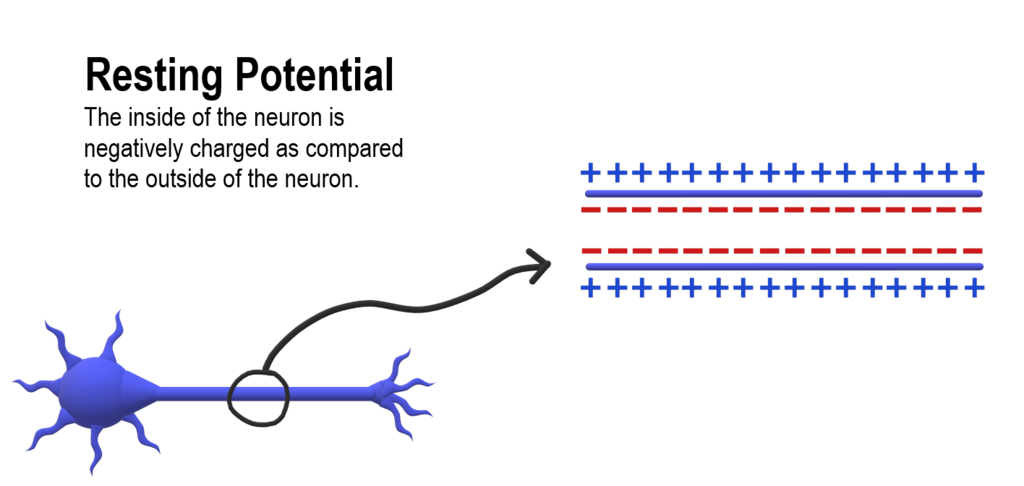
A neuron at rest isn't truly resting. It's maintaining a state of readiness, like a drawn bowstring. This readiness comes from a carefully maintained electrical charge across its membrane, known as the resting membrane potential. Typically, this potential sits around -70 millivolts (mV), meaning the inside of the cell is negatively charged compared to the outside.
This voltage doesn't appear by magic. It's the result of a delicate balancing act between two fundamental forces acting on charged ions, primarily potassium (K+), sodium (Na+), and chloride (Cl-). First, there's the chemical force, or concentration gradient, which pushes ions to move from an area of high concentration to one of low concentration. It’s simple diffusion. Second, there's the electrical force, where like charges repel and opposite charges attract. The combined influence of these two forces is called the electrochemical gradient.
For any single ion, there's a theoretical point where these two forces would perfectly cancel each other out. At this voltage, the electrical pull drawing the ion in would exactly equal the chemical push driving it out. This balance point is called the electrochemical equilibrium.
Calculating the Balance
To find the exact voltage needed to balance an ion's concentration gradient, we use a specific formula: the Nernst equation. It allows us to calculate the equilibrium potential for a single type of ion, assuming the membrane were permeable only to it.
Let's consider potassium (K+). Neurons have a much higher concentration of K+ inside than outside. The concentration gradient powerfully pushes K+ out of the cell. As these positive ions leave, the inside of the cell becomes more negative, creating an electrical force that pulls the K+ ions back in. The Nernst equation tells us that for a typical neuron, these forces balance at around -90 mV. This is the equilibrium potential for K+.
The equilibrium potential for sodium (Na+), which is highly concentrated outside the cell, is the opposite, at about +60 mV. The chemical and electrical forces both push it powerfully into the cell.
Putting It All Together
If the resting potential were determined solely by potassium, it would be -90 mV. But we know it’s -70 mV. What accounts for the difference? The cell membrane isn't a perfect barrier. It's dotted with ion channels, and at rest, it's most permeable to K+ due to always-open potassium channels called leak channels. However, it also has a slight permeability to Na+.
Because the membrane is slightly leaky to sodium, a small but steady stream of positive Na+ ions trickles into the cell, nudging the -90 mV potential slightly upward toward sodium's equilibrium of +60 mV. The final resting potential of -70 mV is a weighted average, reflecting the membrane's high permeability to K+ and low permeability to Na+.
To calculate this real-world resting potential, we need a more comprehensive tool: the Goldman-Hodgkin-Katz (GHK) equation. It expands on the Nernst equation by factoring in the concentrations and relative permeabilities of all key ions simultaneously.
Maintaining the Gradient
Those constant leaks of K+ out and Na+ in would eventually run down the concentration gradients, causing the neuron's battery to die. To prevent this, the cell employs an active-transport protein: the sodium-potassium pump. This molecular machine works tirelessly in the background.
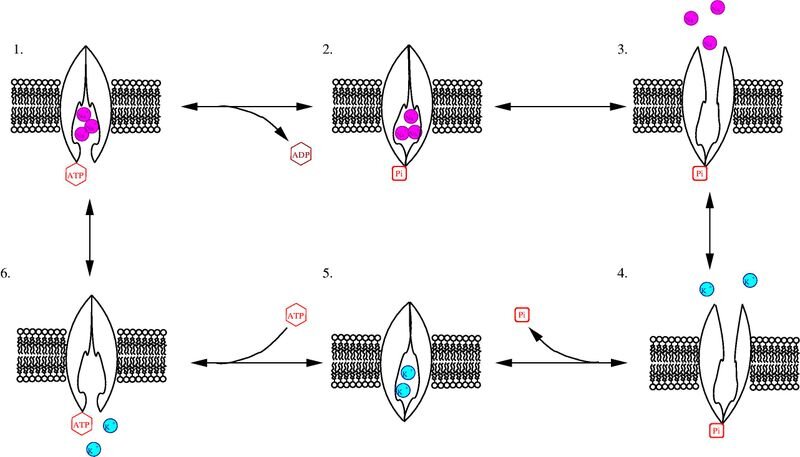
For every cycle, the pump uses one molecule of ATP, the cell's energy currency, to eject three Na+ ions from the cell and import two K+ ions. This process recharges the ionic gradients, pushing the ions back to where they started. The pump acts like a bilge pump on a boat, constantly working to counteract the slow leak and keep the neuron ready to fire. Without it, the resting membrane potential, and therefore all neural signaling, would cease.