Advanced Network Security and Protocol Analysis
TLS 1.3 Handshake Forensics
The 1-RTT Handshake Architecture
The most significant architectural shift in TLS 1.3 is the reduction of the handshake from two round-trips (2-RTT) in TLS 1.2 to just one (1-RTT). This optimization fundamentally changes the flow of cryptographic negotiation and has profound implications for forensic analysis. Where TLS 1.2 required a sequential exchange to negotiate ciphers and then exchange keys, TLS 1.3 is speculative. The client anticipates the server's capabilities and sends its key share in the very first message.
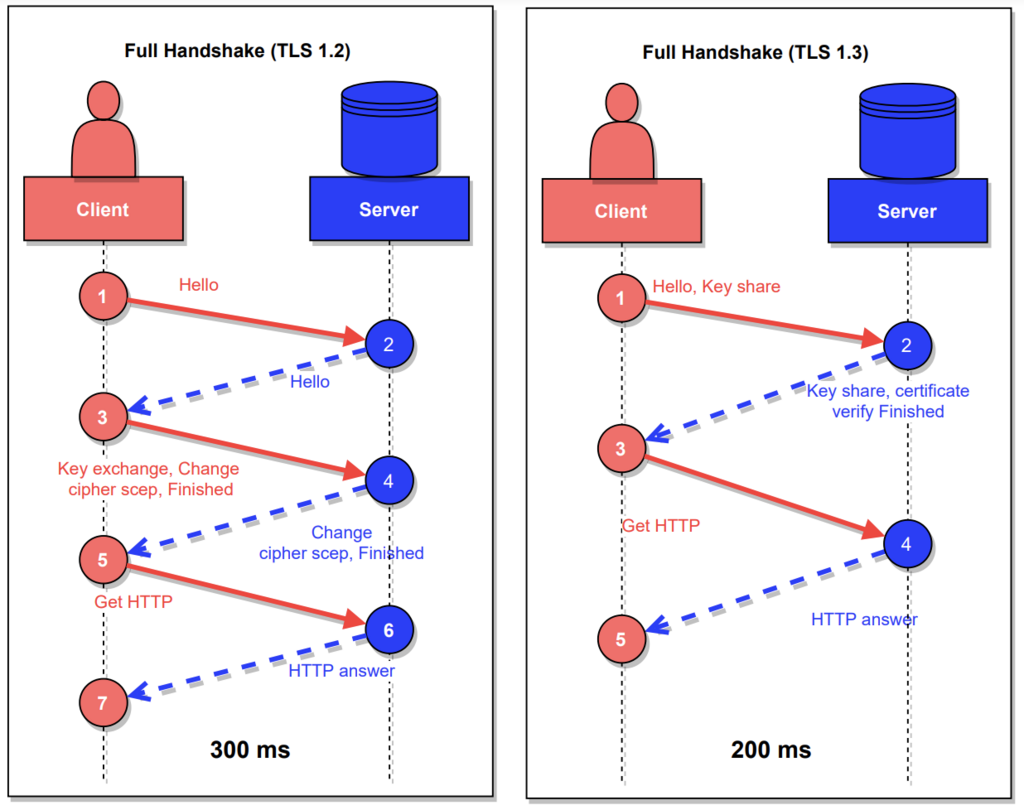
In TLS 1.2, the ClientHello and ServerHello messages establish the cipher suite. This is followed by a second round trip where the server sends its Certificate and ServerKeyExchange, and the client responds with its ClientKeyExchange. All these critical messages, including the server's certificate, are sent in cleartext.
TLS 1.3 collapses this. The ClientHello now includes a key_share extension containing the client's ephemeral Diffie-Hellman public key. The server, upon receiving this, can immediately compute the shared secret. It then sends its ServerHello (also with a key_share), followed immediately by the EncryptedExtensions block, its Certificate, CertificateVerify, and Finished messages. Critically, everything after the ServerHello is encrypted using keys derived from the initial handshake. This move provides substantial handshake confidentiality that was absent in prior versions.
Key Negotiation and PFS
The lynchpin of the 1-RTT handshake is the key_share extension. In the ClientHello, the client doesn't just list supported groups (like specific elliptic curves); it sends one or more public keys for those groups. The server selects one, includes its own public key for that group in the ServerHello's key_share extension, and both parties can then derive the handshake_secret.
This design enforces (PFS) by eliminating static RSA key exchange. In TLS 1.2, a server could use its long-term RSA private key to decrypt sessions if recorded. If that key were compromised, all past traffic would be exposed. By mandating ephemeral Diffie-Hellman (DHE) or Elliptic-Curve Diffie-Hellman (ECDHE), TLS 1.3 ensures each session has a unique, temporary key. The compromise of a server's long-term signing key does not compromise past session keys.
To reduce the risks caused by non-forward secret connections and million-message attacks, RSA encryption was removed from TLS 1.3, leaving ephemeral Diffie-Hellman as the only key exchange mechanism.
From a forensic standpoint, this means you can no longer passively decrypt TLS 1.3 traffic with just a server's private key. Analysis requires access to the ephemeral keys, which are typically only held in memory during the session. This forces investigators to rely on live memory analysis or instrumented endpoints rather than post-facto network captures.
Resumption and Replay Attacks
TLS 1.3 introduces a highly efficient resumption mechanism called Zero Round-Trip Time (0-RTT). After a successful initial handshake, a server can issue a Pre-Shared Key (PSK) ticket to the client. On a subsequent connection, the client can send this PSK in the ClientHello along with early application data (early_data extension). If the server accepts the PSK, it can immediately decrypt the early data without any round trips, dramatically reducing latency.
However, this efficiency comes at a cost: vulnerability to . Since the 0-RTT data is encrypted with a key derived from the PSK, an attacker can capture this data and 'replay' it to the server. The server has no way of knowing if the request is fresh or a duplicate. While the protocol requires servers to reject replayed 0-RTT data, this is not always trivial to implement correctly, especially across a distributed cluster of servers. This is particularly dangerous for non-idempotent requests, like a financial transaction or an API call that changes a database state.
Forensic Challenges: ECH
The final frontier in TLS forensics is the emerging (ECH) extension. Historically, even with encrypted traffic, the ClientHello message leaked critical metadata, most notably the Server Name Indication (SNI) field, which reveals the hostname the client is trying to connect to. This has been a cornerstone of network monitoring and filtering.
ECH encrypts the entire ClientHello message. This makes it nearly impossible for a passive observer to determine the destination server for a given TLS connection, beyond the server's IP address. For forensics, this is a major hurdle. Traffic analysis that relies on SNI data becomes obsolete. Investigators are left with IP addresses (which may host many services), traffic volume, and timing analysis. While ECH enhances privacy, it effectively blinds traditional network security monitoring tools, forcing a shift towards endpoint-based analysis or more sophisticated traffic correlation techniques.
Now, let's test your understanding of these advanced TLS 1.3 concepts.
What is the most significant architectural change in the TLS 1.3 handshake compared to TLS 1.2?
How does TLS 1.3 enforce Perfect Forward Secrecy (PFS) and prevent decryption of past sessions even if a server's long-term key is compromised?