Advanced Network Engineering Mastery
Networking Fundamentals
The Internet's Rulebook
For two computers to talk to each other, they need a shared set of rules. These rules, called protocols, are organized into frameworks known as networking models. Think of them as a detailed instruction manual for sending data, ensuring that a message sent from a computer in Tokyo can be understood by one in Toronto.
The most famous conceptual model is the Open Systems Interconnection (OSI) model. It breaks down the complex process of network communication into seven distinct layers. Each layer has a specific job, and it only talks to the layers directly above and below it. This makes troubleshooting easier—if there's a problem, you can pinpoint which layer is failing.
While the OSI model is great for learning, the real world mostly runs on a simpler, four-layer model: the TCP/IP model. This is the practical framework that powers the internet. It combines some of the OSI layers because, in practice, their functions are closely related.
| TCP/IP Layer | Corresponding OSI Layers |
|---|---|
| Application | Application, Presentation, Session |
| Transport | Transport |
| Internet | Network |
| Network Access | Data Link, Physical |
We'll focus on the concepts from the lower layers of these models first, which handle how data physically gets from one place to another.
Traffic Cops of the Network
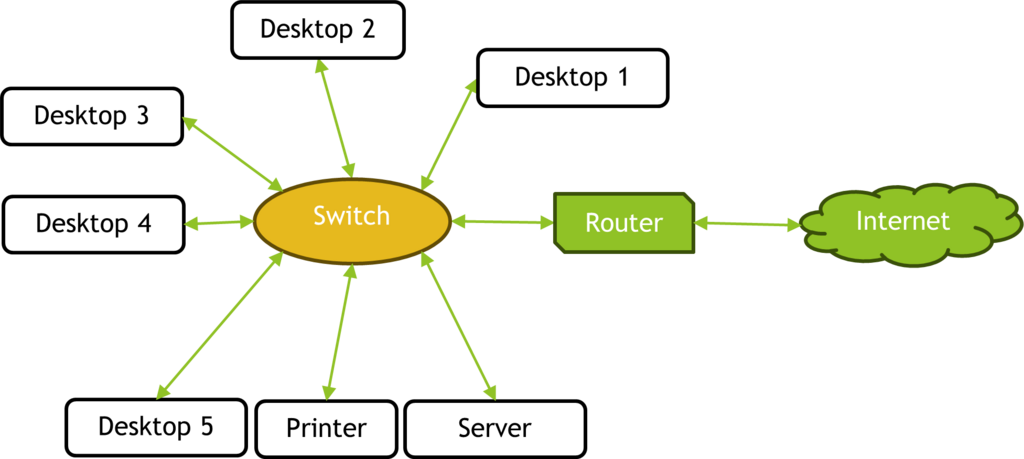
Models are just the theory. To actually move data, we need hardware. Three key devices manage the flow of traffic on a network: switches, routers, and firewalls.
Switch
noun
A device that connects other devices within the same local network, like an office or home. It intelligently forwards data packets only to the specific device they're meant for.
Think of a switch as a mail sorter inside an office building. It knows which mail goes to which desk, so it doesn't just shout out every message to the entire floor. This keeps communication efficient and private within the local network (LAN).
Router
noun
A device that connects different networks together and directs traffic between them. It's the gateway from your local network to the wider internet.
If a switch is the office mail sorter, a router is the local post office. It looks at the destination address on a packet of data and decides the best path to send it on its journey across the internet, hopping from network to network.
Finally, there are firewalls. A firewall acts as a security guard between networks, typically between your trusted local network and the untrusted internet. It inspects incoming and outgoing traffic and decides whether to allow or block it based on a set of security rules. This helps prevent unauthorized access and protect against malicious attacks.
Your Network Address
For devices to send and receive data, they need addresses, just like houses in a city. In networking, devices have two main types of addresses: a MAC address and an IP address.
A MAC address is like a person's fingerprint. It's a unique, permanent identifier burned into the network hardware by the manufacturer. It's used for communication within the same local network.
An IP address is more like your home address. It's a logical address that identifies your device on a network, and it can change. Your home router assigns a private IP address to your laptop, but when you take it to a coffee shop, you get a new one from their network.
There are two versions of IP addresses in use today:
- IPv4: The older standard, which looks like this:
192.168.1.1. It has about 4.3 billion possible addresses. That sounds like a lot, but with the explosion of internet-connected devices, we've nearly run out. - IPv6: The new standard, which looks like this:
2001:0db8:85a3:0000:0000:8a2e:0370:7334. It provides an astronomical number of addresses, ensuring we have enough for the foreseeable future.
Sometimes, a network administrator needs to divide a large block of IP addresses into smaller, more manageable groups. This process is called subnetting. It's like taking the addresses for an entire city district and dividing them up by neighborhood. It improves organization and security.
The Network's Helpers
Beyond addresses and hardware, several essential protocols work behind the scenes to keep things running smoothly.
DHCP (Dynamic Host Configuration Protocol): This is the protocol that automatically assigns IP addresses to devices when they join a network. Without DHCP, you'd have to manually configure the IP address for your phone, laptop, and every other device. It's a huge time-saver.
ARP (Address Resolution Protocol): When a device wants to send data to another device on the same local network, it knows the destination IP address but needs the corresponding MAC address. ARP is the messenger that broadcasts a query like, "Whose IP address is 192.168.1.10?" The device with that IP replies with its MAC address.
ICMP (Internet Control Message Protocol): This protocol is used by network devices to send error messages and operational information. The common
pingcommand, used to test if another device is reachable, uses ICMP. It sends a small message and waits for a reply, like shouting "Marco!" and waiting to hear "Polo!"
Which networking model is a conceptual framework broken into seven layers, often used for teaching, while the other is a more practical, four-layer model that powers the modern internet?
Using the analogy of a postal service, a device that acts like a local post office, deciding the best path to send data to other networks, is called a ________.
These fundamental pieces—the models, the hardware, the addresses, and the helper protocols—form the foundation of all computer networking. Understanding them is the first step to understanding the internet itself.