Advanced Network Engineering Fundamentals
Advanced Routing Protocols
OSPF: Building a Map of the Network
Open Shortest Path First (OSPF) is a link-state routing protocol. Unlike protocols that rely on secondhand information from neighbors, OSPF-enabled routers act like cartographers. Each one explores its immediate surroundings, gathers information about connected links and their status, and then shares this data with all other routers in the same area. This shared information is called a Link-State Advertisement (LSA).
Every router collects these LSAs and builds an identical, complete map of the network's topology. With this map in hand, each router independently runs the Shortest Path First (SPF) algorithm, created by Edsger Dijkstra, to calculate the most efficient, loop-free path to every destination. It's like having a GPS that knows every street and traffic condition in the city, allowing it to calculate the best route from your current location.
To keep this process manageable in large networks, OSPF uses the concept of areas. A network can be segmented into smaller, more manageable areas. Routers within an area share detailed information, but they only share summarized route information with routers in other areas. This hierarchical design significantly reduces the processing load and the size of the routing tables, making OSF highly scalable.
EIGRP: A Hybrid Approach
Enhanced Interior Gateway Routing Protocol (EIGRP) is often called a hybrid protocol because it combines the best features of both distance-vector and link-state protocols. It was originally a proprietary Cisco protocol but is now an open standard.
Instead of building a full map of the network like OSPF, EIGRP routers share their entire routing tables with their direct neighbors. However, they are much smarter than basic distance-vector protocols. The key to EIGRP's efficiency is the Diffusing Update Algorithm (DUAL). DUAL allows a router to pre-calculate backup routes and store them in its topology table.
For each destination, an EIGRP router identifies a primary route, called the successor, and potentially a backup route, called the feasible successor. If the primary path fails, the router can switch to the feasible successor almost instantly, without needing to ask its neighbors for new information. This ability to pre-calculate a loop-free backup path gives EIGRP incredibly fast convergence times.
| Feature | OSPF | EIGRP |
|---|---|---|
| Protocol Type | Link-State | Advanced Distance-Vector (Hybrid) |
| Standard | Open Standard (IETF) | Originally Cisco, now Open Standard |
| Algorithm | SPF (Dijkstra) | DUAL |
| Network View | Full topology map of an area | Relies on neighbor's routing tables |
| Convergence | Fast, but recalculates SPF | Extremely fast due to feasible successors |
BGP: The Protocol of the Internet
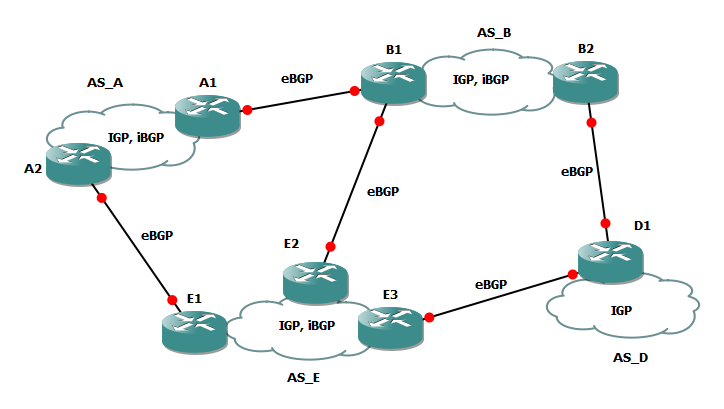
While OSPF and EIGRP are used to route traffic within a single organization's network (an Interior Gateway Protocol, or IGP), the Border Gateway Protocol (BGP) is used to route traffic between different networks. It's the protocol that makes the internet work.
The internet is a massive network of interconnected, independently managed networks called Autonomous Systems (AS). An AS could be an Internet Service Provider (ISP), a large tech company, or a university. BGP is an Exterior Gateway Protocol (EGP) designed to exchange routing information between these huge ASes.
BGP doesn't just find a path, it finds a path that adheres to specific policies. It prioritizes policy over speed, which is crucial for managing traffic between different corporate or national entities.
Unlike IGPs that focus on the shortest or fastest path, BGP uses a complex set of path attributes to make routing decisions. These attributes can include the AS-path (the list of ASes a route has passed through), local preference, and origin type. Network administrators use these attributes to implement routing policies that control how their traffic enters and leaves their network. This policy-based routing is what allows ISPs to manage peering agreements and traffic flow on a global scale.
Making Protocols Work Together
Large networks rarely use a single routing protocol. It's common for a company to use OSPF in one part of its network and EIGRP in another, perhaps due to a merger or different departmental needs. To make these different protocol domains communicate, a process called route redistribution is used.
Route redistribution involves a router that speaks both protocols translating and advertising routes learned from one protocol into the other. This sounds simple, but it's a delicate process. Each protocol has its own metrics and rules, so careful planning is required to ensure routes are translated accurately and to prevent problems like routing loops.
A key concept in redistribution is administrative distance (AD). This is a value from 0 to 255 that a router uses to rate the trustworthiness of a routing source. If a router learns about the same destination from two different protocols, it will prefer the one with the lower AD. When redistributing, administrators must manage these AD values carefully to ensure traffic flows along the intended paths.
Ready to test your knowledge on these advanced protocols?
How does an OSPF router determine the best path to a destination?
What is the primary purpose of the Border Gateway Protocol (BGP)?
Understanding these protocols is key to designing, building, and managing scalable and reliable modern networks. Each has its own strengths and is suited for different scenarios, from internal company networks to the global internet.