Advanced Musical Notation Mastery
Advanced Tonality Systems
Beyond the Basics
You already know how key signatures for simple keys like C, G, and F major work. They organize the diatonic scale, telling you which notes are consistently sharpened or flattened. But what happens when we venture further out? Music doesn't stop at one or two accidentals. The system that organizes all 12 major and minor keys is called the Circle of Fifths (or Fourths, depending on which way you go).
Moving clockwise around the circle, each new key is a perfect fifth higher than the last, adding one sharp. G major (one sharp) is a fifth above C major. D major (two sharps) is a fifth above G, and so on. Moving counter-clockwise, each key is a perfect fourth higher (or a fifth lower), adding one flat. F major (one flat) is a fourth above C major. B-flat major (two flats) is a fourth above F.
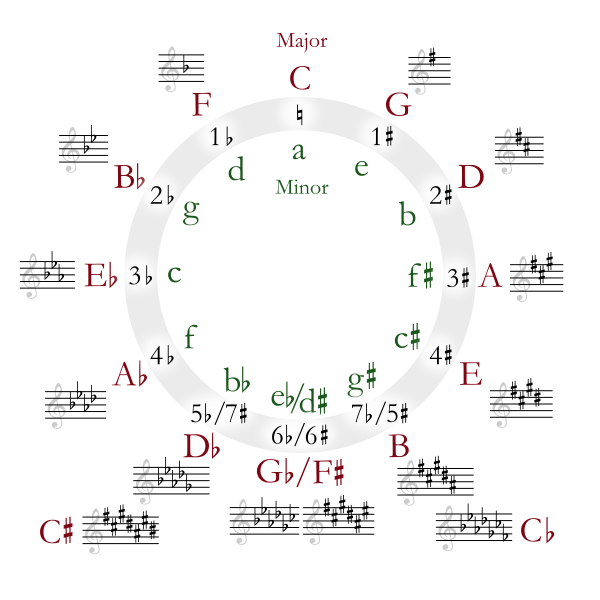
This pattern is beautifully consistent. When we get to keys with five, six, or even seven sharps or flats, the logic remains the same. For sharp keys, the order of sharps is always F-C-G-D-A-E-B. For flat keys, the order is the reverse: B-E-A-D-G-C-F.
There's a great shortcut for identifying sharp keys. The last sharp in the key signature is always the leading tone, the seventh note of the scale. So, if the last sharp is A-sharp (as in B major, with five sharps), the tonic is a half step up: B.
For flat keys, the second-to-last flat in the key signature is the tonic. In A-flat major (four flats: B♭, E♭, A♭, D♭), the second-to-last flat is A-flat. The one exception you have to memorize is F major, which has only one flat.
Enharmonic Keys
As you follow the Circle of Fifths, you'll eventually hit a point where keys have two names. For example, the key with six sharps is F-sharp major. The key with six flats is G-flat major. On a piano, these two scales use the exact same black and white keys. This is called enharmonic equivalence—notes or keys that sound the same but are written differently.
| Key | Number of Accidentals | Notes |
|---|---|---|
| B major | 5 Sharps (F#, C#, G#, D#, A#) | B-C#-D#-E-F#-G#-A# |
| D♭ major | 5 Flats (B♭, E♭, A♭, D♭, G♭) | D♭-E♭-F-G♭-A♭-B♭-C |
| F# major | 6 Sharps (F#, C#, G#, D#, A#, E#) | F#-G#-A#-B-C#-D#-E# |
| G♭ major | 6 Flats (B♭, E♭, A♭, D♭, G♭, C♭) | G♭-A♭-B♭-C♭-D♭-E♭-F |
| C# major | 7 Sharps (F#, C#, G#, D#, A#, E#, B#) | C#-D#-E#-F#-G#-A#-B# |
| C♭ major | 7 Flats (B♭, E♭, A♭, D♭, G♭, C♭, F♭) | C♭-D♭-E♭-F♭-G♭-A♭-B♭ |
So why choose one over the other? The decision often comes down to context and readability. A composer might choose G-flat major over F-sharp major if the music is about to modulate to another flat key, like C-flat major. This avoids a jarring switch from sharps to flats in the notation. The choice can also be influenced by the instruments involved. A harpist, for instance, sets pedals for each scale degree. It might be easier to manage pedal changes in one enharmonic key versus another depending on the surrounding music.
Double Accidentals and Minor Scales
This brings us to double sharps () and double flats (). These accidentals raise or lower a note by two half steps (a whole step). They might seem strange, but they are essential for maintaining the correct interval structure of a scale, especially in minor keys.
Remember the harmonic minor scale? Its defining feature is a raised seventh degree, which creates a dramatic-sounding augmented second between the sixth and seventh notes. Let's see what happens in C-sharp harmonic minor. The natural minor scale is C#-D#-E-F#-G#-A-B.
To create the harmonic minor, we must raise the seventh degree (B) by a half step. The key signature already has seven sharps, including B-sharp. So, raising B-sharp by another half step requires a double sharp: B-double-sharp ().
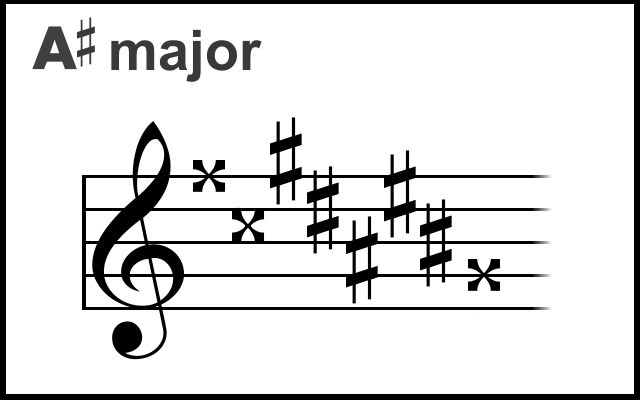
The notes of C-sharp harmonic minor are: C#-D#-E-F#-G#-A-B.
Why not just write C-sharp? Because each letter name can only appear once in a diatonic scale. The seventh degree must be a type of B. Using C-sharp would mean the scale has no seventh degree and two different notes for its tonic. The B preserves the scale's intervalic integrity by ensuring it has a root, second, third, fourth, fifth, sixth, and seventh.
Similarly, in the melodic minor scale, both the sixth and seventh degrees are raised when ascending. In G-sharp melodic minor, the sixth degree (E#) becomes E-double-sharp (), and the seventh degree (F#) becomes F-double-sharp (). This might look complicated on the page, but it's the only way to follow the rules of scale construction and musical grammar.
Time to check your understanding of these advanced concepts.
When moving clockwise around the Circle of Fifths, each subsequent key is a perfect fifth higher and adds one what?
A key signature contains five sharps: F#, C#, G#, D#, and A#. What major key does this indicate?
Mastering these complex keys and the logic of double accidentals unlocks the full expressive range of Western harmony.