Advanced Moltbot Clawbot Applications
Advanced Clawbot Mechanics
Gear Ratios and Torque
Your Clawbot's motors have a fixed amount of power. You can't change that, but you can change how that power is used. This is where gear ratios come in. They allow you to trade speed for torque, or torque for speed.
Torque is a rotational force. In your Clawbot, it's what gives the arm the strength to lift objects and the claw the power to grip them tightly. When you have a small gear driving a larger gear, you increase torque but decrease speed. This is called gearing down.
The gear ratio is calculated by dividing the number of teeth on the driven gear by the number of teeth on the driving gear.
A 36-tooth gear driven by a 12-tooth gear gives a 3:1 ratio. This setup triples the torque from the motor but reduces the output speed to one-third. It’s ideal for the arm's shoulder joint, where lifting strength is more important than speed.
Mechanical advantage is your friend out there!
Conversely, if you need speed, you can gear up. A large gear driving a smaller gear increases speed but reduces torque. This might be useful for a part of your robot that needs to move quickly but doesn't handle a heavy load. For the Clawbot's arm, though, gearing down for more torque is almost always the right choice.
Strengthen the Structure
A powerful arm is useless if the robot's chassis can't support the load. When the Clawbot lifts a heavy object, the center of gravity shifts forward. This can cause the robot to tip over.
You can increase stability by widening the wheelbase or adding counterweights to the back of the chassis. But a more elegant solution is to add structural support through triangulation.
Triangles are inherently strong shapes. Adding diagonal braces to the square sections of your robot’s tower and chassis will significantly reduce flex and torsion. Look for places where the frame bends under load and connect those points with an extra metal beam to form a triangle. This simple change can dramatically improve your robot's lifting capacity and overall stability.
Advanced Claw Design
The standard Clawbot claw is a simple pincer. It works, but it can be improved for better gripping on different objects. One common modification is to use a worm gear in the claw mechanism.
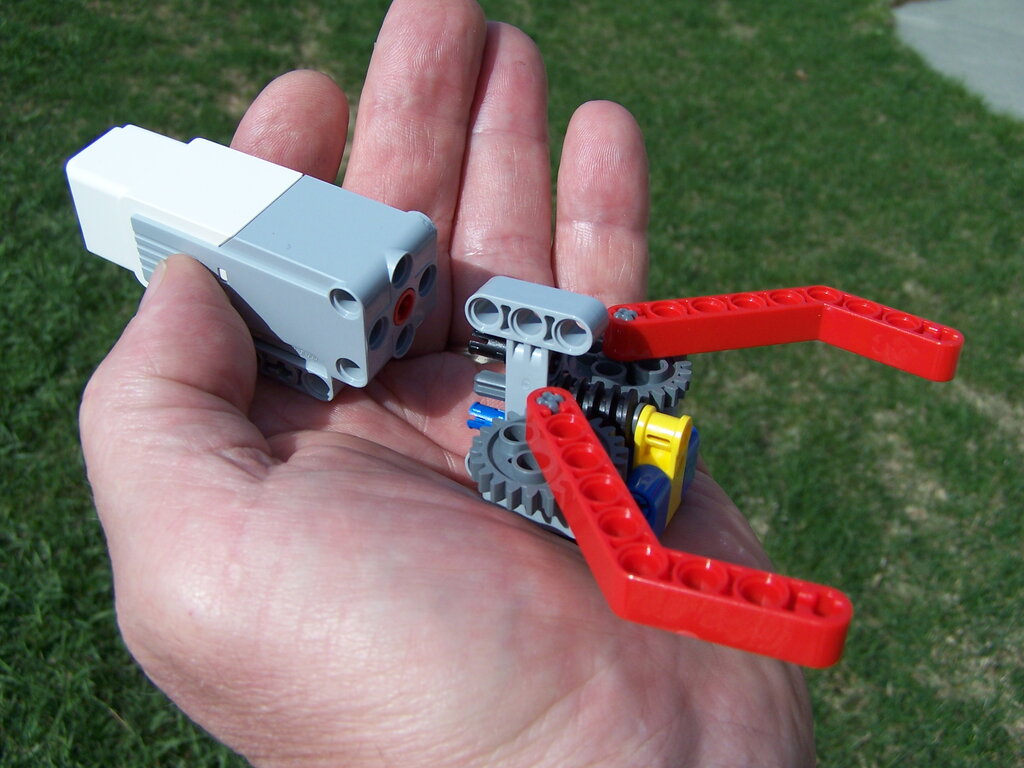
A worm gear meshes with a spur gear. When the motor turns the worm, the spur gear rotates very slowly but with immense torque. A key feature of worm gears is that they are not back-drivable. This means the spur gear cannot turn the worm.
What does this mean for your claw? Once you grip an object, the claw will stay locked in place even if you cut power to the motor. This is great for conserving battery and ensuring a secure hold on an object while the arm is moving.
You can also experiment with the shape of the claw itself. Adding rubber treads can increase friction for a better grip. Changing the pincers from straight pieces to curved ones can help cradle round objects more securely. The best design depends on the task you want your Clawbot to perform.
What is the most effective way to configure gears to increase the lifting torque of a robot's arm?
A motor is attached to a 12-tooth driving gear, which meshes with a 60-tooth driven gear on the robot's arm. What is the gear ratio of this system?
With these modifications, your Clawbot will be stronger, more stable, and more capable.