Advanced ML in AI Software Development
MLOps Fundamentals
From Lab to Live
Getting a machine learning model to make accurate predictions in a controlled environment is one thing. Getting it to work reliably in the real world is a completely different challenge. This is where Machine Learning Operations, or MLOps, comes in. It’s a set of practices that combines machine learning, data engineering, and software development to automate and manage the entire lifecycle of an ML model.
Think of it like this: building a model is like designing a brilliant new engine. MLOps is the entire assembly line, quality control, and maintenance system needed to build the car, get it on the road, and keep it running smoothly for years. It bridges the gap between the experimental phase of data science and the operational demands of a live software product.
MLOps (Machine Learning Operations) is the discipline of managing the end-to-end lifecycle of machine learning models — from development to deployment and ongoing monitoring.
The Model's Journey
A machine learning model goes through a continuous cycle, not a one-time build. This lifecycle ensures the model remains relevant, accurate, and valuable over time.
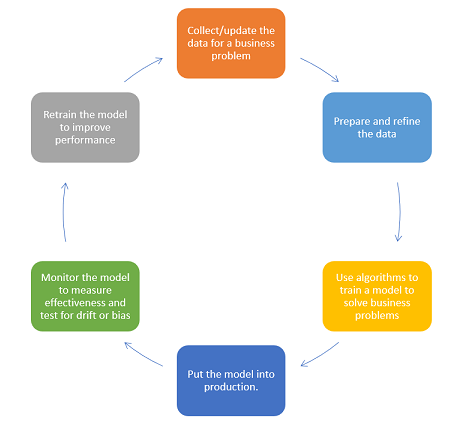
The main stages are:
- Development: This is the starting point. It involves understanding the business problem, collecting and preparing data, and then training and evaluating various models to find the best performer.
- Deployment: Once a model is trained and validated, it needs to be integrated into a real application. This means moving it from a data scientist's notebook to a production environment where it can make predictions on live data.
- Monitoring: The job isn't done after deployment. We must constantly monitor the model's performance. Is it still accurate? Is the incoming data changing in unexpected ways? This step is crucial for detecting problems before they impact users.
- Maintenance: Based on monitoring, a model might need to be retrained with new data to maintain its accuracy. This kicks off the cycle all over again, creating a new version of the model that can then be deployed.
Automating the Flow
The key to managing the ML lifecycle efficiently is automation. Two core concepts from the world of software development are adapted for MLOps: Continuous Integration and Continuous Delivery (CI/CD), and workflow orchestration.
CI/CD
noun
A method to frequently deliver apps to customers by introducing automation into the stages of app development. The main concepts attributed to CI/CD are continuous integration, continuous delivery, and continuous deployment.
In traditional software, CI/CD pipelines automatically test code changes and prepare them for release. In machine learning, this pipeline is more complex because it’s not just about code. An MLOps pipeline also has to handle data and models.
- Continuous Integration (CI) goes beyond testing just the code. It also involves automatically validating new data and testing the model itself.
- Continuous Delivery (CD) isn't just about deploying a single software package. It's about deploying a whole pipeline that can automatically retrain and serve a new model.
To manage these multi-step processes, teams use workflow orchestration tools. These tools act as a conductor for an orchestra, ensuring that each step of the pipeline—data validation, training, testing, deployment—happens in the correct order and that the entire process runs smoothly from start to finish.
Versioning and Reproducibility
If a model in production starts making strange predictions, how do you fix it? The first step is to figure out what changed. Was it the code? The training data? The model parameters? Without a record, troubleshooting is nearly impossible.
This is why versioning is a pillar of MLOps. It’s about keeping a detailed history of everything:
- Code Versioning: Tracking changes to the code, usually with a tool like Git.
- Data Versioning: Tracking the dataset used to train a specific model. Even small changes in data can lead to big changes in model behavior.
- Model Versioning: Saving each trained model and linking it to the exact code and data that produced it.
Proper versioning ensures reproducibility. It gives you the power to go back in time, inspect a previous model, and understand exactly how it was created. This is essential for debugging, compliance, and building trust in your ML systems.
MLOps provides the structure and automation needed to turn promising machine learning experiments into reliable, scalable, and maintainable products.
What is the primary goal of MLOps?
In the ML lifecycle, what is the main purpose of the "Monitoring" stage?