Advanced Medical Terminology Mastery
Advanced Morphological Deconstruction
The Logic of Word Order
You already know that medical terms are built from parts: a prefix, a root, and a suffix. But what happens when you have multiple roots? The order isn't random. It often follows a logical path, either tracing the flow through anatomy or describing a hierarchy of affected structures.
Consider the term esophagogastroduodenoscopy. It's a mouthful, but its structure tells a story. The roots are ordered by anatomical pathway: first the esophagus (esophago-), then the stomach (gastro-), and finally the duodenum (duodeno-), the first part of the small intestine. The suffix -scopy means 'to visually examine.' So, the term describes a visual examination that follows the exact path food takes as it begins digestion.
This principle of order also applies to disease processes. A term like osteoarthropathy breaks down into osteo- (bone), arthro- (joint), and -pathy (disease). The order implies a disease process that affects the bones and then the joints. The combining vowel, usually an 'o', is the glue that makes these multi-root words pronounceable, smoothing the transition from one root to the next.
Suffixes That Define the Action
While roots name the body part, suffixes define the action taken. For surgical procedures, subtle changes in the suffix completely alter the objective. Understanding these differences is crucial for grasping the clinical plan.
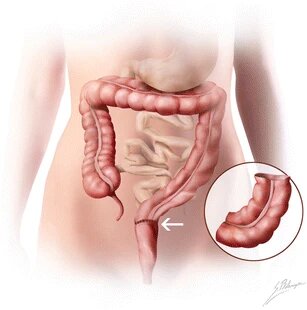
Let's look at three related suffixes using the root colo- (colon):
- Colotomy: The suffix
-tomymeans 'to cut into.' A colotomy is a surgical incision into the colon, perhaps to remove an obstruction, after which the incision is closed. - Colectomy: The suffix
-ectomymeans 'to surgically remove.' A colectomy is the removal of all or part of the colon. - Colostomy: The suffix
-stomymeans 'to create a new opening.' A colostomy creates a permanent or temporary opening from the colon to the outside of the body, called a stoma, to allow waste to exit.
Each suffix points to a vastly different procedure with different outcomes and patient care needs.
Tomy = Incision Ectomy = Removal Stomy = Opening
Other surgical suffixes describe more specific actions. They don't just involve cutting, but puncturing, crushing, or fusing.
-centesisdescribes a surgical puncture to remove fluid.Arthrocentesis, for example, is the procedure of using a needle to drain fluid from a joint (arthro-).-tripsymeans 'to crush.' A common use is inlithotripsy, which uses shock waves to crush stones (litho-), such as kidney stones or gallstones, so they can be passed more easily.-desismeans 'to bind or fuse together.'Arthrodesisis a surgical procedure to permanently fuse a joint, eliminating motion to relieve pain from severe arthritis.
Names vs. Descriptions
Not all medical terms are built from Latin and Greek parts. Some are eponyms—names derived from a person, often the physician who first discovered a condition or invented a procedure. This creates a trade-off between historical tradition and descriptive clarity.
For example, the uterine tube is also known as the Fallopian tube, named after 16th-century anatomist Gabriele Falloppio. While 'Fallopian tube' is common, 'uterine tube' is more descriptive, telling you its anatomical connection. Similarly, Parkinson's disease is named after James Parkinson, but its descriptive name, paralysis agitans, points to its key symptoms: tremor (agitation) and stiffness (paralysis).
Modern medicine is slowly moving away from eponyms toward descriptive terms to improve clarity and avoid confusion. Descriptive names are universally understandable, whereas eponyms require prior knowledge of the person they honor. There's also the issue that some historical figures honored with eponyms are now viewed as controversial.
Most medical terms are built from prefix + root + suffix.
Beyond conditions, many surgical tools carry eponyms. You'll hear about the DeBakey forceps or the Kelly clamp. These names give no clue as to their function; you simply have to learn them. This is in contrast to a descriptively named tool like a 'bone saw.'
Interpreting Complex Terms
With this framework, we can decode highly complex terms by breaking them into their constituent parts and reading their logic. Complex adjectives, for example, often describe a precise location by combining directional terms. A 'posterolateral' incision on the knee isn't just 'back and to the side'; it refers to a specific quadrant.
Let's deconstruct a challenging surgical term: choledocholithotomy.
- Identify the roots: We see
choledocho-andlitho-. - Define the roots:
choledocho-refers to the common bile duct.litho-means stone. - Identify the suffix: The term ends in
-tomy. - Define the suffix:
-tomymeans 'to cut into.'
Putting it all together, a choledocholithotomy is a surgical incision into the common bile duct to remove a stone. The word itself provides a complete summary of the procedure's location, target, and action.
Now, let's test your ability to deconstruct and interpret these advanced terms.
In the term esophagogastroduodenoscopy, what principle dictates the order of the roots esophago-, gastro-, and duodeno-?
A surgeon needs to create a new, long-term opening from the colon to the outside of the body for waste removal. Which procedure would be performed?