Advanced Mechanisms of Photosynthesis
Chloroplast Molecular Architecture
The Energy Conversion Engine
You already know chloroplasts are the site of photosynthesis. But let's move past that general idea and look at the machinery inside. The real work happens within a complex internal system of membranes called thylakoids. Imagine a stack of flattened, hollow discs inside a larger bag. The fluid filling the larger bag is the stroma, while the space inside each disc is the thylakoid lumen.
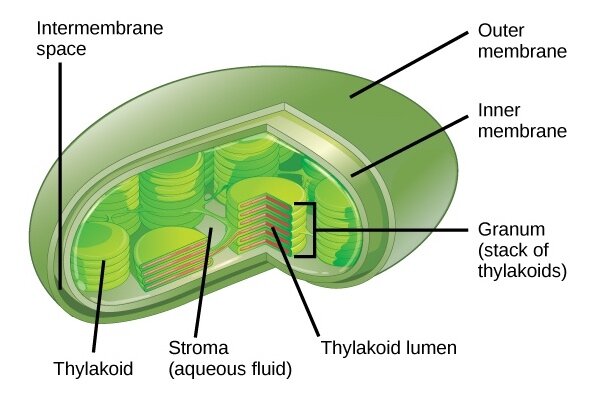
This separation is critical. The thylakoid membrane, a phospholipid bilayer, creates a distinct compartment—the lumen—separate from the stroma. The entire process of converting light to chemical energy hinges on creating a steep electrochemical difference between these two spaces. Think of it like a dam holding back water. By pumping protons (H⁺ ions) from the stroma into the tiny lumen, the cell builds immense potential energy. This proton gradient is the direct power source for making ATP, the cell's energy currency.
The Light-Catching Net
Embedded within the thylakoid membrane are vast networks of pigment molecules, primarily chlorophyll and carotenoids. These aren't just floating around randomly; they are precisely organized into structures called antenna complexes. The job of an antenna complex is to act like a satellite dish, gathering as much light energy as possible and funneling it to a single point.
Each antenna complex contains hundreds of pigment molecules, but only one specialized pair of chlorophyll molecules, the reaction center, can actually convert light energy into chemical energy.
When a photon of light strikes a pigment molecule in the antenna complex, it excites an electron. However, this electron doesn't just leave the molecule. Instead, the energy of that excitement is passed to an adjacent pigment molecule through a process called resonance energy transfer, a bit like one tuning fork causing a nearby one to vibrate. This chain reaction continues, with the energy hopping from molecule to molecule with extreme speed and efficiency, until it reaches the reaction center.
The Point of No Return
Once the energy arrives at the reaction center, the real chemistry begins. This is where light energy is finally converted into chemical energy. The thylakoid membrane contains two distinct types of these light-converting engines, called photosystems.
Photosystem II (PSII) comes first. Its reaction center chlorophyll pair is called because it's best at absorbing light with a wavelength of 680 nanometers. When P680 receives the energy from the antenna complex, it gets so excited that it gives up an electron entirely. This electron is handed off to an electron transport chain, starting the process of building that proton gradient we talked about earlier. To replace its lost electron, PSII does something incredible: it splits a water molecule, releasing oxygen as a byproduct.
Photosystem I (PSI) is the second engine. Its reaction center is called P700, tuned to absorb light at a 700-nanometer wavelength. It also gets excited by light energy from its own antenna complex and gives up an electron. This high-energy electron is used to create NADPH, another energy-carrying molecule. P700 gets its replacement electron from the chain that started back at PSII.
In the light dependent reaction, special protein complexes containing pigments called photosystems that are located on the thylakoid membranes of chloroplast absorbs light to break down water into excited electrons, H+ ions, and oxygen.
This elegant architecture, from the separation of stroma and lumen to the precise funneling of energy in the antenna complex, ensures that every captured photon is put to work efficiently. The specific arrangement of these molecules is not an accident; it's a highly optimized system for turning sunlight into life.
What is the primary function of creating a steep proton (H⁺) gradient across the thylakoid membrane?
How is energy transferred from one pigment molecule to another within an antenna complex before it reaches the reaction center?