Advanced Mechanisms of Human Reproduction
Gametogenesis and Hormonal Control
The Making of Gametes
Gametogenesis is the process of creating gametes—sperm and eggs. While both processes rely on meiosis to halve the chromosome number, they follow remarkably different timelines and are governed by a complex interplay of hormones.
Spermatogenesis: Continuous Production
In males, gamete production, or spermatogenesis, begins at puberty and continues throughout life. The process occurs within the seminiferous tubules of the testes. It starts with diploid stem cells called spermatogonia, which undergo mitosis to create a continuous supply of precursor cells. One daughter cell remains a stem cell, while the other becomes a primary spermatocyte, destined to become a sperm.
The primary spermatocyte undergoes Meiosis I to produce two haploid secondary spermatocytes. These then quickly enter Meiosis II, each dividing to form two spermatids. The result is four haploid spermatids from one initial primary spermatocyte. These spermatids are not yet functional sperm; they must undergo a final maturation stage called spermiogenesis, where they develop a tail and an acrosome cap. This entire cycle is supported by two critical cell types: and Leydig cells.
Leydig cells, located in the tissue between the seminiferous tubules, produce testosterone. Sertoli cells nourish and guide the developing sperm cells through each stage.
Oogenesis: A Journey with Pauses
Oogenesis, the production of eggs (ova), is starkly different. It begins before a female is even born. During foetal development, diploid stem cells called oogonia divide by mitosis. They then develop into primary oocytes, which immediately enter Meiosis I but are frozen in place. This state of suspended animation is known as and lasts until puberty.
At birth, a female has her lifetime supply of primary oocytes, each nestled within a small bundle of cells called a primordial follicle. After puberty, each menstrual cycle prompts a few of these follicles to begin developing in a process called folliculogenesis.
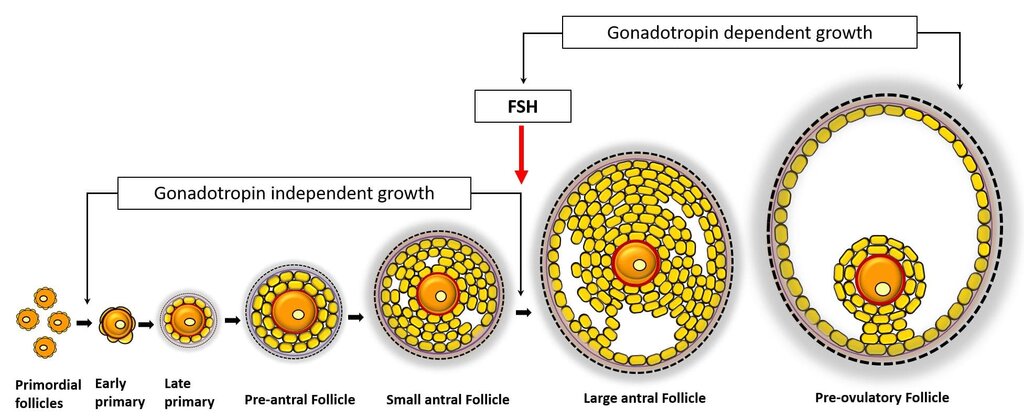
Usually, one dominant follicle matures each cycle. In response to a hormonal surge, its primary oocyte completes Meiosis I. This division is unequal: it produces one large secondary oocyte (which contains most of the cytoplasm) and a tiny, non-viable polar body. The secondary oocyte then begins Meiosis II but arrests again, this time at Metaphase II. It is this arrested secondary oocyte that is ovulated. Meiosis II will only complete if the egg is fertilised by a sperm.
The Hormonal Command Centre
Both spermatogenesis and oogenesis are driven by the —a sophisticated feedback loop involving the brain and the gonads.
Control of gonadal hormone release relies on activation of the hypothalamic-pituitary-gonadal (HPG) axis.
It all starts in the hypothalamus, which secretes Gonadotropin-releasing hormone (GnRH). GnRH travels to the anterior pituitary gland, stimulating it to release two key hormones: Follicle-stimulating hormone (FSH) and Luteinizing hormone (LH). These hormones then act on the gonads, but their specific effects differ between males and females.
In males, LH stimulates Leydig cells to produce testosterone. Testosterone is the primary driver of spermatogenesis and also creates a negative feedback loop, telling the hypothalamus and pituitary to slow down GnRH, FSH, and LH production. FSH acts on Sertoli cells, stimulating them to nourish developing sperm and to release inhibin, a hormone that specifically inhibits FSH release.
In females, the process is cyclical. FSH stimulates the growth of ovarian follicles (folliculogenesis), and as the follicles grow, their granulosa cells produce estrogen. For most of the cycle, estrogen and inhibin exert negative feedback. However, once estrogen levels reach a high peak, the feedback switches to positive, causing a massive surge of LH. This LH surge is the trigger for ovulation.
Let's check your understanding of these complex processes.
What is a primary difference between the products of meiosis in spermatogenesis and oogenesis?
In the male hormonal system, Luteinizing Hormone (LH) directly stimulates the _______ to produce _______.
Understanding these hormonal feedback loops and cellular pathways is key to comprehending fertility, the menstrual cycle, and the basis of reproductive health.