Advanced Mechanics of the Tongue and Jaw
Neuromuscular Control Systems
The Unsung Duet
Chewing, speaking, swallowing—these actions feel effortless, but they represent a masterful feat of neural coordination. The tongue, a muscular hydrostat capable of incredibly complex movements, must operate in perfect sync with the powerful, bone-crushing force of the jaw. This intricate dance is directed by a sophisticated partnership between two cranial nerves: the hypoglossal nerve (CN XII), which controls the tongue, and the mandibular branch of the trigeminal nerve (CN V3), which manages the mighty muscles of mastication .
Their integration is so seamless that we rarely bite our own tongue, even while vigorously chewing tough food. This isn't luck; it's the result of a precise control system that relies on pre-programmed rhythms and constant sensory feedback, operating far below the level of conscious thought.
The core of this system doesn't just prevent injury; it enables the precise manipulation of food, forming it into a neat package, or bolus, ready for swallowing.
The Brainstem's Rhythm Section
Instead of the cerebral cortex micromanaging every single chewing motion, it delegates the task. When you decide to chew, your brain sends a signal down to the brainstem, essentially telling it to “activate the chewing program.” This program is run by a network of neurons called a (CPG).
Think of a CPG as the rhythm section in a band. It produces the basic, cyclical beat of jaw opening and closing without needing continuous commands from the lead singer (the cortex). This generator, located primarily in the pons and medulla, creates a stable, rhythmic output that drives the motor neurons of the trigeminal nerve. The hypoglossal nucleus, which controls the tongue, is tightly coupled with this CPG. As the jaw-opening muscles are activated, the CPG simultaneously signals the tongue's protrusor muscles (like the genioglossus) to move the tongue forward and out of the way. As the jaw closes, the tongue retracts. This built-in synchronization is the first line of defense against biting your tongue.
Sensing and Adapting
A pre-programmed rhythm isn't enough. Chewing involves food of varying shapes, sizes, and textures. The system needs real-time data to adapt. This is where proprioception—the sense of self-movement and body position—comes in.
Two key sources provide this critical feedback:
- Muscle Spindles: Located within the masseter and other jaw muscles, these sensory receptors report on the stretch and speed of muscle contraction. They tell the brainstem how open the jaw is and how fast it's moving.
- Periodontal Ligaments: These are tiny tissues that anchor your teeth into your jawbone. They are exquisitely sensitive to pressure. When you bite down, they send signals through the trigeminal nerve that provide precise information about the location and hardness of the food.
This sensory data is fed back to the CPG in a continuous loop. If you suddenly bite into something hard, like a nut, the feedback from the periodontal ligaments can instantly modify the CPG's output, adjusting the force and rhythm of chewing to deal with the unexpected resistance.
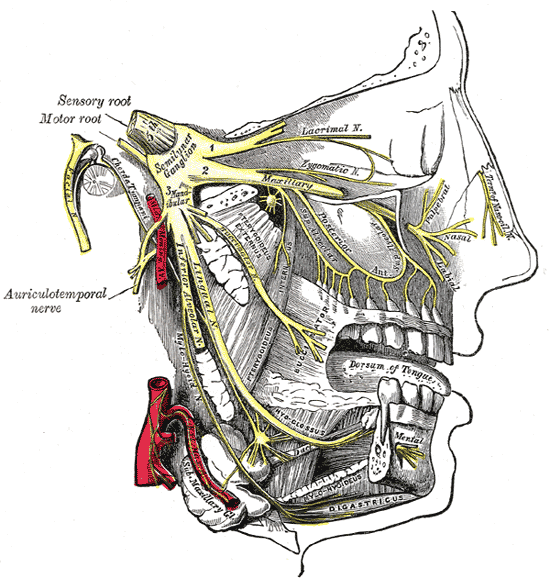
This constant stream of information allows the chewing rhythm to adapt on the fly, ensuring efficiency and safety. The tongue, guided by its own sensory feedback, uses this information to constantly reposition the food bolus onto the chewing surfaces of the teeth, acting more like a skilled chef than a simple muscle.
Reflexive Protection
Even with CPGs and sensory feedback, mistakes can happen. The final layer of protection is a powerful reflexive loop. The jaw-closing muscles are directly linked to the muscles that stick the tongue out.
When the motor neurons for the masseter (jaw closer) fire strongly, they trigger an inhibitory signal to the motor neurons in the hypoglossal nucleus that control the genioglossus (the main tongue protrudor). This is called reciprocal inhibition. In simple terms, the command to “bite down hard” is automatically coupled with a command to “keep the tongue out of the way.”
This reflex acts as a fail-safe. It ensures that during the most powerful phase of the chewing cycle, when the risk of injury is highest, the tongue is reflexively prevented from moving into the danger zone. It’s this elegant, multi-layered system of rhythmic generation, sensory adaptation, and reflexive protection that allows the tongue and jaw to perform their complex duet, day in and day out, without a second thought.
Which two cranial nerves are primarily responsible for the coordinated movements of the tongue and jaw during chewing?
What is the primary function of a Central Pattern Generator (CPG) in the brainstem related to chewing?