Advanced Mechanics of the AI Productivity Paradox
Measurement Redefinition Frameworks
The Modern Productivity Paradox
The proliferation of generative AI presents a sharp contradiction. We see transformative capabilities emerging daily, yet macroeconomic indicators like Total Factor Productivity (TFP) show sluggish growth. This isn't a new phenomenon—it's a modern iteration of the Solow Paradox—but generative AI has intensified the discrepancy. The core of the problem lies in measurement. TFP, calculated as the residual of output growth after accounting for the growth in labor and capital inputs, is meant to capture technological progress. However, its framework is ill-equipped for an economy increasingly driven by intangible value.
Generative AI's economic contributions are often non-pecuniary. It generates enormous consumer surplus through 'free' or low-cost services, from code generation to content creation, which traditional GDP accounting largely ignores. When a developer uses an AI assistant to write boilerplate code, the value created—faster development, fewer bugs, more complex features—isn't directly captured in a transaction. This creates a vast and growing chasm between perceived value creation at the micro-level and measured economic output at the macro-level. The very nature of digital goods, with their near-zero marginal cost of reproduction, fundamentally challenges accounting systems built for a world of rivalrous physical goods.
Intangible Capital and Mismeasurement
Standard national accounts were designed for an industrial economy, where capital meant factories and machines. Today, value is increasingly derived from digital and intangible assets: algorithms, data, and proprietary software. Investment in AI R&D, for instance, creates a durable asset that yields future productivity gains, yet it's often treated as an intermediate expense rather than a capital investment. This failure to properly capitalize intangible assets systematically understates the economy's true capital stock and, consequently, its productive capacity.
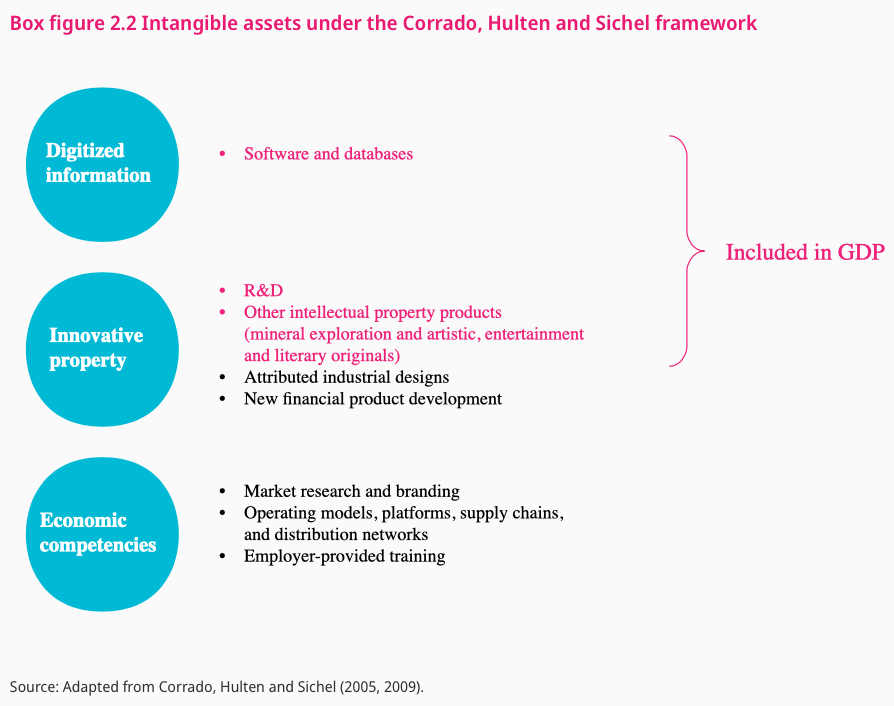
Correcting this requires a shift towards intangible capital accounting. This involves treating AI development, data acquisition, and model training as capital expenditures that depreciate over time, much like physical machinery. By capitalizing these investments, we get a more accurate picture of the productive assets being accumulated. The output of these assets—better decision-making, hyper-personalized services, automated workflows—also requires new measurement techniques. The benefits are often realized as quality improvements rather than quantity increases, a distinction that traditional output measures struggle to capture.
The J-Curve and Restructuring Lags
Even with perfect measurement, a significant lag often exists between technological investment and productivity gains. 's J-curve hypothesis posits that the deployment of general-purpose technologies like AI necessitates a costly and time-consuming period of co-invention and restructuring. Firms don't just plug in an AI and see immediate results; they must redesign business processes, retrain employees, and develop new organizational models to leverage the technology effectively.
This "Restructuring Lag" can cause a temporary dip in measured productivity. Resources are diverted to reorganization and experimentation, with the payoff deferred. The initial phase of AI adoption is characterized by investment and disruption, forming the initial downward slope of the 'J'. Only after these complementary innovations are in place does productivity begin to accelerate, creating the steep upward curve. This lag means that the productivity benefits of today's massive AI investments may not fully appear in macroeconomic data for several years.
Advanced Valuation Methodologies
To close the gap between AI's impact and its measurement, economists are developing more sophisticated frameworks. One promising area is the development of for AI services. Instead of just tracking the price of a service, these indices account for improvements in performance, accuracy, and scope. A subscription to an AI API might cost the same year over year, but the underlying model's capabilities could have improved exponentially. A quality-adjusted index would reflect this as a price decrease, providing a more accurate measure of real output.
Another powerful tool is the use of hedonic pricing models for valuing high-dimensional task automation. This approach deconstructs a complex automated task into its constituent characteristics—speed, accuracy, complexity, reliability—and assigns an implicit price to each. By modeling how the combination of these attributes contributes to the overall value of the automated service, we can estimate the economic worth of AI systems that perform tasks previously done by humans. This allows for a more granular valuation than simply looking at the cost of the software, capturing the immense producer surplus generated by automating complex workflows.
Measure what matters: If developers take longer with AI but believe they’re faster, your productivity metrics aren’t capturing reality.
These advanced methods are not just academic exercises. They are essential for creating accurate economic indicators that reflect the realities of an AI-driven economy, ensuring that policy and investment decisions are based on a true understanding of technological progress.
What is the central contradiction, often referred to as a modern Solow Paradox, presented by the proliferation of generative AI?
According to the text, why does traditional Total Factor Productivity (TFP) struggle to measure the impact of generative AI?