Advanced Mechanics of Martial Arts
Kinetic Chain Mechanics
The Body as a Whip
Powerful striking isn't about arm strength. A devastating punch or kick is the final, sharp crack of a kinetic whip that starts at the floor. Every powerful movement begins with your feet pushing against the ground. This generates a 'ground reaction force' — Newton's third law in action. For every action, there is an equal and opposite reaction. The harder you push off the ground, the more force the ground pushes back into your body.
This initial force is the first link in the kinetic chain. It travels up through your ankle, knee, and into your hips. Think of it as loading a spring. Without a solid connection to the ground, you're just flailing your limbs. A stable base is the platform from which all power is launched.
The Engine of Rotation
The force from the ground travels to the body's engine: the hips and torso. Rotating your hips and core transfers the linear momentum from your legs into rotational torque. This is where the real power multiplication happens. The muscles of your posterior chain — the glutes, hamstrings, and lower back — contract explosively to drive this rotation. A stiff core acts as a conduit, ensuring this powerful twist is passed efficiently up through the spine to the shoulders.
Imagine trying to throw a punch using only your arm. It would have very little power. Now, imagine a baseball pitcher's wind-up. The power comes from their entire body rotating, starting from their push-off from the pitcher's mound. The arm is just the final delivery system. The same principle applies in striking.
Mass, Velocity, and Style
The classic physics equation for force is simple, but it perfectly explains the different striking philosophies in martial arts.
Styles like Shotokan Karate often emphasise speed and acceleration. They use a 'snap' mechanic, where the limb shoots out and retracts almost instantly. This maximises the 'a' in the equation, generating a sharp, penetrating force designed to strike vulnerable points. The focus is on reaching maximum velocity at the point of impact.
In contrast, Muay Thai focuses on the 'm' side of the equation. A Thai roundhouse kick is a 'heavy' strike that uses the entire body's mass. Instead of snapping back, the fighter drives through the target, committing their body weight and momentum to the blow. This follow-through ensures maximum mass is transferred, creating devastating impact, even if the peak velocity is slightly lower than a karate kick.
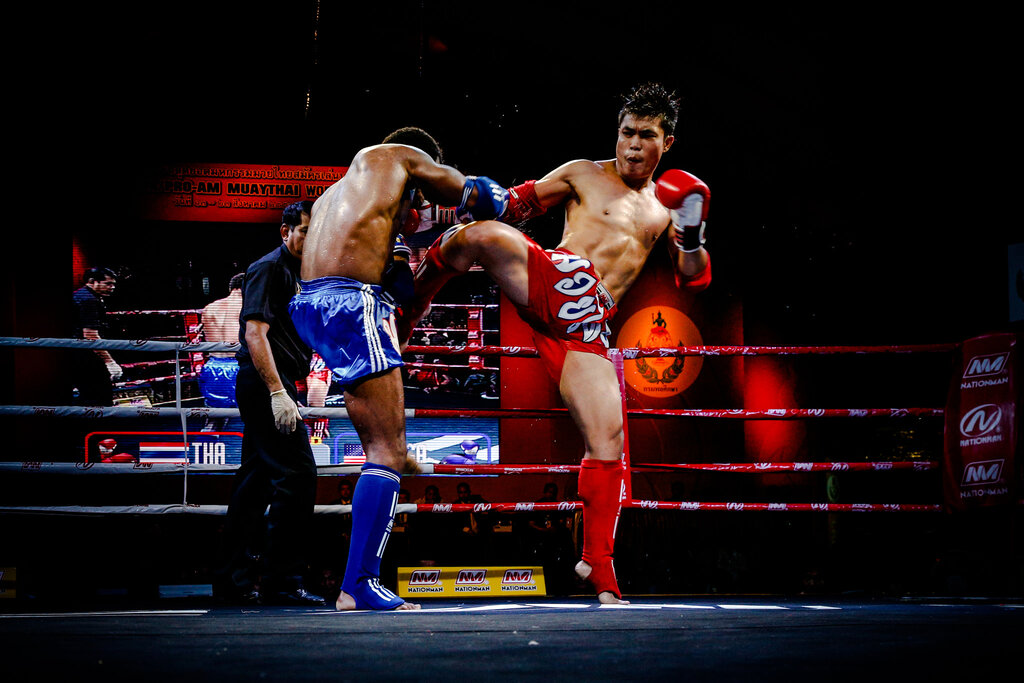
Neither approach is inherently superior; they are different strategic trade-offs between mass and velocity to solve the same problem of generating force.
Plugging Energy Leaks
The kinetic chain is only as strong as its weakest link. Any break in the sequence or instability in the joints causes , robbing your strike of its potential power. Think of it like a hose with holes in it. By the time the water reaches the nozzle, the pressure is greatly reduced.
Common leaks include lifting the heel of your base foot too early, having a weak or flexible core that absorbs the rotational force instead of transferring it, or letting your shoulder fly up before your hips have fully turned. Perfecting a strike is the process of identifying and plugging these leaks, ensuring that every bit of force generated from the ground makes it to the target.
Time to test your understanding of how power is really generated.
According to the principles of biomechanics, where does the power for a devastating strike truly begin?
Using the equation , a Muay Thai roundhouse kick, which drives through the target with the fighter's full body weight, primarily focuses on maximising which variable?
Understanding the kinetic chain transforms striking from a simple muscular action into a full-body exercise in physics. By focusing on the sequence of movement from the ground up, any practitioner can dramatically increase their power.