Advanced Mechanics of Black Holes
Spacetime Curvature Modeling
Metrics for the Void
To move beyond simple analogies of spacetime as a rubber sheet, we need a mathematical tool to describe its geometry precisely. This tool is called a metric. A metric is essentially a rule that tells you the distance, or more accurately the 'interval,' between two infinitesimally close points in spacetime. The components of this metric are collected in a structure called the metric tensor (), which encodes all the information about the curvature of spacetime at a given point.
The geometry of flat, empty spacetime (as in special relativity) is described by the simple Minkowski metric. But near a massive object like a black hole, spacetime is curved, and we need a more complex metric from the solutions to Einstein's field equations.
The Simplest Case
The first exact solution to Einstein's field equations was found by Karl Schwarzschild in 1916, describing the simplest possible black hole: one that is spherically symmetric, electrically neutral, and, most importantly, not rotating. This is described by the Schwarzschild metric.
Notice how the metric components blow up (go to infinity) or become zero when the radial coordinate equals the Schwarzschild radius, . This is the location of the event horizon. At the very center (), the curvature becomes infinite, creating a point-like singularity where our current laws of physics break down. Objects and even light that pass inside this radius follow paths, called geodesics, that inevitably lead to the singularity.
Adding Spin
The Schwarzschild metric is an idealization. In reality, collapsing stars carry angular momentum, so we expect most black holes to be spinning. A rotating black hole drags spacetime around with it, an effect called frame-dragging or the Lense-Thirring effect. This cosmic whirlpool is described by the Kerr metric, discovered by Roy Kerr in 1963.
The Kerr metric is far more complex. It depends not just on mass () but also on angular momentum (), represented by a spin parameter . Its most striking feature is a cross-term, , which mathematically represents the dragging of spacetime. It directly links the time coordinate with an angular coordinate.
This leads to a fascinating new region outside the event horizon called the ergosphere. Within the ergosphere, spacetime is dragged around faster than the speed of light. This doesn't mean objects travel faster than light, but that space itself is moving so fast that standing still is impossible. An object must rotate with the black hole. Theoretically, energy could be extracted from this region through the Penrose process.
Furthermore, the singularity in a Kerr black hole is not a point but a ring. This opens up speculative possibilities, though what happens at such a singularity is still unknown.
Paths Through Curvature
In curved spacetime, the 'straightest possible line' is called a geodesic. This is the path an object follows when no non-gravitational forces are acting on it. For massive objects, these are called timelike geodesics. For massless particles like photons, the paths are called null geodesics, where the spacetime interval is always zero.
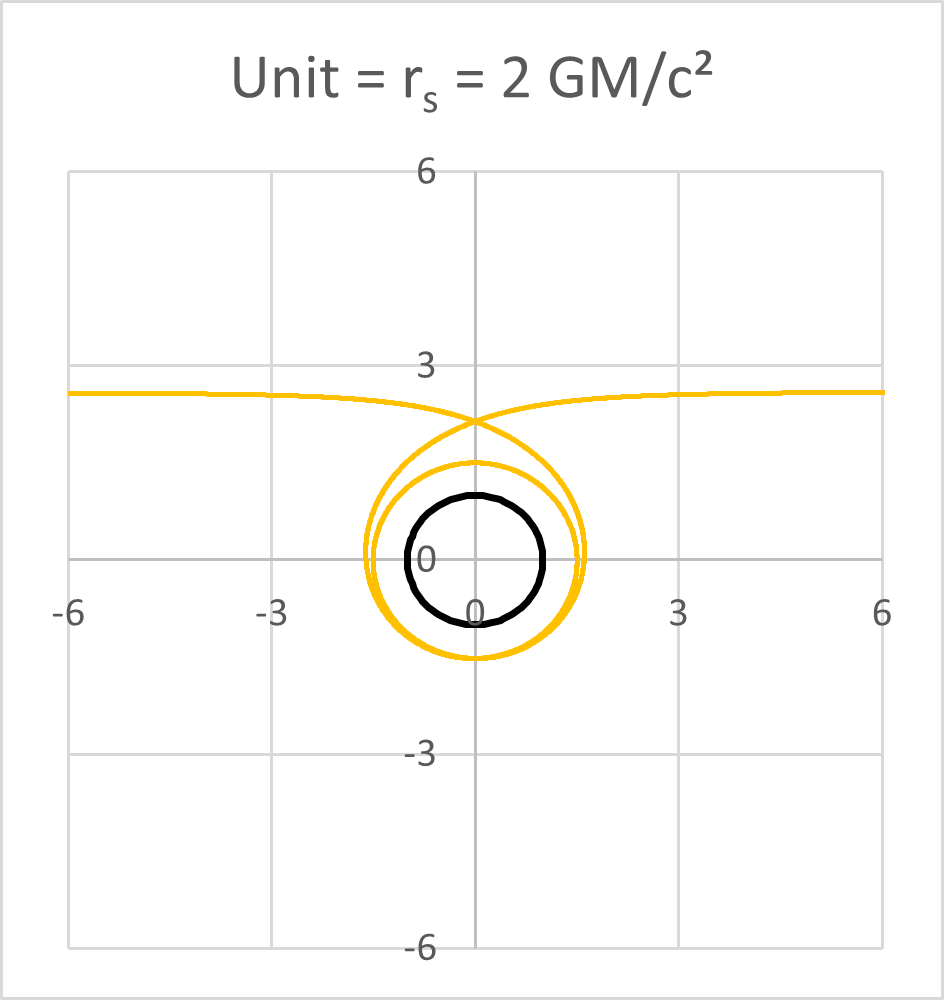
Calculating these geodesics involves solving a set of complex differential equations derived from the metric. The solutions describe everything from stable planetary orbits far from a black hole to the final plunge of matter across the event horizon. For light, these paths explain the phenomenon of gravitational lensing, where a black hole can bend light from a distant star, creating multiple images or even a perfect circle known as an Einstein ring.
What is the primary function of the metric tensor, represented as , in the context of general relativity?
The phenomenon where a rotating black hole drags spacetime around with it is known as the Lense-Thirring effect or __________.
By using the correct metric, physicists can accurately model the strange and beautiful physics near a black hole, turning abstract concepts into concrete predictions we can test with astronomical observations.