Advanced Martial Arts Systems
Strike Biomechanics
The Body as a Whip
A powerful strike isn’t just about arm or leg strength. It’s a full-body event, a chain reaction that starts from the ground and ends at your target. This sequence is called the , and understanding it is the key to unlocking real power. Think of it like cracking a whip. The power doesn’t come from the tip; it starts in the handle, with a flick of the wrist. That energy travels up the length of the whip, accelerating until the tip moves at supersonic speed. Your body works the same way.
Every strike begins with your feet pushing against the floor. This generates a ground reaction force, the first link in the chain. This force travels up your legs, is amplified by the rotation of your hips and torso, and finally channeled into your arm or leg for the strike. A weak link anywhere in this chain—poor footwork, a soft core, or stiff hips—will bleed power before it ever reaches the target.
Your Core is the Engine
While the energy starts at your feet, the hips and core are the engine that multiplies it. The powerful rotation of your hips and torso generates , a rotational force that dramatically increases the power of a strike. When you throw a punch, you don't just push your arm forward. You pivot your back foot, rotate your hip, twist your torso, and then the punch extends. Each step adds another layer of velocity and mass to the strike.
This is why core strength is so non-negotiable for strikers. A strong, stable core provides a solid platform for the limbs to operate from and acts as the crucial conduit for transferring force from the lower body to the upper body.
Mass vs. Velocity
The physics of impact comes down to a simple equation: Force = Mass x Acceleration. To hit harder, you must increase the effective mass behind your strike, increase its acceleration (speed), or both. Different martial arts and techniques prioritize one side of this equation over the other.
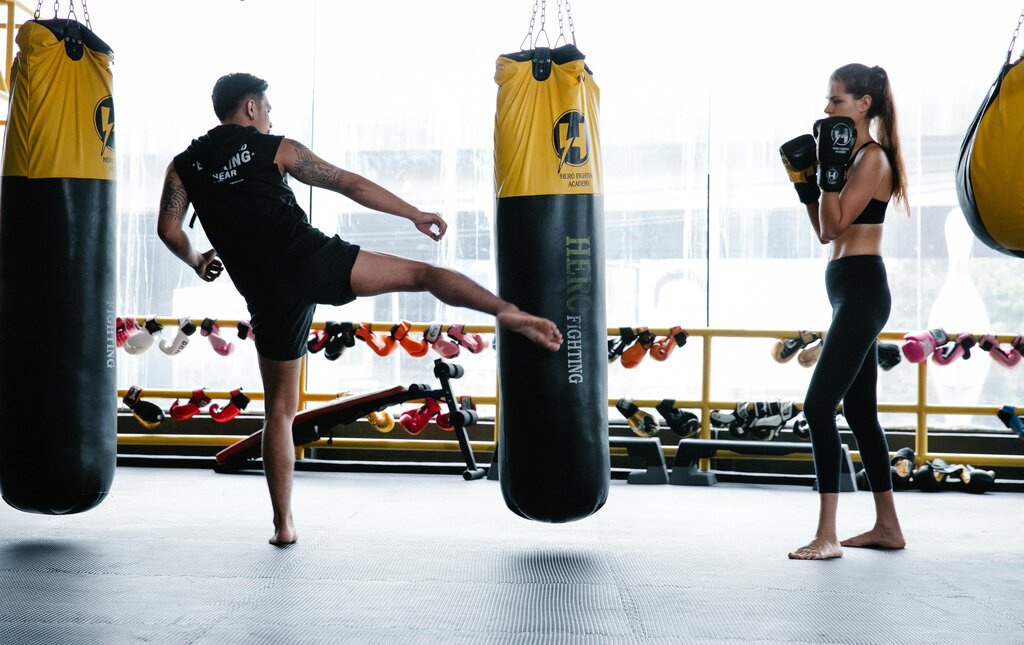
Some strikes are mass-dominant. A Muay Thai roundhouse kick is a prime example. The kicker swings their entire body, turning the hips over completely and putting their full body weight into the impact. The goal is to maximize the 'm' in the equation, treating the leg like a baseball bat. The trade-off is that it's slower to launch and recover from.
Other strikes are velocity-dominant. Think of a Karate snap kick or a boxer's jab. These techniques focus on maximizing 'a' (acceleration). They use a quick, explosive extension and retraction, snapping the limb toward the target with maximum speed. They don't carry the same weight as a mass-dominant strike, but they are faster, harder to see coming, and allow for quicker recovery.
| Strike Type | Primary Goal | Example | Key Biomechanics |
|---|---|---|---|
| Mass-Dominant | Maximize Mass (m) | Muay Thai Roundhouse | Full hip/torso rotation, committing body weight |
| Velocity-Dominant | Maximize Acceleration (a) | Karate Snap Kick | Rapid limb extension/retraction, minimal commitment |
The key to velocity is staying relaxed. Tension is the enemy of speed. A tense muscle is a slow muscle. The best strikers remain fluid and loose, only tensing the muscles at the precise moment of impact. This allows them to fire their most efficiently, generating explosive speed.
Power comes from speed, and speed comes from relaxation. A strike should be like a stone thrown from a sling, not a log pushed forward.
Ready to test your knowledge on the mechanics of a powerful strike?
What is the 'kinetic chain' in the context of a powerful strike?
According to the physics equation Force = Mass x Acceleration, a Muay Thai roundhouse kick is considered a 'mass-dominant' strike because it primarily focuses on...
By understanding these principles—the kinetic chain, the role of the core, and the trade-off between mass and velocity—you can analyze any strike and train more intelligently to improve your own power and efficiency.