Advanced Martial Arts Mechanics
Combat Taxonomy
A Taxonomy of Combat
Martial arts are often grouped by country of origin or style name, but a more useful way to understand them is through a technical taxonomy. This means categorising them based on their core function and physical principles. At the highest level, combat systems are divided into two main families: striking and grappling.
The primary distinction between striking and grappling martial arts lies in their range of combat and focus on different skill sets.
Striking arts, like Boxing or Karate, are fundamentally about from a distance. The goal is to generate force with your limbs and deliver it to a target efficiently and powerfully. Success is measured by impact. Grappling arts, such as Judo or Brazilian Jiu-Jitsu, are about gaining a mechanical advantage in close quarters. The objective is to control an opponent's body through leverage, joint locks, and chokeholds. Here, success is measured by control and submission.
Stance Dictates Strategy
The functional goal of a martial art directly shapes its foundational stances. A fighter's stance isn't arbitrary; it's a solution to a specific set of problems. Let's compare two striking arts: Muay Thai and Boxing.
A Muay Thai fighter stands tall and relatively square. This upright posture allows for a clear field of vision and makes it easy to lift a leg to either block (check) an incoming low kick or deliver one of their own. The hips are open, ready to generate power for kicks, knees, and elbows. The focus is on being a stable, versatile weapons platform.
A boxer, in contrast, adopts a bladed stance. By turning sideways, they present a smaller target to their opponent, protecting their centreline. The lead shoulder is forward, maximising the reach of the jab and creating a barrier for the chin. This stance is optimised for head movement, footwork, and defending against punches.
Clinching, Throwing, and Hybrid Systems
Between striking and grappling lies a transitional range: the clinch. Here, fighters are too close to strike effectively but not yet on the ground. This is the domain of arts like Greco-Roman Wrestling and Judo, which specialise in controlling an opponent's posture and using their momentum against them through throws and takedowns. The objective is to manipulate range—either to break away and create space for strikes, or to close the distance further and take the fight to the mat.
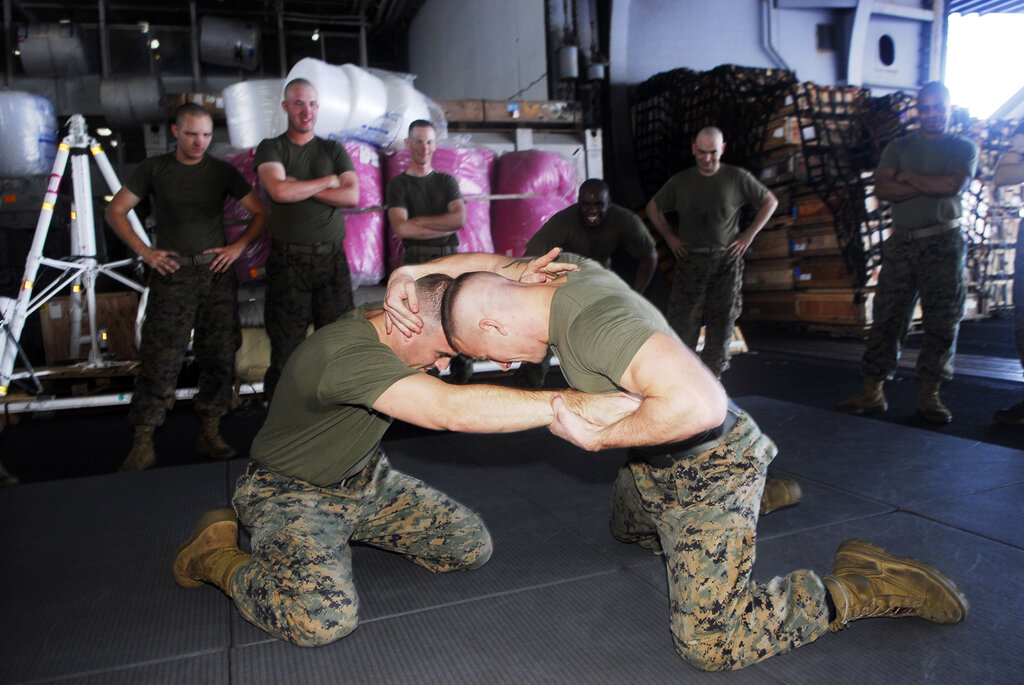
This is where hybrid systems emerge. Modern combat sports like Mixed Martial Arts (MMA) and military systems like aren't defined by a single objective. Instead, they are toolkits designed to solve problems across all ranges. An MMA fighter borrows the footwork and punching of boxing, the kicks and clinching of Muay Thai, and the ground-fighting of Brazilian Jiu-Jitsu. They are not a boxer or a grappler; they are a problem-solver who can transition between striking, clinching, and grappling as the situation demands. This adaptability is the hallmark of a true hybrid system.
By understanding this taxonomy, you can look at any martial art and analyse its core purpose. You can see why a practitioner moves a certain way and predict their strategy. It moves the conversation from 'which style is best?' to 'which tool is right for the job?'
Ready to test your understanding of combat taxonomy? Let's see how well you can categorise these concepts.
What is the primary distinction between striking and grappling martial arts?
A Muay Thai fighter's tall, square stance is optimised for which of the following actions?
This framework helps break down complex encounters into a series of strategic choices, giving you a deeper appreciation for the science behind martial arts.