Advanced Martial Arts Mechanics and Strategy
Movement Dynamics Analysis
The Straight Line vs. The Curve
In any confrontation, the fundamental problem is one of geometry. You need to close the distance to your opponent while creating an angle for attack and limiting their ability to respond. Martial arts have developed two primary solutions to this problem: moving in straight, explosive lines or flowing in evasive circles. Neither is inherently superior; they are simply different tools for different situations, reflecting distinct philosophies on how to control space and time.
Think of a style like Shotokan Karate as a battering ram. The practitioner drives forward in a powerful, linear fashion, aiming to overwhelm the opponent's defenses through sheer commitment and speed. The goal is to cover the distance from point A to point B as quickly and efficiently as possible, delivering a decisive blow.
Conversely, styles like Aikido or Baguazhang approach the problem like a flowing river. Instead of meeting force head-on, they move in circles, redirecting the opponent's energy and maneuvering to their vulnerable flanks. This approach prioritizes evasion and positioning over direct confrontation.
Generating Power
The way an artist moves dictates how they generate kinetic energy. A linear attack relies on explosive, forward-driving force generated from the ground up. The body's mass is projected directly toward the target. This requires a stable base and a powerful hip drive to transfer momentum through the core and into the striking limb. The entire body becomes a single, committed projectile.
Circular movements generate power differently, relying on rotational force. Instead of a direct push, the artist uses their body's rotation to create torque and centripetal force, much like a spinning top or a whip. The limbs accelerate as they move along an arc, and power is generated by the rapid turning of the hips and shoulders. This allows for continuous motion, where the energy of one movement flows seamlessly into the next.
The Geometry of a Fight
The choice between linear and circular footwork has profound strategic implications. A straight-line entry is the fastest path to the target, creating immense forward pressure that can disrupt an opponent's rhythm and force them onto the defensive. It's an excellent tool for interception, cutting off an opponent's attack before it fully develops.
The trade-off for this speed is predictability. A linear attack commits your center of mass along a single vector, making you vulnerable to side-steps and angular counters if you misjudge the timing or distance.
Circular footwork excels at creating advantageous angles. By moving around the opponent, a martial artist can get "offline" from their weapons—their hands and feet—while creating openings to attack their flanks or back. This evasive movement makes it difficult for a linear attacker to track and target them. The strategy is not to absorb force, but to avoid it entirely, letting the opponent's committed momentum carry them past you.
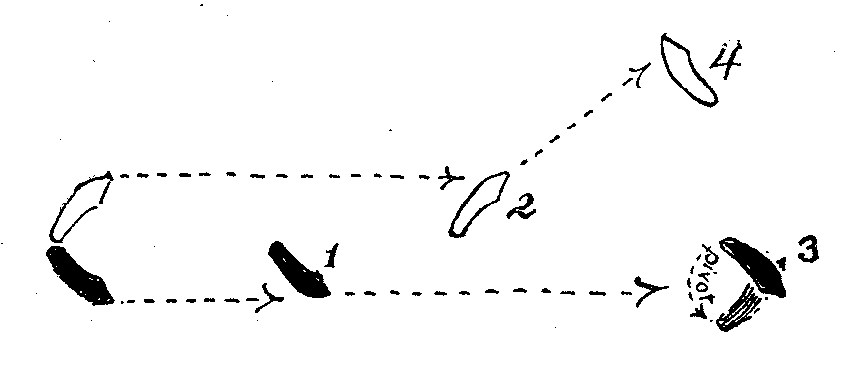
The disadvantage of circular movement lies in its relative inefficiency in covering ground directly. It requires more time and space to set up an attack, which can be a liability against an aggressive opponent who is constantly pressing forward. A purely circular fighter might find themselves constantly giving ground without creating an opportunity to counter-attack effectively.
Strategic Application
In practice, most effective martial artists blend both linear and circular patterns. The key is understanding when to use each. A fighter might use circular footwork to gauge distance and test an opponent's reactions. Once an opening is identified, they might explode forward with a linear attack to capitalize on it. This is a common pattern in sport karate and kickboxing.
By seamlessly transitioning between angles and utilising lateral movement to reposition yourself, you can maintain the upper hand, confuse your opponent, and create opportunities for powerful strikes.
Conversely, an artist might initiate with a direct, linear feint to draw a reaction from the opponent. As the opponent commits to defending against the straight-line attack, the artist shifts to a circular path, evading the counter and striking from an unexpected angle. This is a hallmark of many Kung Fu systems and is a fundamental principle in the art of fencing.
Ultimately, the choice of movement is a mechanical trade-off. Linear patterns trade positional safety for speed and forward pressure. Circular patterns trade directness for superior angles and evasiveness. Mastery lies not in exclusive devotion to one, but in the fluid ability to switch between them based on the ever-changing geometry of the fight.
Ready to test your understanding of these movement dynamics?
According to the text, what is the fundamental problem that needs to be solved in any confrontation?
How do martial arts styles that favor circular movement, like Aikido, primarily generate power?
The analysis of linear and circular motion is a cornerstone of understanding fight strategy, revealing the deep interplay between physics and physical conflict.