Advanced Market Mechanics and Terminology
Order Book Dynamics
The Heart of the Exchange
Every stock exchange, from the NYSE to decentralized crypto platforms, has a core mechanism that makes trading possible: the Limit Order Book, or LOB. It isn't a physical book, but a live, digital ledger of all open buy and sell orders for a specific asset. Think of it as a dynamic marketplace where buyers and sellers state their intentions, and the exchange's job is to match them up.
This list of orders is the foundation of price discovery. The constant push and pull between what buyers are willing to pay (bids) and what sellers are willing to accept (asks) is what determines an asset's current market price. The system that orchestrates this is called the matching engine.
How Orders Are Matched
A matching engine doesn't just pair orders randomly. It follows a strict rule called price-time priority. This two-part principle ensures fairness and efficiency.
- Price Priority: The best price gets filled first. For buyers, the highest bid price has top priority. For sellers, the lowest ask price gets priority.
- Time Priority: If multiple orders exist at the same price, the one that was placed first gets filled first. It's a first-come, first-served system for orders at the same price level.
Imagine a simple scenario: The lowest ask for a stock is 💲100.05. A new buy order comes in at 💲100.05. The matching engine immediately executes the trade. If another buy order arrives at 💲100.06, it jumps to the front of the line because it offers a better (higher) price for sellers.
The difference between the highest bid and the lowest ask is known as the This spread is a crucial indicator of a stock's liquidity. A narrow spread suggests high liquidity and strong agreement on price, while a wide spread often means lower liquidity and higher volatility.
Reading the Market's Depth
Most retail trading platforms show Level 1 data: the best bid, the best ask, and the last traded price. But to truly understand market sentiment, professional traders use also known as Depth of Market (DOM). This gives you a view of the order book, showing the queue of buy and sell orders at different price levels.
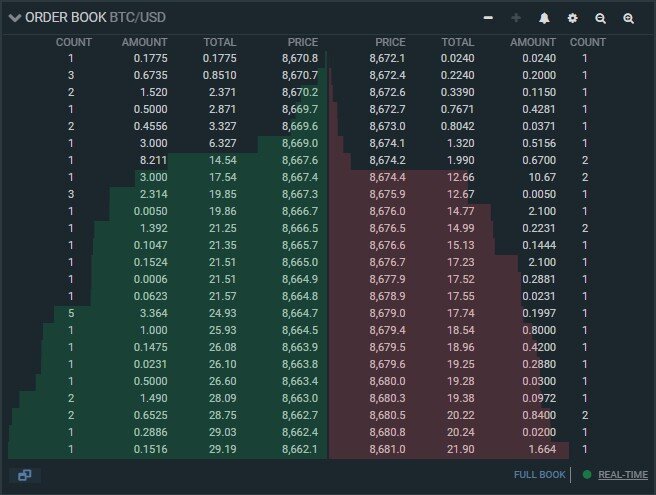
Looking at the DOM reveals the market's structure. Large clusters of buy orders at a specific price create a "buy wall," which can act as a short-term price support. Conversely, a large cluster of sell orders creates a "sell wall," acting as resistance. A "thick" book with many orders at various price levels signifies high liquidity, meaning large trades can be executed with minimal price impact. A "thin" book suggests low liquidity, where even small trades can cause significant price swings.
| Bid Size (Shares) | Bid Price | Ask Price | Ask Size (Shares) |
|---|---|---|---|
| 500 | $99.99 | $100.01 | 800 |
| 1,200 | $99.98 | $100.02 | 1,500 |
| 2,500 | $99.97 | $100.03 | 1,100 |
| 10,000 | $99.96 | $100.04 | 300 |
In the table above, the bid-ask spread is $0.02 ($100.01 - $99.99). Notice the large buy order for 10,000 shares at $99.96. This is a significant buy wall that could provide price support if the stock starts to fall.
Order Flow as an Indicator
The order book provides a snapshot in time, but the real story is in how it changes. [{
Imagine watching a large sell wall at 💲105. If you see a rapid succession of buy orders chipping away at that wall, it signals aggressive buying pressure. If the wall is completely absorbed, the price often moves up quickly to the next resistance level. This is order flow in action.
Conversely, if you see traders consistently pulling their bid orders or lowering their prices, it suggests waning confidence and could foreshadow a drop in price. The balance, or imbalance, between buying and selling pressure in the order flow often precedes the actual price move. This gives observant traders a potential edge.
By learning to read the Limit Order Book and interpret its flow, you move from simply reacting to price changes to anticipating them. You begin to understand the underlying supply and demand forces that drive the market every second.
Ready to test your knowledge?
What is the primary principle a matching engine uses to pair buy and sell orders in a Limit Order Book?
A narrow bid-ask spread for a stock most likely indicates which of the following?