Advanced Logic for AI Agents
Modal Logic
Beyond True and False
In classical logic, statements are either true or false. "The cat is on the mat" is true if the cat is indeed on the mat. But what about statements like "The cat might be on the mat" or "The cat must be sleeping"? These statements aren't just about what is, but about what could be or what has to be. This is the territory of modal logic.
Modal logic adds operators that qualify the truth of a judgment. It's a powerful tool for reasoning about different modes of truth.
Modality
noun
A qualification on the truth of a statement, expressing concepts such as possibility, necessity, belief, or obligation.
Possibility and Necessity
The two most fundamental operators in modal logic are for necessity and possibility. They're usually represented by symbols. Let's say stands for the proposition "It will rain tomorrow."
- The necessity operator is written as . So, means "It is necessary that it will rain tomorrow." This is a very strong claim. It means there is no other option; rain is unavoidable.
- The possibility operator is written as . So, means "It is possible that it will rain tomorrow." This is a weaker claim. It means rain is one of the potential outcomes for tomorrow's weather.
Think of it this way: If something is necessary (), then it must also be possible (). If it must happen, then it certainly can happen. However, just because something is possible doesn't make it necessary.
These two operators are elegantly connected. Saying something must be true is the same as saying it's not possible for it to be false. And saying something might be true is the same as saying it's not necessary for it to be false.
The first formula says "P is necessary" is equivalent to "It's not possible that P is false." The second says "P is possible" is equivalent to "It's not necessary that P is false." This duality gives modal logic a clean, symmetrical structure.
Entering Possible Worlds
How do we formally define what makes a modal statement true? The most common way is with Kripke semantics, an idea developed by philosopher Saul Kripke. It involves the concept of "possible worlds."
Imagine a collection of worlds, including our own. These worlds are connected by an "accessibility relation," which means we can "see" some worlds from our current one. A statement's modal status depends on what's happening in these accessible worlds.
- is true in our world if is true in all possible worlds we can access from ours.
- is true in our world if is true in at least one possible world we can access from ours.
In this model, even though might be false in our world (w1), we can still say it's necessarily true from our perspective because it holds in every future possibility we consider accessible. This framework allows us to be very precise about what we mean by "possible" and "necessary."
Why AI Needs Modality
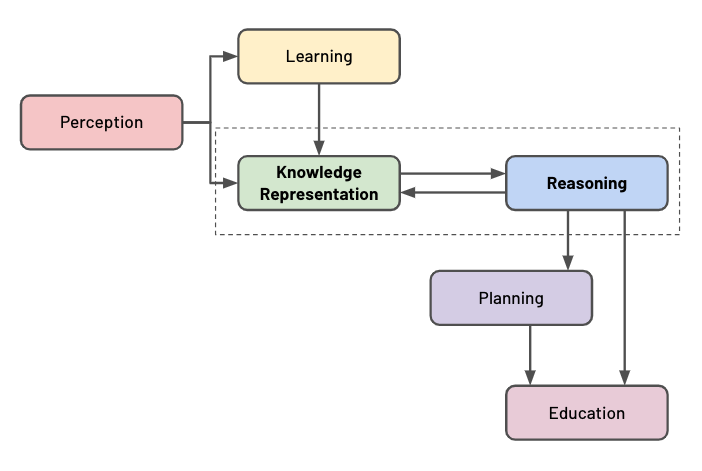
Modal logic isn't just a philosophical curiosity; it's crucial for artificial intelligence. AI agents need to reason not just about the current state of the world, but also about what they know, what they believe, and what they should do. The operators and can be re-interpreted to model these concepts.
- Epistemic Logic (Logic of Knowledge): We can use to mean "The agent knows that..." So means "The agent knows is true." This helps an AI distinguish between facts about the world and facts it has in its knowledge base.
- Doxastic Logic (Logic of Belief): can mean "The agent believes that..." An agent might believe () without actually being true in the real world. This is essential for modeling agents that can have incorrect beliefs and must update them when new information arrives.
- Deontic Logic (Logic of Obligation): can be read as "It is obligatory that..." This is useful for programming ethical constraints or rules into an AI. would mean "The agent must ensure happens."
For example, a self-driving car might operate on the rule, "It is obligatory that the car stops at a red light." This is a modal statement about what must happen, not just a description of what is happening.
By using different flavors of modal logic, developers can create more sophisticated AI agents that can plan, make decisions under uncertainty, and interact with the world in a way that reflects an understanding of complex concepts like knowledge and duty.
In modal logic, if the statement "It is possible that the sun will rise tomorrow" is represented as , which expression correctly represents "It is necessary that the sun will rise tomorrow"?
Using Kripke's 'possible worlds' semantics, a statement P is considered necessary () in our current world if...