Advanced LLM Context Engineering
Advanced Context Engineering
Beyond the Basics
You've learned how to give a Large Language Model (LLM) the right context to get a good response. But what happens when the task is complex, or the information needed isn't in your head? That’s where advanced techniques come in. These methods move beyond simple instructions, transforming how we interact with AI by connecting it to external data and enabling it to reason in more sophisticated ways.
Retrieval-Augmented Generation
One of the biggest limitations of LLMs is that their knowledge is frozen in time. They only know what they were trained on, and they can't access live information. Retrieval-Augmented Generation, or RAG, solves this problem. It connects an LLM to an external knowledge base, like a company's internal documents or a real-time news feed.
Here’s how it works: when you ask a question, the system first retrieves relevant information from the knowledge base. Then, it augments the original prompt with this new information and feeds the combined context to the LLM to generate an answer. This allows the model to provide responses that are accurate, up-to-date, and specific to a given domain.
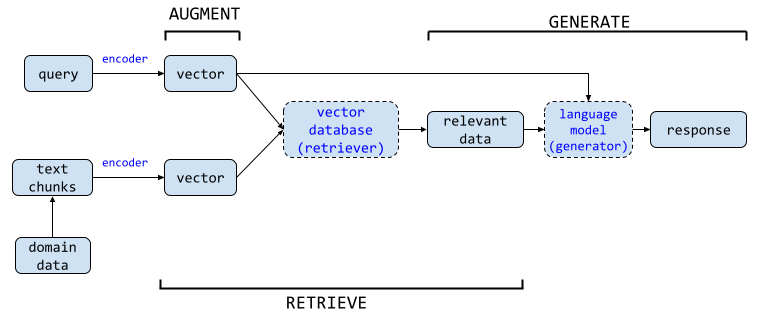
Think of it like an open-book exam. Instead of relying solely on its memory, the LLM can look up the facts it needs before answering. This dramatically reduces the chances of the model “hallucinating,” or making up incorrect information.
RAG gives LLMs access to current, private, or specialized information, making their answers more trustworthy and relevant.
New Ways of Prompting
Beyond just providing data, we can also change how we ask the LLM to think. Two powerful methods for this are Program of Thought (PoT) prompting and Optimization by PROmpting (OPRO).
Program
noun
A set of instructions written in a programming language that a computer can execute to perform a specific task.
Program of Thought (PoT) prompting guides an LLM to generate a piece of code to solve a problem instead of just outputting a direct answer. For complex tasks involving math or multi-step logic, natural language can be ambiguous. Code, however, is precise.
The LLM writes a program, executes it, and uses the output to form its final answer. This forces a structured, logical reasoning process that is often more reliable for quantitative or symbolic problems.
# User Prompt:
# If a bakery sells 15 dozen cookies per day at $2.50 each,
# and their daily cost for ingredients is $120,
# what is their weekly profit?

# LLM's Program of Thought:
def calculate_weekly_profit():
  cookies_per_dozen = 12
  dozens_per_day = 15
  price_per_cookie = 2.50
  daily_ingredient_cost = 120.00
  days_per_week = 7

  # Calculate daily revenue
  total_cookies_per_day = dozens_per_day * cookies_per_dozen
  daily_revenue = total_cookies_per_day * price_per_cookie

  # Calculate daily and weekly profit
  daily_profit = daily_revenue - daily_ingredient_cost
  weekly_profit = daily_profit * days_per_week

  return weekly_profit

# Execution and Output:
profit = calculate_weekly_profit()
print(f"The bakery's weekly profit is ${profit:.2f}")
# The bakery's weekly profit is $2310.00
Optimization by PROmpting (OPRO) takes a meta-approach. Instead of you trying to find the perfect prompt, OPRO uses an LLM to do it for you. The process is iterative: an LLM generates a prompt for a specific task, another LLM (or the same one) executes that prompt and scores its performance, and then the first LLM uses that feedback to create an even better prompt.
This cycle continues, automatically discovering highly effective instructions that a human might not think of.
Structuring the Conversation
As AI systems become more autonomous, they need standardized ways to interact with the digital world. This is where agentic engineering and protocols come into play.
ACE (Agentic Context Engineering), a framework that treats contexts as evolving playbooks that accumulate, refine, and organize strategies through a modular process of generation, reflection, and curation.
Agentic Context Engineering creates contexts that are dynamic and evolving. Instead of a one-time instruction, the context acts like a playbook that the AI agent can update based on its experiences. The agent generates strategies, reflects on their success, and curates the best ones into its playbook. This allows the AI to learn and adapt over time, improving its performance on recurring or long-term tasks without needing constant human intervention.
Finally, the Model Context Protocol (MCP) is an emerging open standard for how LLMs connect to external tools and data sources. Think of it as a universal translator or a USB-C port for AI. It provides a structured, predictable format for information, so an LLM can reliably access an API, query a database, or use a new software tool without custom engineering for each connection.
MCP standardizes communication, making it easier to build complex, multi-tool AI agents that can reason and act more effectively.
These advanced methods are pushing the boundaries of what's possible with AI. By giving models access to external knowledge, improving their reasoning, and standardizing their connections to the world, we can build more powerful, reliable, and intelligent systems.