Advanced Krebs Cycle Biochemistry
Pyruvate Processing
From Cytosol to Mitochondria
Glycolysis splits a glucose molecule into two molecules of pyruvate. This all happens in the cell's cytoplasm. For aerobic respiration to continue, pyruvate must travel from the cytoplasm into the mitochondrial matrix, the innermost compartment of the mitochondrion. Think of this as moving from the factory floor to a specialised workshop where the real high-energy work begins.
This journey isn't a passive drift. Pyruvate crosses the outer mitochondrial membrane easily through large pores, but to get across the highly selective inner membrane, it needs a specific transport protein. Once inside the matrix, pyruvate is at a critical crossroads. It's about to be transformed into a molecule that can enter the Krebs cycle.
The Pyruvate Gatekeeper
The transformation of pyruvate is managed by a massive molecular machine called the pyruvate dehydrogenase complex (PDH). This isn't a single enzyme but a large, coordinated group of three distinct enzymes that work together. Its job is to convert the three-carbon pyruvate into a two-carbon molecule called acetyl-CoA. This reaction is a crucial link between glycolysis and the rest of aerobic respiration.
This conversion step, known as oxidative decarboxylation, is irreversible. It commits the carbon atoms from glucose to either enter the Krebs cycle for full oxidation or be used for fatty acid synthesis.
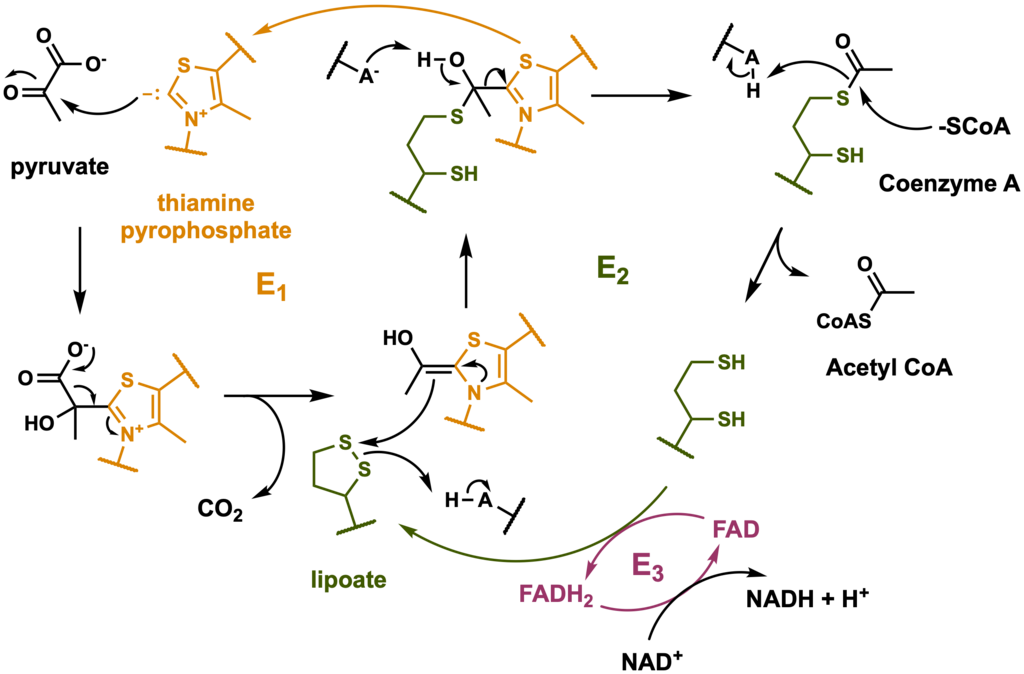
The process unfolds in three main steps, each handled by one of the PDH enzymes:
-
Decarboxylation: The first enzyme (E1) cleaves off one of pyruvate's carbons, which is released as a molecule of carbon dioxide (CO₂). This is the first point in cellular respiration where carbon from the original glucose molecule is lost as waste.
-
Oxidation: The remaining two-carbon fragment is oxidised, and its electrons are transferred to a cofactor. This fragment is then attached to another cofactor, lipoate, which is part of the second enzyme (E2).
-
Acetyl-CoA Formation: The second enzyme (E2) transfers the two-carbon acetyl group from lipoate to Coenzyme A (CoA), forming acetyl-CoA. This molecule is the fuel for the Krebs cycle.
Finally, the third enzyme (E3) regenerates the oxidised form of the lipoate cofactor, transferring the collected electrons to NAD+ to form NADH. For every molecule of pyruvate processed, one molecule of NADH is generated.
A Team of Helpers
The PDH complex can't do its job alone. It relies on a crew of five essential cofactors. Three of them— (TPP), lipoate, and FAD—are tightly bound to the enzymes. The other two—Coenzyme A (CoA) and NAD+—act as mobile carriers.
| Cofactor | Role in PDH Complex |
|---|---|
| TPP (Thiamine pyrophosphate) | Binds to pyruvate, facilitating its decarboxylation by E1. |
| Lipoate (Lipoic Acid) | Accepts the acetyl group from TPP and transfers it to CoA. |
| Coenzyme A (CoA) | Accepts the acetyl group from lipoate to form acetyl-CoA. |
| FAD (Flavin adenine dinucleotide) | Accepts electrons from reduced lipoate during its regeneration. |
| NAD+ (Nicotinamide adenine dinucleotide) | Accepts electrons from FADH₂ to form NADH, the final electron carrier. |
Since one glucose molecule yields two pyruvate molecules, this entire process happens twice. The total yield from processing one glucose molecule into two acetyl-CoA molecules is 2 CO₂, 2 NADH, and 2 acetyl-CoA.
With acetyl-CoA now formed, the stage is set for the Krebs cycle, where the real energy harvest begins.
Ready to test your understanding?
Where in the cell does the conversion of pyruvate to acetyl-CoA occur?
What is the name of the large, multi-enzyme structure that converts pyruvate into acetyl-CoA?