Advanced Injection Molding Mastery
Polymer Rheology Dynamics
Flowing Under Pressure
A polymer melt isn't like water or oil. When you heat a thermoplastic past its glass transition temperature () and melt temperature (), it becomes a thick, viscous fluid. But its viscosity—its resistance to flow—isn't constant. It changes dramatically depending on how much force is applied.
This behavior is called non-Newtonian. For a Newtonian fluid like water, viscosity is a fixed property at a given temperature. No matter how fast you stir it, its resistance to that stirring remains the same. Polymer melts are different. Their viscosity drops as the speed, or shear rate, of the flow increases. This is the key to understanding how they behave inside an injection molding machine.
This phenomenon, where a fluid gets 'thinner' or less viscous as it flows faster, is called shear thinning. It's the most important rheological property of polymers in injection molding. Without it, the process would require immense, impractical pressures to fill a mold.
Molecules on the Move
Shear thinning happens because of what the long polymer chains are doing at the molecular level. In a static melt, these chains are randomly coiled and entangled, like a bowl of spaghetti. This entanglement creates a high resistance to flow.
When a shear force is applied—like the pressure from the injection screw—the chains begin to untangle and align themselves in the direction of the flow. This alignment drastically reduces the friction between chains, causing the bulk viscosity to drop.
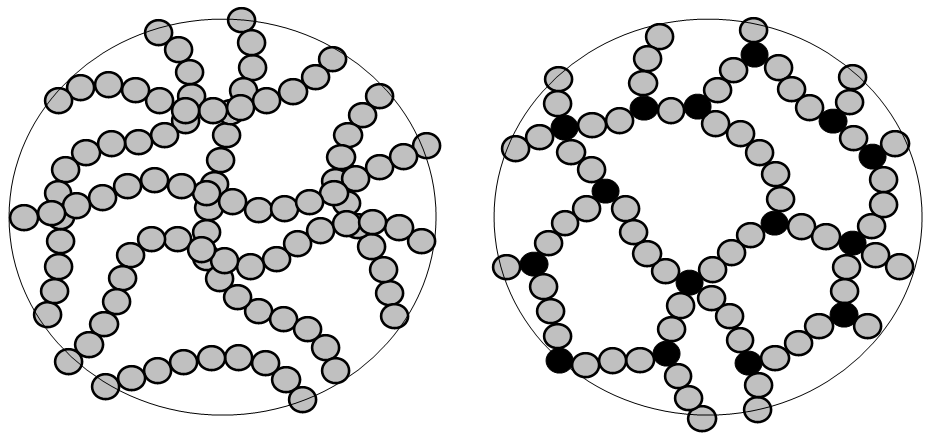
This molecular orientation doesn't just disappear when the flow stops. As the polymer rapidly cools and solidifies in the mold cavity, much of this alignment gets frozen in place. This has a profound impact on the final part's properties.
The part becomes anisotropic, meaning its mechanical properties are different in different directions. It will be significantly stronger and stiffer in the direction of polymer flow compared to the transverse (cross-flow) direction. This is a critical consideration for designing strong, reliable plastic parts. Engineers must predict the flow path of the polymer within the mold to ensure the areas of highest stress are aligned with the direction of greatest strength.
Frozen-in molecular orientation creates parts that are stronger along the path of the polymer flow.
Measuring the Flow
To process polymers consistently, we need to quantify their flow behavior. While a full viscosity curve from a rheometer gives the most complete picture, manufacturers often rely on simpler, standardized tests for quality control. Two of the most common are the Melt Flow Index (MFI) and Spiral Flow Testing.
| Test | Description | What it Measures | Limitations |
|---|---|---|---|
| Melt Flow Index (MFI) | Measures the mass of polymer (in grams) that extrudes through a standard die in 10 minutes under a specific temperature and load. | A single-point estimate of viscosity at a very low shear rate. | Doesn't capture shear-thinning behavior. Not representative of high-speed injection molding conditions. |
| Spiral Flow Test | Injects polymer melt into a long, spiral-shaped mold cavity at a set pressure and temperature until it freezes. | The length of the flow path before solidification. | Provides a better, more practical indication of flowability under molding conditions than MFI, but is still specific to the test conditions. |
MFI is useful for a quick check of material consistency from batch to batch, but it's a poor predictor of how a polymer will actually behave in a complex mold. Because it operates at very low shear rates, it doesn't account for the shear-thinning effects that dominate the injection process. The Spiral Flow test gives a more realistic picture of a material's processability, as it simulates the conditions of filling a thin-walled part.
Let's review these concepts before moving on.
Now, test your understanding.
What is the primary reason a polymer melt is considered a non-Newtonian fluid?
The phenomenon where a fluid becomes less viscous as it flows faster is known as:
Understanding how polymer melts flow under pressure is fundamental to successful injection molding. By accounting for shear thinning and molecular orientation, engineers can design better parts and more efficient manufacturing processes.